





Best Employee Recognition Platforms
A shift has been unfolding inside companies that once relied only on annual reviews and late appreciation.
Leaders noticed that teams respond better to continuous feedback, immediate gratitude, and transparent recognition that feels real.
The market reacted fast, building tools that organize this entire process with precision and measurable impact.
That is where the concept behind the Employee Recognition Platforms becomes central, not as a trend but as a visible structure that helps teams stay aligned, productive, and valued.
While offices change and hybrid culture grows, these platforms support connection and morale in a very grounded way.
1. Concept Overview
Employee recognition platforms are digital systems designed to centralize appreciation, rewards, and workplace acknowledgement inside one unified environment.
They make recognition visible to everyone, they keep managers consistent, and they help HR teams track patterns and sentiment.
While traditional programs used paper certificates or scattered messages, modern platforms work quietly as part of the workflow, prompting managers at the right moments and capturing recognition moments in real time.
In my field experience, companies look for tools that simplify operations and make culture measurable.
People often compare this to what happens when teams evaluate Hot Desking Software Tools or discuss Hot Desking vs. Desk Hoteling in office planning, because the principle is similar, a smart system organizes human movement and human behavior.
The same observation happens when a manager reads about What Is Hot Desking? Pros, Cons, the logic is simple, create structure so the team can move freely with clarity.
Employee recognition platforms do exactly that, they remove randomness and create a predictable path for appreciation.
2. Why Companies Use Them

Most company leaders do not adopt these tools just to celebrate birthdays or team wins, they implement them because they want measurable consistency.
HR directors want reporting. Managers want prompts. Teams want visibility.
A platform brings all these elements together, creating a single truth inside the organization.
Benefits often include:
- A continuous flow of feedback that reduces misunderstandings
- Real time tracking of recognition patterns
- A shared space that supports fairness
- Integration with daily tools like email and chat platforms
- Clear visibility for leadership without micromanaging
- Better retention and stronger culture
This explains why the Employee Recognition Platforms receive high adoption rates across industries, from tech startups to large corporations.
When I sit with HR leaders, I often notice their relief when they finally automate recognition.
It fixes problems they did not even realize were connected, like miscommunication, low morale, and uneven feedback cycles.
3. Core Features
Employee Recognition Platforms commonly include a set of essential features that support teams of different sizes. Over time, these evolved from simple points based systems into complete employee engagement ecosystems.
Here are the main capabilities companies look for:
- Peer to peer recognition for organic appreciation
- Manager led recognition with structured guidelines
- Reward catalogs with physical and digital options
- Analytics dashboards to track productivity and trends
- Integration support with business apps
- Automated celebrations for milestones or anniversaries
- Feedback modules for continuous improvement
- Mobile access for remote and field teams
Many leaders tell me they want something simple and not overly technical, a tool that works without disrupting daily habits.
The platforms that succeed are those where recognition fits smoothly into existing routines, not something employees forget to use.
As a reference, the Society for Human Resource Management highlights that well structured recognition programs contribute to stronger team alignment and lower turnover, which validates the practical use of these platforms in strategic HR planning.
4. The Top 10 Best Employee Recognition Platforms
Below is a detailed view of the Top 10 Best Employee Recognition Platforms, described with features, tone, and clarity.
The content stays grounded in human experience, not distant theory.
5. Bonusly Review + Pros, Cons and Pricing
Bonusly has become one of the most recognizable employee recognition platforms largely because it makes the process simple, joyful and fast.
It is built around the idea that recognition should happen in the flow of work, not as a separate ceremony once a month.
Everything inside Bonusly is immediate, social and easy to use. Employees send micro bonuses to each other, attach short appreciation messages and choose small rewards that truly reflect their preferences.
The interface is clean and familiar. Employees can send recognition in less than ten seconds, and that immediacy increases daily participation.
Bonusly understands something fundamental, consistent recognition is more valuable than occasional praise.
When people receive small but frequent appreciation moments, engagement rises naturally and without forcing cultural change from top down.
One of the strongest elements of Bonusly is its global reward catalog. Employees can redeem points for gift cards, donations, brand experiences, company branded items or even custom corporate rewards defined internally.
This variety makes the reward system feel personal. People do not feel limited or pushed toward generic items.
The catalog is integrated directly within the platform, which means the process is smooth and frictionless.
Bonusly also integrates well with tools that employees already use. Slack, Microsoft Teams, Google Workspace and other communication channels can display recognition instantly.
This keeps appreciation visible and creates a natural rhythm across teams.
The platform includes automatic birthday and anniversary recognition, which saves HR time and ensures that important moments are never missed.
Analytics inside Bonusly are clear and simple to understand. HR teams can see which teams participate most, which individuals are highly recognized and how values are being reinforced.
The insights are not complex, but they are extremely practical. Bonusly chooses clarity over sophistication, and that makes it ideal for companies that want straightforward results without complexity.
Bonusly works well for small, mid sized and even large organizations looking for a lightweight recognition system that still delivers strong cultural impact. It combines simplicity, modern design and real human touch.
Pros
• Extremely easy and fast to use
• Strong global reward catalog
• High participation due to micro bonus system
• Excellent integrations with daily work tools
• Automated birthday and anniversary recognition
• Simple analytics that guide HR decisions
Cons
• Not as deep in performance management features
• Limited customization for complex enterprise needs
• Analytics may feel basic for data heavy organizations
Pricing
Bonusly offers transparent pricing models.
• Core plan starts at 3 USD per user per month
• Pro plan starts at 5 USD per user per month
• Custom enterprise plans available for large organizations
• Reward budgets are separate and customizable
2. Kudos Review + Pros, Cons and Pricing
Kudos is a platform built with a deeper purpose. Instead of simple compliments, it focuses on values-based recognition, meaning every appreciation message is tied to a specific organizational value.
This structure makes recognition more intentional and more aligned with long term culture building.
Companies that want to shape behavior, reinforce purpose, and elevate leadership communication often find Kudos especially valuable.
The interface is clean and professional, offering a social style feed where employees can send recognition and celebrate achievements.
However, what makes Kudos stand out is the way it turns recognition into a cultural tool.
Managers and HR teams appreciate how the system tracks the values most commonly recognized, helping leadership understand what behaviors are being demonstrated in real life. This adds a strategic dimension that many competing platforms do not offer.
Kudos also provides rewards, although the recognition side is often considered the heart of the platform. The rewards catalog is global, modern, and flexible.
Companies can choose between curated gift cards, merchandise, or their own custom rewards program.
For organizations that want to maintain tighter cultural alignment, this flexibility is useful.
Another strong point is reporting. Kudos offers detailed dashboards that help HR measure engagement, identify team strengths, and monitor recognition activity.
This data is especially important for companies that rely on structured organizational development.
Kudos works well for mid sized and large companies that want a more meaningful recognition strategy, something deeper than points or emojis.
It can be a powerful tool when culture building is a priority.
Pros
• Strong values-based recognition framework
• Detailed reporting and cultural insights
• Professional and polished interface
• Good reward catalog and customization options
• Encourages structured and intentional recognition
• Supports international teams well
Cons
• Not as playful as Bonusly or similar tools
• Some features may feel complex for smaller teams
• Pricing is higher than lightweight competitors
Pricing
• Pricing usually starts at 5 to 7 USD per user per month, depending on features
• Enterprise plans available on request.
3. WorkTango Review + Pros, Cons and Pricing
WorkTango is one of the most complete platforms in the recognition world because it goes beyond simple appreciation messages. It brings recognition, rewards, surveys, feedback and goal tracking into one ecosystem.
This makes it especially valuable for companies that want an integrated employee experience rather than separate tools scattered across different departments.
The platform has a more mature, structured approach, and many HR teams appreciate the depth that WorkTango offers.
Recognition inside WorkTango is designed to be meaningful.
Employees can send appreciation directly to colleagues, teams or even entire departments, and every message is tied to company values. This reinforces culture in a consistent and disciplined way.
The social feed keeps the energy visible and public, which increases motivation and connection across the organization.
Unlike simpler tools, WorkTango connects recognition with rewards and performance, offering leaders the visibility they need to understand behavior patterns.
One of WorkTango’s strongest advantages is its reward marketplace.
It is extremely broad, covering gift cards, merchandise, experiences, donations and even custom corporate rewards. This variety ensures that employees feel their preferences matter.
A personalized reward is often more powerful than a generic one, and WorkTango understands that very well.
However, where WorkTango truly differentiates itself is in analytics.
The platform includes advanced dashboards that aggregate engagement scores, recognition frequency, value alignment, top contributors, team performance and more.
This level of insight helps leadership make better decisions, something that traditional recognition platforms are not fully equipped to do.
WorkTango is ideal for medium and large organizations that want not only recognition but a full employee engagement and performance management framework.
It feels robust, serious and aligned with long term organizational goals.
Pros
• Integrated recognition, surveys and performance suite
• Deep analytics with actionable insights
• Strong values driven recognition system
• Very wide reward marketplace
• Highly configurable for complex organizations
• Supports global teams effectively
Cons
• More complex than lighter recognition platforms
• Can feel overwhelming for very small teams
• Pricing is higher than simpler alternatives
Pricing
• Pricing usually starts around 8 to 12 USD per user per month
• Full suite and enterprise plans require a quote
• Custom modules may increase price depending on configuration
4. Motivosity Review + Pros, Cons and Pricing
Motivosity has built its reputation around one simple idea, people stay longer and perform better when they feel known, appreciated and connected.
Unlike some platforms that focus heavily on points and rewards first, Motivosity starts with community.
That is its charm and its main strategic advantage. Instead of creating a sterile environment where people only exchange points, Motivosity encourages real interaction and human presence inside the workplace.
The platform structures recognition through a social feed that resembles a daily heartbeat of the company.
Colleagues send appreciation, applaud milestones and acknowledge behaviors tied to company values.
The system prioritizes authenticity. Messages feel personal, not mechanical.
The feed becomes a living archive of what people contribute, something that is often forgotten in traditional performance reviews.
Motivosity also enhances visibility inside teams. With its Highlights feature, employees can celebrate smaller wins that normally would not make it to a formal recognition program.
This is important because small moments create culture. The platform also gives every employee a budget, usually one or two dollars per month, allowing them to send micro bonuses to coworkers.
This small reward system feels surprisingly powerful. It removes hierarchy barriers and makes recognition feel democratic.
Another area where Motivosity excels is manager development. The platform includes coaching tools, one on one meeting structures, goal tracking and feedback systems.
Managers often struggle with consistency, and Motivosity gives them a rhythm to follow. The coaching guidance improves leadership quality in a very practical way.
Companies also appreciate Motivosity’s analytics. The reports show recognition trends, team connection patterns, participation rates and manager involvement.
The data helps HR understand where engagement is strong and where intervention may be needed. None of this feels theoretical. It is actionable and very clear.
Motivosity is well suited for small to mid sized businesses that want warmth, culture and genuine recognition without the heaviness of corporate software.
It brings people closer, and that alone has enormous impact on retention and morale.
Pros
• Human centric recognition experience
• Strong social feed with value driven messages
• Micro bonus system empowers everyone
• Excellent manager coaching tools
• Clear analytics with practical insights
• Very user friendly interface
Cons
• Reward catalog smaller than enterprise platforms
• Limited advanced automation settings
• Not ideal for very large global enterprises
Pricing
Motivosity offers modular pricing depending on the suite you choose.
• Community Suite starts at 4 USD per user per month
• Recognize Suite starts at 6 USD per user per month
• Lead Suite and Listen Suite require a custom quote
• Full bundle typically ranges between 8 to 12 USD per user per month
5. O.C. Tanner Review + Pros, Cons and Pricing
O.C. Tanner is one of the most established names in employee recognition, with decades of experience translating service awards and traditional recognition programs into digital and modern solutions.
The platform is built around the philosophy that recognition should not only celebrate accomplishments but also reinforce culture, values, and employee engagement on a continuous basis.
It is particularly suitable for large enterprises and organizations with complex recognition needs.
The platform combines peer-to-peer recognition, manager recognition, milestone awards, and custom programs into one unified experience.
Every recognition moment is tied to company values, ensuring that cultural alignment remains consistent throughout the organization.
The social feed enables visibility, turning every acknowledgment into a learning moment and a motivation boost for teams.
For hybrid environments where employees rotate desks or use Hot Desking Software Tools, these visible acknowledgments help maintain a sense of continuity and belonging.
O.C. Tanner excels in milestone and service award programs. From years of service recognition to significant career achievements, the platform delivers both digital and physical awards with a sense of ceremony and personalization.
This attention to emotional impact enhances retention and strengthens the long-term connection employees have with the company.
Another strong point is O.C. Tanner’s analytics. HR and leadership teams can access insights into recognition trends, participation rates, manager involvement, and alignment with corporate values.
These actionable reports allow decision-makers to identify areas of strength and improvement, helping organizations evolve their recognition strategy efficiently.
Unlike simpler platforms, O.C. Tanner focuses on integrating recognition with overall employee engagement and performance goals.
The platform also supports robust integrations with Slack, Microsoft Teams, and HRIS systems, enabling recognition to occur in daily workflows without additional friction.
Employees can participate effortlessly while leaders maintain oversight. Budget management, reward distribution, and program tracking are intuitive, allowing even large-scale deployments to run smoothly.
O.C. Tanner is ideal for companies seeking a mature, enterprise-level recognition platform with a balance between digital efficiency and the human touch.
It provides cultural reinforcement, operational clarity, and tangible rewards that resonate deeply with employees.
Pros
• Strong enterprise recognition and service award programs
• Culture and values aligned recognition
• Social feed increases visibility and engagement
• Advanced analytics with actionable insights
• Integrates with Teams, Slack, and HRIS systems
• Physical and digital award options
Cons
• Pricing is higher than mid-market alternatives
• Platform complexity requires onboarding support
• Best suited for medium to large organizations
Pricing
• Custom pricing based on company size and program modules
• Typical enterprise plans range from 8 to 12 USD per user per month
• Rewards and milestone programs may incur additional costs
• Full enterprise solutions require direct consultation
6. Guusto Review + Pros, Cons and Pricing
Guusto has steadily positioned itself as one of the most reliable and practical employee recognition solutions, especially for organizations that prefer a straightforward, reward first approach.
The platform is built on the idea that recognition should be simple, transparent and accessible for every manager and team member.
Guusto removes the complexity that many HR platforms introduce and focuses on what people actually care about, meaningful rewards delivered fast.
At the core of Guusto is its digital gift card system. Every recognition sent through the platform results in a reward that employees can redeem at hundreds of partner merchants.
Guusto understands something essential, people value freedom of choice. Instead of forcing a single reward store with limited options, Guusto allows employees to spend their reward wherever it fits their lifestyle.
This design alone dramatically increases satisfaction and keeps engagement consistent.
One detail that makes Guusto stand out is its real time tracking for budgets. Managers can allocate reward budgets easily, track spending and verify that rewards are being used for the intended purpose.
The system is surprisingly intuitive. HR teams do not need deep training. They can set up programs, define rules and track results all in the same dashboard.
This kind of operational clarity is rare in the recognition space.
Guusto also supports peer to peer recognition, manager driven recognition, spot bonuses and structured reward programs for big initiatives.
Everything is centralized into a clean layout. Unlike platforms that try to combine recognition and performance management into one, Guusto stays focused on recognition only.
This makes the platform fast, lightweight and easy for companies with limited HR resources.
There is a strong emphasis on social responsibility inside Guusto. For every gift sent through the platform, Guusto donates clean water through its partnership model.
Many companies highlight this feature during onboarding because it adds a sense of purpose to the act of recognition. Employees enjoy knowing that every reward has a positive impact outside the organization.
The platform integrates well with popular internal tools such as Slack and Microsoft Teams. Recognition messages can appear instantly inside collaboration channels, keeping appreciation visible and helping teams feel connected.
For hybrid workplaces using Hot Desking Software Tools or exploring decisions around Hot Desking vs. Desk Hoteling, this visibility becomes even more valuable because it bridges physical distance and maintains team unity.
Guusto is strong for companies that want a reward rich environment without overwhelming HR with complex maintenance.
It brings clarity, speed and high impact recognition in a way that feels natural and modern.
Pros
• Simple and intuitive design
• Strong global gift card network
• Real time budgeting and tracking
• Clear reward management and reporting
• Social responsibility model with water donations
• Fast integration with communication tools
Cons
• Not built for deep engagement analytics
• Limited cultural features compared to larger platforms
• Focused mainly on monetary rewards
Pricing
Guusto offers flexible and transparent pricing.
• Team plan starts at 3 USD per user per month
• Business plan starts at 5 USD per user per month
• Enterprise pricing available upon request
• Reward budgets are separate and customizable
• Free plan available with limited features
7. Terryberry Review + Pros, Cons and Pricing
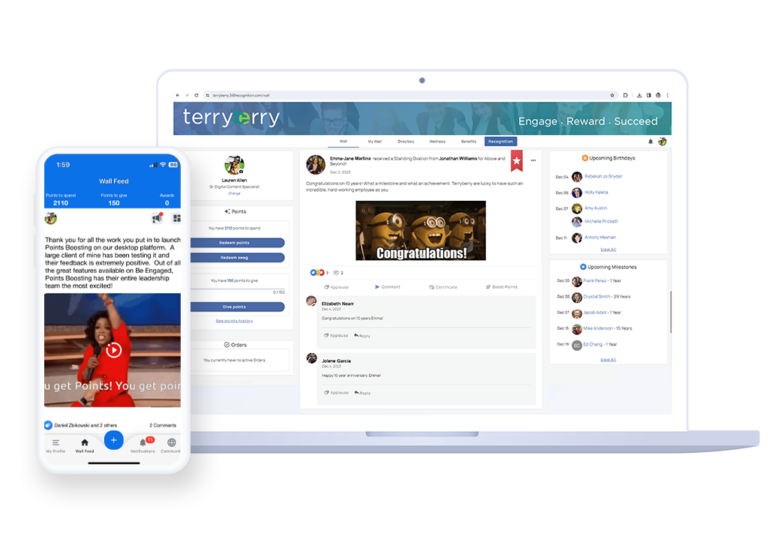
Terryberry is one of the longest standing names in employee recognition, a platform that has evolved from traditional service awards into a complete digital ecosystem that supports modern recognition habits.
While many new platforms focus only on points and badges, Terryberry brings decades of recognition psychology and blends it with current workplace expectations.
The result is a platform that feels stable, mature and deeply rooted in real organizational behavior.
The strength of Terryberry begins with its scope. It is not just an app for quick recognition. It is a full recognition suite with performance aligned components.
Organizations use it to centralize milestone programs, peer to peer appreciation, wellness challenges, manager recognition, social feeds, reward catalogs and performance based activities.
The platform is modular, which means companies can start small and expand their recognition journey naturally.
Terryberry’s recognition feed resembles a structured internal social network. Every appreciation becomes visible to the entire organization, and this visibility changes how teams interact.
It reinforces culture consistently, something especially important for hybrid teams who rely heavily on tools like Hot Desking Software Tools to stay connected physically and digitally.
The ability to celebrate achievements openly supports unity and keeps teams emotionally aligned even when physical presence varies.
One standout feature is Terryberry’s service awards program. Few platforms manage milestones with the level of elegance and history Terryberry provides.
Their approach blends digital celebration with real physical awards, giving employees a sense of ceremony. That kind of emotional memory improves retention and strengthens the feeling of belonging.
Managers benefit from guided recognition templates and automated reminders. The platform identifies recognition gaps, highlights managers who need support and offers insights into departmental engagement.
This is crucial for companies that want to avoid silent disengagement inside departments. The analytics engine does not overwhelm the user. Instead, it organizes metrics into practical insights that actually guide action.
Terryberry also offers a complete wellness module with challenges, leaderboards and motivational content.
While not every company uses this add on, it is valuable for organizations that want recognition to merge with health and lifestyle initiatives.
The idea is simple, appreciation should not be limited to work output but should extend to wellbeing and personal growth.
Its reward system is diverse, offering global gift cards, branded merchandise and experiential rewards.
Employees enjoy the variety and HR teams appreciate the operational control. Budget automation, tracking and forecasting functions help finance departments maintain discipline without restricting creativity.
Terryberry integrates smoothly with HR systems, intranets, Teams and Slack. Recognition can flow from daily tools straight into the main platform, keeping everything unified.
The platform’s maturity is evident in its client support. Terryberry offers onboarding specialists, program strategy consultants and dedicated account managers for medium and large companies.
This makes it suitable for complex multi level cultural initiatives.
Pros
• Very complete recognition suite
• Strong service award and milestone capabilities
• Customizable recognition programs
• Social feed enhances cultural visibility
• Advanced analytics for managers
• Global reward catalog with diverse options
Cons
• Interface feels more traditional compared to newer platforms
• Setup can be longer due to the wide range of features
• Pricing varies, which can confuse smaller companies
Pricing
Terryberry uses a customized pricing structure. Although exact values depend on company size and modules, the general structure is as follows.
• Core recognition platform begins around 5 to 7 USD per user per month
• Service award programs vary based on award type and volume
• Wellness and additional modules have separate pricing
• Enterprise pricing available upon request
8. Nectar Review + Pros, Cons and Pricing
Nectar is designed with one principle in mind, recognition should be simple, frequent and culturally aligned.
Unlike some platforms that overcomplicate the process with dozens of features, Nectar focuses on making recognition effortless and meaningful.
Its clean interface and streamlined workflows ensure employees feel appreciated without needing a manual or training session, which increases adoption significantly.
The platform allows employees to recognize each other through points and personalized messages. These recognitions are visible in a social feed, creating a transparent culture of appreciation.
Companies can tie recognition to specific core values, which helps reinforce desired behaviors consistently.
Whether celebrating project completion, going the extra mile, or simply saying thank you, Nectar keeps recognition authentic and timely.
One of Nectar’s strongest advantages is its reward system. Employees can redeem points for thousands of global gift cards, merchandise, experiences, or donations to charity.
This wide variety ensures employees feel their personal preferences are considered.
Unlike other platforms that only provide internal gift options, Nectar connects recognition with real-world value, which strengthens engagement and loyalty.
The platform also offers insightful analytics. Managers and HR teams can see which employees are receiving recognition, which teams are most active, and how the recognition aligns with company values.
This data helps identify engagement trends, potential gaps, and areas where culture reinforcement may be needed.
By providing actionable insights, Nectar empowers leadership to make informed decisions without guesswork.
Nectar integrates seamlessly with popular workplace tools like Slack, Microsoft Teams, and Google Workspace.
This allows recognition to flow naturally in daily routines, which is especially important for companies that use Hot Desking Software Tools or operate in hybrid environments.
When physical presence fluctuates, maintaining visibility of recognition ensures team cohesion and cultural alignment.
The platform also emphasizes simplicity in administration. HR teams can easily set budgets, monitor usage, and adjust programs on the fly.
This reduces overhead and allows organizations to scale recognition programs without increasing administrative burden.
Nectar is particularly effective for small to medium businesses seeking a user-friendly, high impact solution.
In essence, Nectar combines usability, meaningful recognition, and powerful analytics to create a platform that supports culture, engagement, and motivation simultaneously.
Pros
• Simple and intuitive interface
• Values-driven recognition system
• Global reward options
• Clear analytics and reporting
• Integrates with Slack, Teams, and Workspace
• Scalable for growing organizations
Cons
• Limited advanced performance management tools
• Some larger enterprises may need additional modules
• Social feed can become busy in very large companies
Pricing
• Standard plan starts at 4 USD per user per month
• Pro plan begins around 6 USD per user per month
• Enterprise and customized plans available on request
• Rewards budgets are separate and adjustable
9. Achievers Review + Pros, Cons and Pricing
Achievers has established itself as one of the most comprehensive employee recognition platforms, particularly suited for medium to large organizations that aim to link recognition with culture, engagement, and performance.
Unlike lighter platforms that focus solely on peer-to-peer recognition, Achievers integrates recognition, rewards, goal alignment, and analytics into one cohesive ecosystem, making it a central hub for employee engagement.
The platform enables employees to give instant recognition through a points-based system. Points can be tied to company values, project milestones, or team achievements.
Every recognition is visible in a company-wide social feed, creating a culture of transparency and shared celebration.
Achievers emphasizes frequent and meaningful recognition, understanding that small, timely acknowledgments often have a greater long-term impact on engagement than occasional large rewards.
One of the strongest aspects of Achievers is its global rewards marketplace.
Employees can redeem points for thousands of options, including gift cards, merchandise, experiences, and even charitable donations.
This flexibility ensures rewards feel personalized and meaningful. HR teams benefit from automated budget tracking and easy administration of rewards, which simplifies program management even in large organizations.
Achievers also provides robust analytics and reporting tools.
Leadership can access dashboards that track engagement trends, recognize high performers, monitor departmental recognition levels, and analyze how recognition aligns with company values.
These insights are actionable and help executives make informed decisions to improve engagement strategies.
The platform integrates with popular communication tools like Microsoft Teams, Slack, and workplace intranets.
Recognition notifications appear in real time, maintaining visibility and engagement across dispersed teams.
Achievers also supports program customization, including milestone awards, wellness initiatives, and managerial coaching.
This flexibility allows companies to align recognition with broader human capital strategies.
Achievers is best suited for organizations seeking a strategic approach to recognition, one that is deeply embedded into culture, leadership, and performance processes.
It balances simplicity for users with robust features for HR and management, creating a platform that drives engagement without overwhelming employees.
Pros
• Comprehensive recognition and rewards ecosystem
• Points tied to values and milestones
• Global reward options
• Detailed analytics and reporting
• Integrates with Teams, Slack, and intranets
• Supports program customization for culture and wellness
Cons
• Can be complex for very small teams
• Higher pricing than lightweight platforms
• Setup may require HR support for configuration
Pricing
• Pricing typically starts at 6 USD per user per month for the basic plan
• Enterprise plans require a custom quote
• Reward budgets are separate and flexible
• Additional modules for wellness and performance tracking may increase cost
10. Workhuman Review + Pros, Cons and Pricing
Workhuman is a leading employee recognition platform that emphasizes human connections and cultural alignment.
Its primary focus is peer-to-peer recognition and social acknowledgment, helping employees feel valued and motivated on a daily basis.
The platform promotes continuous recognition, tying achievements to company values and core behaviors. The social feed acts as a hub for visible appreciation, which strengthens morale and drives engagement across teams.
Workhuman also excels in milestone and service awards, delivering both digital and physical rewards. Integration with communication tools like Slack, Teams, and HRIS platforms ensures recognition fits seamlessly into daily workflows.
Analytics provide insights into engagement trends, manager participation, and recognition patterns, enabling HR to make informed decisions and monitor the health of company culture.
For hybrid workplaces using Hot Desking Software Tools, Workhuman keeps recognition visible regardless of where employees are located.
Its intuitive interface allows easy peer-to-peer recognition without administrative overhead.
Reward options are flexible, ranging from gift cards to experiential awards, making the system appealing across different demographics and geographies.
Pros
• Strong peer-to-peer recognition
• Milestone and service awards
• Integration with workplace tools
• Actionable analytics
• Flexible rewards
Cons
• Higher pricing for enterprise
• Can be complex for smaller teams
• Limited customization for small businesses
Pricing
• Plans start around 7 USD per user per month
• Enterprise solutions require custom quote
• Rewards budgets separate and adjustable
These platforms form the foundation of the Top 10 Best Employee Recognition Platforms. Each one approaches recognition from a different angle, but they all share the mission of helping companies create a more consistent and appreciative work environment.
5. Practical Application
Companies usually adopt these platforms gradually. First, HR teams test basic recognition features. Next, they connect the platform to reward programs. Later, they add analytics and automated recognition flows.
A common pattern I see is that teams begin with peer recognition, because it is the easiest to introduce. As momentum builds, managers join with structured feedback, then leadership uses data to understand engagement trends.
The implementation process usually follows:
- Internal communication about the recognition system
- Basic onboarding for managers
- Soft launch with selected teams
- Full launch across the company
- Continuous data monitoring
- Periodic updates to reward catalog or guidelines
Teams often comment on the physical sensation of relief once recognition becomes routine. Confusion decreases. Managers stop improvising. HR gains visibility. And employees finally feel that their contribution is not invisible or forgotten.
6. Cultural Impact

Recognition affects more than performance metrics. It shapes how teams feel.
Culture becomes tangible when people can see their impact displayed in a shared feed or when someone acknowledges small daily efforts that, otherwise, disappear in silence.
I have seen teams transform after the adoption of the Employee Recognition Platforms. People communicate more.
Projects feel lighter. And even in hybrid environments, the emotional distance reduces.
This is why many organizations consider recognition platforms as essential as their productivity tools. When used well, they become the emotional backbone of the workplace.
FAQ
Meaning of recognition platforms
Employee recognition platforms are digital systems that centralize appreciation, rewards, and acknowledgements.
They keep feedback organized and visible for teams of all sizes, and they act as the core structure behind the Employee Recognition Platforms.
How these platforms help teams
These tools help teams by simplifying appreciation, automating celebrations, organizing peer recognition, and providing performance insights. Many companies mix these tools with operational systems the same way they evaluate Hot Desking Software Tools.
Types of recognition features
Most platforms inside the Top 10 Best Employee Recognition Platforms include peer recognition, manager recognition, rewards, analytics, automations, and communication feeds that support ongoing engagement.
Why companies adopt recognition tools
Companies adopt these systems to create consistency and visibility. When recognition is structured, teams stay connected and performance improves.
Best approach to implementation
Start small with peer recognition, then add manager guidelines, then expand into rewards and analytics. This gradual approach ensures that the Employee Recognition Platforms integrate smoothly into daily habits.