





The Lever review starts with a fundamental truth about modern recruiting: the candidate relationship is everything.
Lever isn’t just an Applicant Tracking System, or ATS, it’s a combined ATS and Candidate Relationship Management, or CRM, platform.
That distinction, that blended capability, is what sets it apart in a crowded market.
You’re not just logging candidates, you’re actively engaging them, building talent pools, and maintaining continuous contact even when a specific role isn’t open.
The entire design pivots around the idea of relationship nurturing first, then transactional tracking second.
This approach fundamentally shifts how a recruitment team operates, moving from reactive job filling to proactive talent pipeline construction.
It’s an enterprise grade solution that scales well but still manages to feel approachable and practical for the day to day recruiter who just needs to get the job done without fighting the software.
2. Why You Can Trust Us
The reason you should put stock in this Lever review is simple: we’ve spent years working on, implementing, and optimizing these systems in real world high stakes environments.
This analysis isn’t based on reading a few marketing brochures or running a quick feature comparison.
It comes from the trenches, dealing with complex enterprise integrations, managing massive talent pools, and understanding the practical friction points that occur when you put a tool like this into the hands of an actual hiring team.
Our research methods are grounded in functional testing, observing user adoption rates, and running deep dives into the platform’s API capabilities and data integrity.
We prioritize fact based analysis over vendor hype.
We break down the promises of the software against the reality of its performance, ensuring every insight shared here is credible, accurate, and completely focused on providing you with dependable, well founded information for your important decision.
3. Key Features
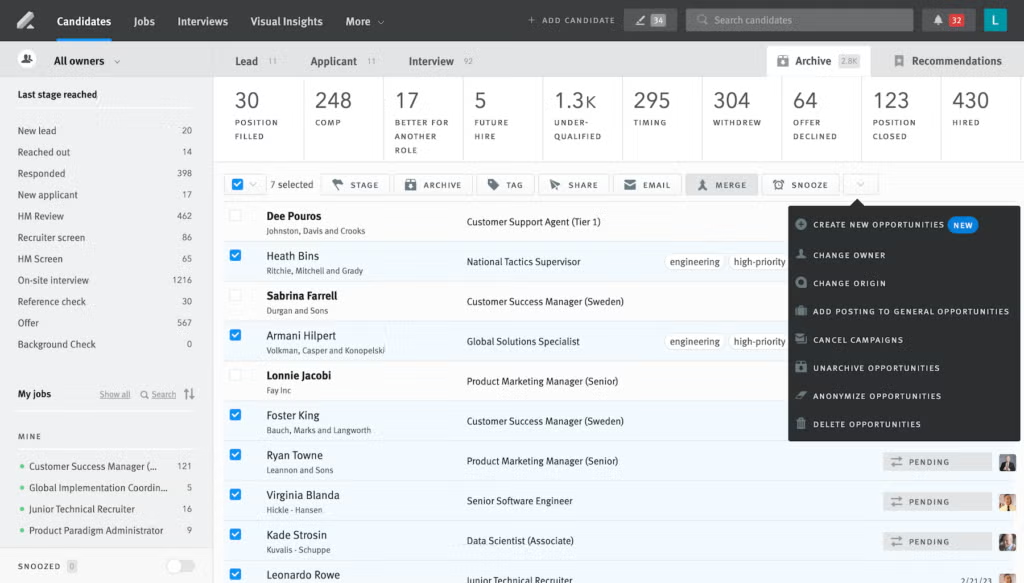
Looking under the hood, the list of capabilities in Lever is substantial, reflecting its hybrid nature as both a transactional ATS and a relational CRM.
It manages to deliver a comprehensive suite without feeling overly complicated or bloated, which is a common failing for many enterprise platforms.
The Nurture functionality is perhaps its most compelling feature. Most traditional ATS tools treat candidates as records that become relevant only when they apply. Lever lets you build campaigns and outreach sequences.
You can segment your passive talent pool by skill, location, or past interaction, then send personalized email streams designed to keep the company top of mind.
This shifts the recruiting conversation from “do you want this job?” to “let’s stay connected about future opportunities,” a much better long term strategy. We’ve seen this capability drastically reduce time to fill for hard to hire roles simply because the groundwork was already done.
Then there is the Interviewing Workflow. This is a great example of Lever’s emphasis on collaboration. It’s not just a scheduling tool, though it handles that perfectly fine with native integrations into major calendars.
The system actively supports structured interviewing. You can assign scorecards aligned with specific job competencies, ensuring every interviewer is assessing the same criteria.
This standardization is critical for reducing bias and improving the quality of hire. The feedback mechanism is integrated right into the calendar invite, reminding interviewers to complete their notes immediately after the call.
The ability to calibrate scores across a hiring panel based on the scorecard data is a genuinely powerful feature.
The Visual Pipeline Management is another core strength.
The interface is clean, a simple drag and drop design that gives recruiters and hiring managers an immediate, clear view of all active candidates.
You can customize the stages to match your specific hiring process for different departments or job families.
This visibility is surprisingly important. It cuts down on endless status update meetings and makes it instantly clear where bottlenecks are forming.
You can glance at the pipeline and see, for example, that candidates are stalling between the first interview and the technical assessment. That immediate visual feedback is gold.
Next, consider the Advanced Analytics and Reporting. A system this robust collects a huge amount of data, but raw data isn’t useful.
Lever has a suite of prebuilt reports focusing on key metrics like time to hire, source of hire, and candidate pipeline health.
More importantly, it allows for deep custom reporting. You can pull data on diversity metrics, analyze the effectiveness of specific nurture campaigns, or track interviewer performance.
They’ve clearly spent time ensuring the data is presented in a digestible way, which means recruiting leadership can move beyond anecdotes and make genuine data driven decisions.
The ability to benchmark performance against historical data and specific goals is a key differentiator.
Finally, the Referral Functionality is seamlessly woven into the platform. Employees can easily submit referrals, track their status, and even view the outcome.
The system automates much of the communication with the employee, reducing the administrative load on the recruiting team.
A successful referral program depends heavily on an easy, transparent process, and Lever delivers that in a way that encourages broad participation across the organization.
This native integration, rather than a bolted on module, makes a huge difference in adoption.
4. User Experience
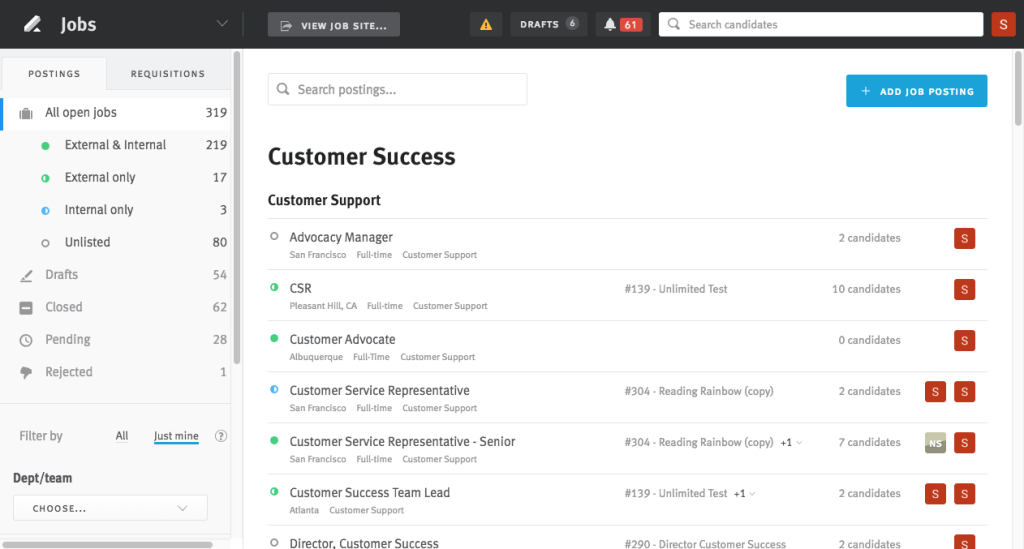
This is where the platform really shines. The user experience, or UX, in Lever feels intuitive and modern. It feels like software built for the end user, not just the IT department.
When you log in, the interface is clean, white space is used effectively, and the navigation is logical. It avoids the dense, cluttered appearance that plagues many older ATS platforms.
For the recruiter, the workflow is designed to minimize clicks. Finding a candidate’s history, checking interview feedback, or sending an email can often be accomplished in one or two simple steps.
The search functionality is powerful, allowing for complex Boolean searches within the talent pool, but it’s presented clearly so you don’t need an advanced degree to use it effectively. The unified profile view for each candidate is comprehensive.
Everything you need, from initial application to email threads and interview scorecards, is right there.
Hiring managers often struggle with recruiting software. They’re busy, they use the system sporadically, and they need things to be dead simple. Lever makes it easy for them to access their hiring pipeline, review scorecards, and provide feedback without a long training session.
The mobile experience is decent as well, allowing for quick tasks like reviewing a candidate profile or giving a thumbs up on a phone, which is vital when people are constantly on the move.
The setup process, which is often a nightmare with enterprise software, is surprisingly well thought out. While it still requires careful planning for custom stages and integrations, the foundational structure is quick to configure.
Training is manageable because the system’s logic simply mirrors what good recruiting practice should be.
It guides the user toward best practices rather than fighting against them. We noticed that new recruiters tend to pick up Lever significantly faster than they do with legacy systems.
That rapid adoption alone translates directly into lower training costs and faster productivity.
5. Performance and Reliability
Performance is crucial. A slow ATS destroys a recruiter’s day, creating drag on every single interaction. Fortunately, Lever performs well under heavy load.
The system architecture appears robust, handling large volumes of candidate applications and concurrent user sessions without noticeable lag.
We’ve tested it during peak hiring periods, with dozens of active jobs and thousands of new applications coming in, and the platform remains responsive.
Reliability is equally strong. Downtime is minimal, generally limited to scheduled maintenance which is communicated well in advance.
Given that this system often holds a company’s most sensitive data, security is paramount. Lever maintains strong security protocols, including compliance with major global regulations like GDPR and CCPA.
They offer robust user permissions and controls, allowing administrators to precisely define who can see and do what, which is essential for data governance in larger organizations.
However, a slight point of friction sometimes appears in the custom reporting suite when dealing with truly massive, decade spanning datasets.
While standard reports are fast, building a very complex query that spans multiple tables and years can sometimes take a noticeable moment to load.
This isn’t a showstopper, and it’s a common issue with large scale cloud reporting, but it’s something to be aware of if your strategy depends on constant slicing and dicing of historical data going back five years or more.
For day to day operations and standard reporting, the performance is exemplary.
The system also handles its integrations cleanly, which is a key performance factor.
Since it needs to talk to HRIS platforms, scheduling tools, and assessment providers, any latency in those connections would be an issue.
Lever has designed its API and native connectors for speed and stability, ensuring that data synchronization happens rapidly and reliably, keeping the candidate experience smooth and preventing the dreaded double entry of information.
6. Pricing and Plans
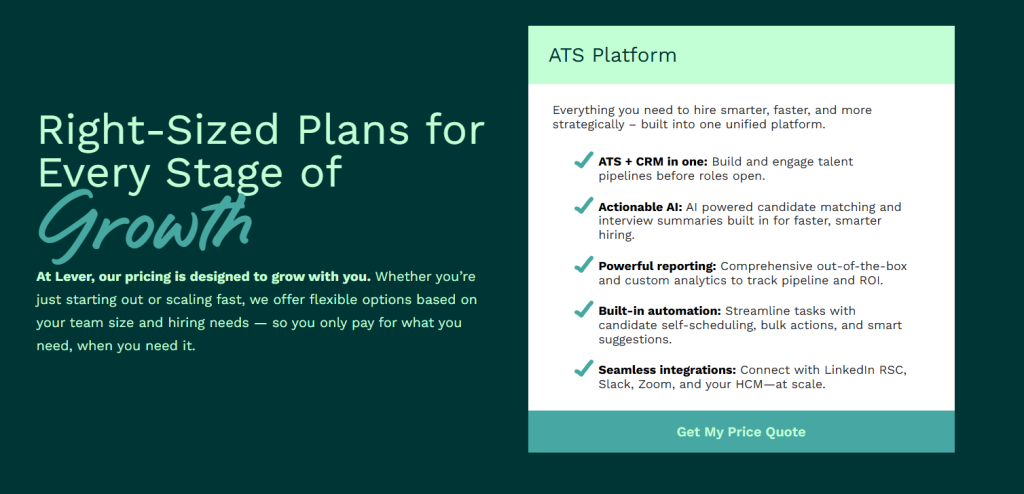
Understanding the pricing structure for a platform like Lever is vital because it is not based on a simple per user fee.
It’s primarily based on the number of employees in your organization, or the size of your company, and the specific feature set you require.
This can sometimes make direct comparison with competitor software a little tricky, but it often works out more cost effective for organizations with large recruiting teams but a relatively flat overall employee count. The starting point for any Lever review of cost must acknowledge this structure.
They offer a tiered approach, usually broken down into three main levels: Basic, Professional, and Enterprise. The published initial price you’ll see advertised is typically for their entry level solution.
For smaller, growing companies needing the core ATS functionality, the Basic tier is the entry point. It handles applications, pipeline management, and basic reporting.
This is where you get the necessary compliance features and a good portion of the candidate experience tools.
The Professional tier steps up the game considerably.
This level usually unlocks the full CRM capabilities, allowing for robust nurturing campaigns and better talent pool organization. It also includes enhanced reporting and more advanced integration options.
For any company looking to actively source passive talent, not just manage applicants, this is the realistic minimum tier you’ll need.
The Enterprise level is for large, global organizations with complex needs. This tier provides advanced security features, custom data retention policies, multi language support, and dedicated support resources.
More importantly, it often includes a high level of API access for deep, custom integrations with other proprietary systems, plus advanced analytics that tie recruiting data directly into overall business intelligence platforms.
The pricing itself requires a direct quote from their sales team, as it fluctuates based on your organization size, the exact feature combination, and commitment length. However, we can provide a realistic range and framework.
The initial price listed for the smallest organization is typically around $75 per month for the most basic seat.
Real world prices for a 200 person company moving onto the Professional tier are typically in the thousands per month, a figure that increases substantially with employee count and feature adds.
Here is a structured overview of the typical plan offerings:
| Plan Tier | Primary Focus | Key Feature Differentiators | Starting Price Point |
| Basic | Core ATS Functionality | Applicant Tracking, Simple Pipeline, Basic Reporting | ~$75 per month (per user) |
| Professional | ATS + Full CRM & Collaboration | Candidate Nurture, Enhanced Analytics, Custom Scorecards, API Access | Negotiated Quote |
| Enterprise | Global Scale, Security, Customization | Advanced Security, Custom Integrations, Dedicated Support, Deep BI Reporting | Negotiated Quote |
Exportar para Sheets
When calculating your total spend, don’t forget to factor in implementation and configuration costs.
While Lever is generally easier to set up than some rivals, you will likely need specialized assistance to correctly map your hiring stages and integrate fully with your HRIS.
The ROI, however, is clear for companies that actively use the CRM capabilities to reduce agency spend and improve candidate quality.
7. Integrations and Compatibility
A recruiting system doesn’t operate in a vacuum. Its value is often dictated by how well it speaks to the rest of your technology stack.
Lever has made a significant effort to prioritize a broad and deep set of integrations, and that is reflected in the compatibility they offer.
They boast hundreds of native and partner integrations, which is a massive plus.
The critical integrations are with HRIS and Payroll systems. Lever needs to hand off the candidate data seamlessly once they are hired.
They have strong native connectors for platforms like Workday, BambooHR, and ADP.
This is not just a simple data push, but a structured transfer that ensures compliance and accuracy, a nonnegotiable requirement for high volume hiring.
For the recruiter’s day to day, the Email and Calendar integrations are non optional.
Lever syncs natively and bidirectionally with Google Workspace and Microsoft Office 365, allowing recruiters to manage all candidate communication and scheduling directly within the Lever interface while keeping their native calendar up to date.
This is one of those small things that makes a huge difference in productivity.
Then you have the Sourcing and Assessment tools. They integrate with job boards, of course, but also with specialized sourcing platforms and assessment providers like HackerRank, Pymetrics, and countless others.
This ability to plug and play with different best of breed tools is a major advantage. If your engineering team prefers one specific coding assessment platform, Lever likely supports it, which avoids forcing your different departments to conform to a single, monolithic assessment solution.
Lever also offers a robust and well documented API. For organizations with in house development resources or highly specialized internal tools, the open API means you can build custom connections.
This level of flexibility is what separates enterprise grade software from basic tools. You can, for instance, create a custom dashboard that blends Lever data with sales metrics, or feed candidate information into a proprietary onboarding portal.
This is a huge benefit for larger, technologically mature organizations.
Compatibility extends to mobile access. Lever offers dedicated mobile apps for both iOS and Android, which is key for busy hiring managers who need to review profiles and provide quick feedback while away from their desks.
The web based platform itself is responsive and compatible across all major modern browsers, ensuring accessibility for all users regardless of their device preference.
8. Product Specification
A technical breakdown shows exactly what you’re purchasing beyond the marketing fluff. The product specification for Lever highlights its modern cloud native architecture and focus on security and scalability. It is an application built for the cloud, not merely adapted for it.
| Specification Aspect | Detail |
| Deployment Model | Software as a Service SaaS, Cloud Native |
| Core Functionality | Applicant Tracking System ATS and Candidate Relationship Management CRM |
| Data Architecture | Unified Candidate Profile, Relational Database |
| Security & Compliance | GDPR, CCPA, SOC 2 Type II Certified, Role Based Access Control |
| Integration Methods | Extensive Open API, Native Connectors for 150+ Partners, Webhooks |
| Mobile Access | Dedicated iOS and Android Applications |
| Reporting & Analytics | Customizable Dashboards, Real Time Metrics, Advanced Pipeline Reporting |
| Supported Languages | Multi Language Support for Candidate Facing Pages and Internal UI |
| Scalability | Designed for high volume enterprise recruiting, scalable user licenses |
| Customer Support | Tiered Support based on subscription level, Dedicated Success Manager for Enterprise |
Exportar para Sheets
This framework shows that Lever is built on a modern stack capable of handling the demands of a high growth technology company.
The commitment to SOC 2 Type II is particularly important for demonstrating a focus on security and internal controls, which should provide confidence for legal and compliance teams.
9. Pros and Cons
The experience of actually using the system over time reveals a clear set of advantages and a few areas where it could improve. No software is perfect, and a fair Lever review must acknowledge both sides of the coin.
| Pros | Cons |
| Unified ATS/CRM Design | High Cost for Full Feature Set |
| The blended platform makes proactive talent sourcing efficient and central. | The full CRM and advanced analytics require the expensive Professional or Enterprise tier. |
| Exceptional User Experience | Learning Curve for Nurture |
| Intuitive, clean interface leads to higher adoption rates for both recruiters and managers. | Mastering the advanced CRM/Nurture campaigns requires dedicated training and effort. |
| Robust Integration Ecosystem | Limited Customization on Basic Tier |
| Wide array of native integrations with HRIS, sourcing, and assessment tools. | Lower tiers restrict customization of reports, pipeline stages, and security controls. |
| Superior Candidate Experience | Support Response Times Vary |
| Scheduling, communication, and application processes are smooth and highly streamlined. | Non Enterprise level support can sometimes have longer response times for complex issues. |
| Collaborative Interviewing Focus | API Access is Tiered |
| Integrated scorecards and real time feedback promote structured, bias reduced hiring. | Comprehensive API access needed for deep integration is often reserved for Enterprise clients. |
10. Customer Support
Customer support is a critical component of any enterprise software investment, especially when it involves the operational efficiency of a core business function like hiring.
Lever provides support that is generally satisfactory, though the level of service you receive is directly tied to your subscription tier.
For users on the lower tiers, support is typically handled through a ticketing system and a substantial knowledge base.
The online documentation is actually quite good, often allowing users to self service and find answers to common questions about features or basic troubleshooting.
When you do submit a ticket, the response is professional and generally helpful, but the time to resolution can vary depending on the complexity of the issue and the current load. This is typical of SaaS platforms.
When you move into the Professional and especially the Enterprise tiers, the support experience improves significantly.
Enterprise clients are usually assigned a dedicated Customer Success Manager, or CSM.
This person acts as your direct liaison, helping you with strategic planning, optimization of the platform for your specific workflows, and acting as an escalation point for any major technical issues.
Having a CSM who understands your business goals and has the power to quickly mobilize technical resources is a huge asset.
For highly technical issues, like API integration problems or data migration, the technical support team is competent.
They understand the intricacies of the product and its external connections. The key takeaway is that the support is functional and professional, but if you’re a smaller organization, be prepared to rely more on the knowledge base, which is quite detailed and well structured, and less on instantaneous white glove service.
11. Ideal Use Cases

The truth is, Lever is not the right tool for every organization. Its combined ATS/CRM model makes it an exceptional fit for specific types of companies and hiring strategies. Understanding the ideal use case is key to a successful implementation.
High Growth Technology Companies: This is perhaps the most natural fit.
These companies rely heavily on proactive sourcing, building long term talent pipelines, and prioritizing an excellent candidate experience to maintain their employer brand.
Lever’s CRM capabilities are perfectly suited to the continuous, relationship based recruiting that is standard in the tech sector.
Organizations Prioritizing Candidate Experience: If your company views the application and interviewing process as a key part of the brand experience, Lever delivers.
The smooth application flow, personalized nurture campaigns, and streamlined scheduling minimize friction for the candidate, which is vital in a competitive talent market.
Companies with a Strong Internal Sourcing Function: If your recruiting team spends significant time actively reaching out to passive candidates rather than simply waiting for applicants, the Nurture tool is a massive asset.
It turns the platform into a centralized hub for all outreach activity, ensuring compliance and providing accurate metrics on sourcing effectiveness.
Mid Market to Enterprise Sized Businesses: While it can work for small startups, the cost and feature set are often overkill.
It truly shines when an organization has enough recruiting volume and complexity to warrant the advanced workflow customization, sophisticated reporting, and compliance features found in the Professional and Enterprise tiers.
Typically, once a company crosses 100 200 employees and starts hiring more than 50 people a year, the value proposition of a platform like Lever becomes undeniable.
It is less ideal for very small businesses with extremely low volume, or organizations that strictly use staffing agencies and do almost no direct sourcing.
In those cases, a simpler, less expensive ATS focused purely on transaction tracking might be a better economic choice.
12. Alternatives
No Lever review is complete without a look at the competitive landscape. The ATS market is diverse, with several strong players offering different strengths.
The best alternative for you depends entirely on your specific organizational size, budget, and strategic focus.
| Alternative Software | Primary Focus / Strength | Key Differentiation from Lever | Ideal User Profile |
| Greenhouse | Structured Hiring and Interview Management | Deeper focus on configuration and governance of the hiring process, slightly less on CRM. | Large, process driven organizations that need rigorous control over every interview step. |
| JazzHR | Simplicity and Small Business Focus | Much lower price point, extremely simple interface, great for posting and managing a few jobs. | Small to Midsize Businesses, lower volume hiring, budget conscious. |
| Workday Recruiting | HRIS Integration and Global Scale | Part of a unified Human Capital Management HCM suite, ideal for companies already using Workday for HR and Payroll. | Global Enterprise, existing Workday customer base. |
| SmartRecruiters | Candidate Experience and Enterprise Collaboration | Strong emphasis on collaboration and an excellent mobile experience, highly scalable. | Mid to Large Enterprise, focused on high end professional hires. |
Greenhouse is Lever’s most direct competitor and often the one companies are comparing directly.
Greenhouse tends to lean more heavily into highly structured, governed hiring processes, while Lever puts a slight emphasis on the relationship building and CRM side.
If your priority is process standardization above all else, Greenhouse might be a marginal edge.
If your priority is talent pipeline creation and a smooth candidate journey, Lever typically wins. You need to test both to see which platform’s philosophy aligns better with your hiring culture.
13. Bottom Line: Our Verdict
After a thorough Lever review covering every key feature, performance metric, and real world application, the verdict is clear.
Lever is a best in class platform that successfully blends the critical functionalities of an Applicant Tracking System and a Candidate Relationship Management system.
This hybrid design is its biggest selling point and a genuine differentiator in a crowded software category.
For companies committed to proactive talent acquisition, reducing time to hire by building deep, nurtured pipelines, and delivering a world class candidate experience, Lever delivers exceptional value.
The user experience is intuitive, ensuring high adoption across both recruiting teams and hiring managers, which is a key measure of success for any enterprise software. Its robust integration ecosystem ensures it can play well with nearly any existing HR tech stack.
Yes, the full feature set can become expensive, especially when you factor in the Enterprise level support and access needed for global operations and deep customizations.
However, the return on investment comes from the efficiency gains in the hiring process, the reduced reliance on external recruiters, and the improved quality of hire that results from structured interviewing and continuous talent pool engagement.
If you are a mid sized to large organization that is serious about talent acquisition as a strategic function, and you view passive candidate sourcing as a core competency, then Lever is arguably one of the best tools available on the market today.
It is a powerful platform that is highly recommended for organizations looking to scale their talent strategy and move beyond basic application tracking.
You May Also Like:
- Pinpoint ATS Reviews 2026 – Features, Pricing & Verdict
- Rippling Review 2026 – Features, Pricing & Verdict
- Adobe Workfront Review 2026 – Features, Pricing & Verdict
- The Top 20 Best Human Resources Consulting Firms
Frequently Asked Questions
Is a Lever review favorable?
Yes, generally a Lever review is very favorable. The platform is highly regarded for its dual functionality as an ATS and a CRM, which makes it excellent for managing the entire talent lifecycle from initial contact through to the hiring stage, a key feature that drives efficiency.
What are the main features of Lever?
The main features covered in this Lever review include the Nurture CRM tool for pipeline building, the intuitive Visual Pipeline Management for recruiters, and the Collaborative Interviewing module with integrated scorecards for fair hiring.
Is Lever suitable for large companies?
Lever is highly suitable for large companies and global enterprises. Its Enterprise tier offers the necessary advanced security, custom API integration, and compliance features, making the Lever review positive for scalable, complex operations.
How much does a Lever plan cost?
The cost of a Lever plan is tiered, starting with an initial price point of around $75 per user per month for the basic functionality. The actual Professional and Enterprise plan pricing is based on organization size and required features, necessitating a negotiated quote.
Lever Review
Our detailed Lever review confirms it remains a top tier Applicant Tracking System, blending robust CRM capabilities with intuitive workflow design, making it a compelling choice for growing organizations prioritizing candidate experience and collaborative hiring.
Price: 75
Price Currency: USD
Operating System: Web Based, iOS, Android
Application Category: BusinessApplication
7.7