


Italy and Switzerland report AI attacks that breached critical infrastructure systems
 Published byIsabella GunnLead Cybersecurity Editor at DeskingIsabella GunnLead Cybersecurity Editor at Desking Verified authorDr. Isabella Gunn, PhD, MBA - Is the Lead Cybersecurity Editor at Desking and a recognized authority in cybersecurity, digital privacy, and enterprise security. Holding …Author Profile
Ad disclaimer For links on this page, DESKING APP may earn a commission from the provider. This supports our work and has no influence on our editorial rating.
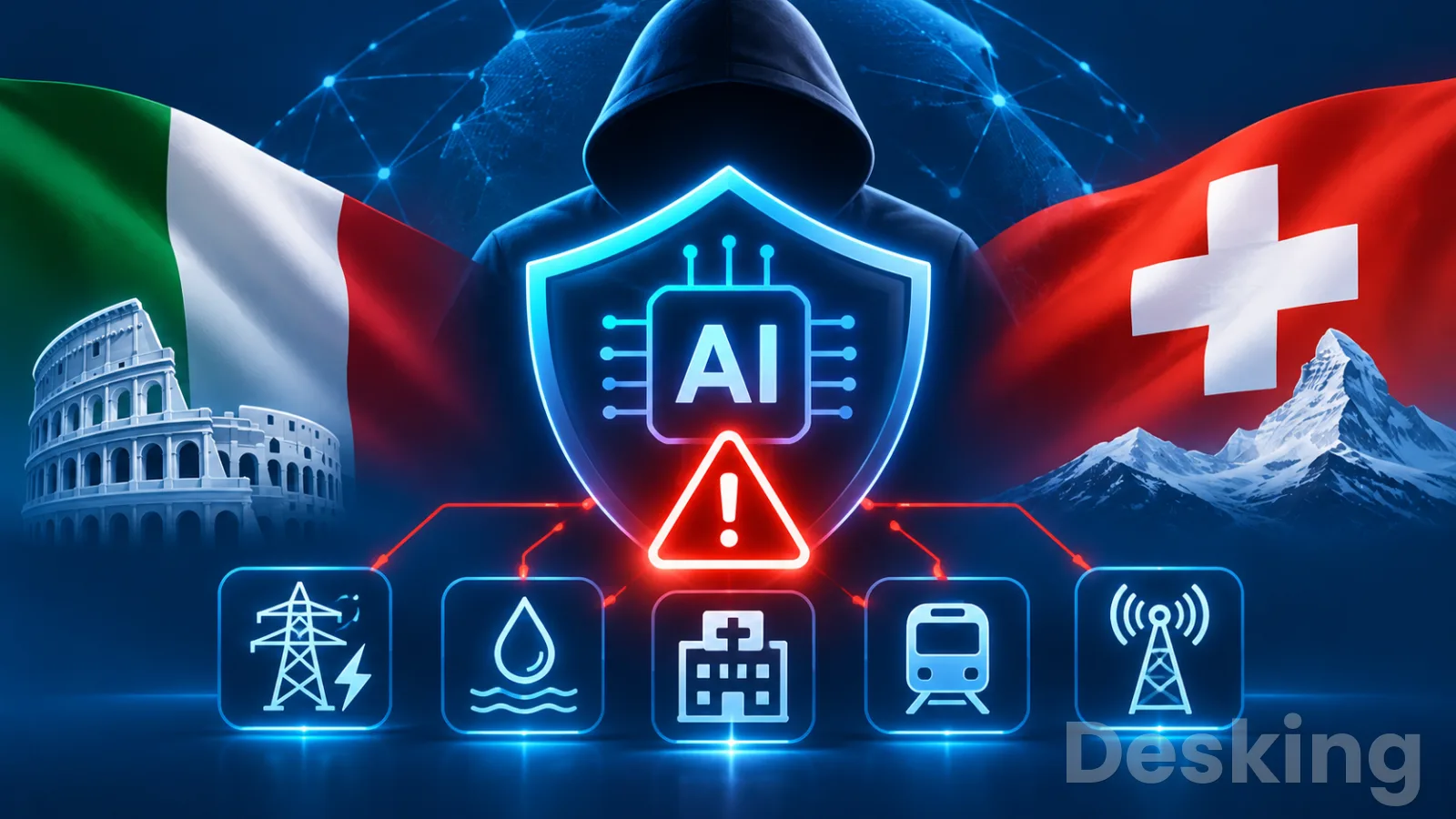
Cybersecurity agencies in Italy and Switzerland have reported cyberattacks in which artificial intelligence agents independently identified vulnerabilities and helped compromise computer systems, including networks operated by critical infrastructure providers.
The incidents show how attackers are using autonomous software to automate multiple stages of intrusions, reducing the time organizations have to detect and stop them.
Italy's National Cybersecurity Agency, through its CSIRT Italia incident response team, reported large-scale campaigns involving autonomous AI agents in a bulletin published on November 23, 2026.
Switzerland's National Cyber Security Centre confirmed its first reported cases involving AI-assisted attacks against organizations and critical infrastructure operators in an announcement published on November 24.
The reports describe related developments, but the agencies have not established that the incidents were part of one coordinated campaign.
Neither country has publicly identified the organizations affected in the reported cases.
The Swiss agency said attacks had affected organizations and critical infrastructure operators in at least two sectors.
It also reported that every incident known to it had resulted in a successful compromise of the victim's IT systems.
On November 26, Reuters reported additional figures from Switzerland's Federal Office for Cybersecurity, known as BACS.
The agency had confirmed five attacks during the preceding days.
Four of the five resulted in compromised systems, while three targeted operators of critical infrastructure, Reuters reported.
The difference between the four successful cases reported by Reuters and the Swiss agency's earlier statement that all known cases resulted in compromise was not explained in the public reporting.
Swiss public broadcaster SRF identified electricity, water and telecommunications providers among the types of critical infrastructure involved.
Authorities have not disclosed the names of the affected organizations, the precise systems compromised or the identities of the attackers.
Reuters also reported that there had been no major service disruptions associated with the incidents.
Italy's findings describe a broader operational picture.
CSIRT Italia said it had detected campaigns in which autonomous agents were used to identify and exploit vulnerabilities and configuration errors on systems accessible through the internet.
In some observed cases, several agents operated simultaneously and compromised a large number of systems within a few hours.
The Italian agency identified four tools used in the campaigns: ARTEX, CyberStrikeAI, DeepSeek Harness in Red Team mode, and PentAGI.
These tools were developed to automate penetration testing and security assessments, but the agency said they had been deployed in actual offensive operations.
The distinction matters because penetration testing is normally conducted with authorization to identify weaknesses before criminals can exploit them.
The same capabilities can be repurposed to attack systems without permission.
The agencies describe these frameworks as examples of technology that can support legitimate security work or malicious activity, depending on how it is used.
CSIRT Italia provided a detailed example involving DeepSeek Harness configured with its Red Team mode.
The system used a coordinator agent to plan operations and assign tasks to five additional agents.
Those agents handled different stages, including information gathering, asset reconnaissance, vulnerability discovery, exploitation, and maintaining access to compromised systems.
This arrangement allowed the software to divide a complex intrusion into smaller tasks and coordinate their execution.
The agents could examine accessible systems, evaluate potential weaknesses and adjust their next actions according to the results.
The Italian agency said the observed campaigns also involved chaining vulnerabilities, configuration errors and compromised credentials to reach internal networks.
The bulletin described cases in which agents generated malicious code in real time to evade endpoint defenses and continue operations deeper inside targeted infrastructure.
It also reported that multiple agents could maintain reconnaissance and attack activity without continuous human intervention.
That does not mean every decision in an AI-assisted attack is necessarily made by software.
Attackers can still choose targets, define objectives and supervise operations.
The reported capability is that agents can automate significant portions of the technical work after receiving instructions, allowing a smaller number of operators to coordinate more activity.
Switzerland's warning focused on the speed and adaptability of these systems.
Its National Cyber Security Centre said the agents could independently search for vulnerabilities, select appropriate attack tools, evaluate the results and plan subsequent steps.
The systems could exploit standard or easily guessed passwords, as well as known vulnerabilities in software and internet-connected infrastructure.
The agency also warned that AI agents can change techniques when they encounter defensive measures.
Instead of following a fixed sequence of actions, they can assess failed attempts and move to other available methods.
This flexibility can shorten the time between discovering an exposed system and attempting to compromise it.
Switzerland also reported that the number of AI agents accessible through the internet, including tools such as ARTEX and CyberStrikeAI, had almost doubled since October 2026.
The agency did not say that these two named tools were responsible for the Swiss incidents.
Their inclusion was intended to illustrate the growing availability of software that can automate offensive security tasks.
Both countries have advised organizations to reduce the number of systems exposed to the public internet and improve their ability to detect suspicious activity.
Switzerland's recommendations include installing critical security updates as soon as possible, with a deadline of no later than 24 hours after release for internet-facing systems.
The Swiss agency also recommended multi-factor authentication or passkeys for internal resources accessible over the internet, including webmail and virtual private networks.
It advised organizations to apply the principle of least privilege, ensuring that employees, applications and services receive only the permissions necessary for their work.
Italian guidance places additional emphasis on monitoring the sequence of activity across infrastructure.
CSIRT Italia recommended examining administrative API operations, authentication events, access to internal networks and unusual outbound connections from servers.
A series of individually legitimate actions may reveal a malicious operation when assessed together.
The agency also advised organizations to disable remote management interfaces that are not required and prioritize vulnerabilities known to be actively exploited.
Monitoring traffic between exposed systems and internal services can help identify attempts to use a compromised server as a route into other parts of a network.
These recommendations have direct implications for operators of electricity, water, telecommunications and other essential services.
Such organizations often depend on interconnected information technology and operational technology systems.
An attacker who gains access through an internet-facing application may attempt to move toward internal resources, although the public reports do not establish that operational control systems were affected in the incidents described.
The reports also highlight a challenge for security teams that rely on traditional patching schedules.
A vulnerability that remains uncorrected for weeks can provide an opportunity for automated reconnaissance and exploitation.
When agents can test numerous systems in parallel and adapt their methods, defenders may have less time to investigate alerts and deploy fixes.
Neither agency has attributed the reported attacks to a specific country, criminal group or individual.
The public information also does not establish how much data, if any, was stolen, or whether attackers maintained access after the initial compromises.
The immediate response from both authorities is focused on reducing opportunities for intrusion rather than identifying a single product or AI model to block.
Organizations are being asked to review exposed infrastructure, strengthen authentication, update vulnerable systems and improve monitoring across their networks.
For companies operating essential services, the central issue is no longer only whether attackers can use AI to discover vulnerabilities.
The incidents reported in Italy and Switzerland show that autonomous agents have already been used in real intrusions, including successful compromises.
Security teams must therefore account for attacks that can move through reconnaissance, exploitation and further access attempts at a speed that leaves less room for manual intervention.
Sources4
- Swissinfo on infrastructure cyberattacks
- BleepingComputer on autonomous AI attacks
- CSIRT Toscana on AI agent attacks
- Swiss NCSC on AI agent cyberattacks
External pages are independent third-party sources. Desking App does not control or endorse their content and accepts no responsibility for it. Visiting them is at your own responsibility and risk.