Pope Francis Private Diary Reveals Visions, Fears and a Two Year Spiritual Crisis
 Published byEva ElekchaGrowth Strategy SpecialistEva ElekchaGrowth Strategy Specialist Verified authorEva Elekcha is a Digital Marketing and Growth Strategy Specialist at Desking, covering the strategies, technologies, and platforms that help businesses strengthen their …Author Profile
Ad disclaimer For links on this page, DESKING APP may earn a commission from the provider. This supports our work and has no influence on our editorial rating.
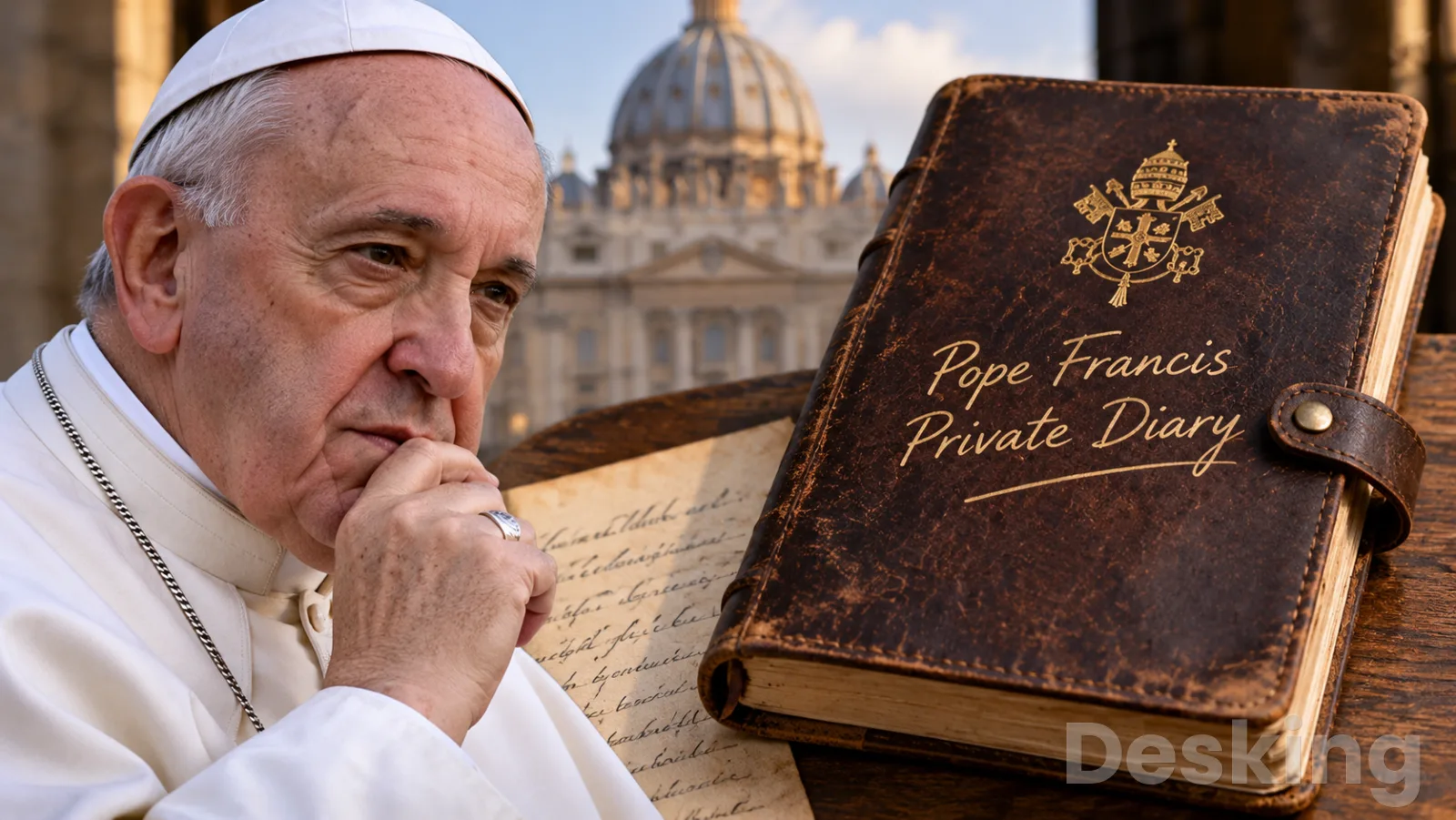
Table of contents
- A notebook that remained private for decades
- The two year spiritual crisis
- Francis described visions of the Devil
- The Chile abuse scandal left a lasting mark
- Fears about leadership and personal inadequacy
- Pope Leo XIV approved the publication
- A rare publication of a pope's personal writings
- Publication in five languages and 94 countries
Pope Francis’s private diary was published on Tuesday, November 24, revealing personal reflections on spiritual crises, encounters with what he believed was the Devil, fears about his ability to lead the Catholic Church and the emotional consequences of the clergy abuse scandal in Chile.
The 160 page book, titled The Private Diary of Pope Francis, brings together selected writings recorded between December 20, 1992, and August 18, 2024, and was edited by Cardinal Víctor Manuel Fernández, one of the late pope’s closest collaborators.
The publication offers an unusually personal account of Jorge Mario Bergoglio, who led the Catholic Church from March 2013 until his death on April 21, 2025.
Among its most significant revelations are a spiritual crisis that lasted approximately two years, reflections on the responsibilities and temptations associated with papal authority, and descriptions of visions that Francis interpreted through his Catholic faith.
The book was released in five languages across 94 countries through a partnership involving the Vatican Publishing House, Libreria Editrice Vaticana, and international publishers.
Its publication also followed approval from Pope Leo XIV, who authorized Fernández to examine the late pontiff’s writings and prepare them for readers.
The Vatican and the publishers describe the volume as a collection of personal reflections rather than a complete historical account of Francis’s pontificate.
Its central subject is his spiritual life, including experiences and doubts that he rarely discussed publicly.
A notebook that remained private for decades

The material comes from a personal planner that Francis began using in December 1992, when he was serving as an auxiliary bishop in Buenos Aires.
According to The Washington Post, the black covered notebook contained 86 pages of notes from before his papacy and another 55 pages of entries written during his time as pope.
The notebook was not originally presented as a manuscript intended for publication.
Francis used it to record brief thoughts, spiritual reflections and personal experiences.
The notes were handwritten in small, slanted script, and some passages were difficult to interpret without additional context.
When Bergoglio was elected pope on March 13, 2013, he moved from Argentina to the Vatican.
The notebook was among the personal belongings he subsequently had transferred to Rome from Buenos Aires.
It was kept at Casa Santa Marta, the Vatican residence where Francis chose to live during his pontificate.
Several people who worked with him knew that he kept the planner, but they believed it contained practical notes, according to Fernández's account to The Washington Post.
The cardinal said he discovered its significance during a private conversation with Francis in 2025, when the pope was already seriously ill.
The two men had been discussing arrangements for a possible situation in which Francis might irreversibly lose consciousness.
During that conversation, the pope moved away from the subject and showed Fernández the diary and other personal books.
Francis indicated that some of the material could be published after his death if it could benefit readers spiritually.
Fernández recalled that the pope used the expression "to edify" when describing the purpose such a publication should serve.
After Francis died in April 2025, Fernández informed Pope Leo XIV about the notebook and the earlier conversation.
Leo authorized a search for the material and arranged for it to be delivered to the cardinal so that he could prepare the editorial work.
Fernández then spent approximately a year selecting and organizing the material.
The resulting book contains 160 pages and includes commentary intended to explain the circumstances behind certain entries.
The distinction matters because readers are not receiving an unedited reproduction of every page Francis wrote.
The published volume presents selected material, arranged by subject and accompanied by explanations from the cardinal who knew the pope personally.
The two year spiritual crisis

One of the central subjects in the diary is a spiritual crisis Francis experienced between the beginning of 2021 and 2022.
According to Reuters, the entries describe a period in which the pope struggled with questions about authority, the decisions required of him and the way he exercised power over people within the Church.
The crisis coincided with worsening health and the demands of governing the Vatican.
Fernández described the period as one of the most difficult spiritual experiences of Francis's life.
In his commentary, he explained that the pope was concerned about becoming someone who manipulated others for personal convenience.
The diary records a December 2022 reflection in which Francis connected his internal difficulties with governance responsibilities and the pressure of making decisions.
He described the experience as a combination of institutional pressures, spiritual desolation and personal struggle.
The cardinal's account also indicates that Francis repeatedly examined his own motives and worried about the possibility of allowing pride or personal power to influence his decisions.
Reuters reported that Fernández considered the crisis the worst spiritual trial that had tormented the late pope.
The cardinal also described a conversation in which another bishop asked Francis why he had not reprimanded an unnamed Vatican official who had publicly criticized him.
Francis reportedly explained that he did not want to become a puppeteer who used and manipulated people according to his own interests.
That concern provides an important part of the diary's account of papal authority.
Rather than presenting leadership only through institutional decisions, the entries show Francis questioning how he should exercise power and whether his position could lead him away from the principles he believed should guide him.
The Washington Post also reported that Francis described himself in a 2022 entry as "the proud, self sufficient, cynical, self deceptive Jorge." The wording reflects the degree of personal criticism contained in the notes.
Fernández said these feelings were not limited to one isolated episode.
He described them as recurring concerns that sometimes left Francis feeling inadequate for the responsibilities of his ministry.
The diary therefore provides a view of the emotional and religious questions behind decisions that were usually discussed publicly in terms of doctrine, administration or Church policy.
Francis described visions of the Devil

The most widely reported passages concern experiences Francis interpreted as encounters with the Devil.
In the diary, he wrote that he had clearly heard the Devil's voice and described several occasions when he believed he had seen him.
Reuters reported that an entry from January 2021 listed three experiences throughout Francis's life, including one during a meeting with Vatican officials.
The accounts include descriptions of threatening eyes and a voice that Francis found difficult to forget.
In one entry, he recalled an encounter during which he believed the Devil was present and speaking to him.
The Vatican's account of the book also describes these experiences as part of the pope's spiritual understanding of temptation.
Francis associated them with moments of personal difficulty, Church governance and his broader religious struggles.
Another entry, written in June 2018, describes a vision of what Francis called the entrance to Hell.
"Last night I saw the entrance to Hell," Francis wrote.
"I peeked in to look a little, and it terrified me."
The Washington Post reported that the pope described reaching for his Rosary after the experience.
He regarded prayer and devotion to the Virgin Mary as sources of protection during these moments.
The diary also includes Francis's description of what he called pagan seduction.
He interpreted the experience as a spiritual temptation and wrote about resisting it through prayer.
These passages should be understood as Francis's own religious descriptions, not as independently verifiable claims about supernatural events.
The book documents what he recorded and how he interpreted those experiences within his faith.
The Vatican's coverage presents the entries as evidence of a more mystical dimension to the late pope's spirituality.
The writings show that, alongside his public emphasis on social issues, pastoral outreach and Church reform, Francis maintained a deeply personal understanding of prayer, temptation and spiritual conflict.
The Washington Post reported that the final entry in the diary also refers to these experiences.
Fernández interpreted the closing passage as a possible indication that Francis had consciously decided to stop writing.
In that final reflection, the pope asked the Virgin Mary to protect and help him.
The cardinal said the entry brought together concerns that had accompanied Francis throughout his life.
The Chile abuse scandal left a lasting mark

The diary also revisits one of the most difficult episodes of Francis's pontificate: the controversy surrounding allegations of sexual abuse and the handling of those allegations by Church authorities in Chile.
In January 2018, Francis traveled to Chile during a period of intense criticism over Bishop Juan Barros, who had been accused of knowing about the sexual abuse committed by priest Fernando Karadima and helping cover it up.
Francis initially defended Barros and publicly questioned the accusations.
During the return flight from South America, journalists challenged the pope over his statements and the experiences of victims who said their allegations had not been taken seriously.
Associated Press correspondent Nicole Winfield was among the journalists who questioned him during the flight.
In its November 24 report, the Associated Press described how Francis insisted that he had not received evidence from victims directly accusing Barros.
Winfield challenged that position, explaining that victims had made allegations and that the pope's response appeared to disregard their accounts.
The diary reveals how deeply the confrontation affected Francis after he returned to Rome.
He wrote that he had been devastated by the situation in Chile and by the exchange with journalists on the airplane.
He also acknowledged that he had not understood the seriousness of the scandal.
"It was hard for me to admit what happened in Chile; I didn't think it was so serious."
The entry provides a personal account of the moment when Francis began to recognize the extent of the problem.
The Associated Press reported that the diary connects the episode with the pope's later description of seeing the gates of Hell and experiencing what he interpreted as a spiritual confrontation.
The controversy had significant consequences for the Catholic Church in Chile.
Francis subsequently ordered a Vatican investigation, apologized to victims and summoned the country's bishops to Rome.
The bishops offered their resignations after the meeting.
In a 2023 interview with the Associated Press, Francis acknowledged that the confrontation aboard the papal aircraft had been a turning point in his understanding of the scandal.
He recalled that the journalists' questions helped him recognize the extent of the corruption and the failures within the Chilean Church hierarchy.
The diary adds a personal dimension to that public record.
It shows how the controversy remained part of Francis's internal reflections years after the original events.
The publication does not remove the criticism surrounding his initial handling of the allegations.
Instead, it provides additional evidence of how he later understood the situation and how the episode affected him.
Fears about leadership and personal inadequacy
The entries also reveal that Francis questioned his own suitability for major responsibilities long before becoming pope.
According to The Washington Post, some of the earliest reflections date from the late 1990s, shortly after Bergoglio became archbishop of Buenos Aires in 1998.
In those notes, he examined his shortcomings and failures and expressed concern that his actions might harm others.
Some passages contain particularly severe judgments about himself.
He considered whether it might be better for God to take his life rather than allow him to continue causing harm.
Similar reflections appeared again in 2009, four years before his election as pope.
The diary shows that these concerns were not limited to the years when he occupied the highest position in the Catholic Church.
The Washington Post reported that Francis's feelings of inadequacy could be triggered by conversations with people who placed considerable confidence in him.
Their expectations sometimes made him question whether he deserved their trust.
In 2011, he also wrote about his age, health and criticism directed at him.
One entry expressed concern about becoming a scandal and asked God to send him death before that happened, while also asking for a good successor.
The publication presents these passages as part of a recurring pattern of self examination.
Fernández told The Washington Post that Francis sometimes struggled with the feeling that he was not equal to the demands of his mission.
The Vatican's account similarly highlights a short entry in which Francis wrote, "I am afraid." The reflection concerned his fear that he might not be capable of fulfilling his responsibilities or could cause harm to others.
These statements provide context for the way Francis approached his religious responsibilities.
They also show a side of the pope that was not necessarily visible in his public appearances, speeches or institutional decisions.
The diary does not establish a clinical diagnosis or provide a medical explanation for these thoughts.
It records spiritual and personal reflections, and the cardinal's commentary interprets them within the context of Francis's faith and ministry.
Pope Leo XIV approved the publication
The publication also involved a decision by Francis's successor, Pope Leo XIV.
Fernández said he informed Leo about the diary after Francis's death and explained the late pope's earlier indication that some of the material could eventually be shared.
According to the cardinal's account, Leo authorized the search for the documents and arranged for them to be delivered to Fernández.
The pope then approved the editorial project.
The decision was significant because the material included private reflections that had not previously been made public.
Fernández said he believed commentary was necessary because some passages could be misunderstood without knowledge of the people, events and circumstances surrounding them.
The cardinal also explained that he did not publish every part of the original material.
In his interview with The Washington Post, Fernández said some passages were written using symbols or a form of code that made them difficult or impossible to interpret.
He also excluded certain paragraphs concerning living individuals because publication could lead readers to judge people based on private remarks.
He said the diary did not contain specific reflections on the controversy surrounding the Vatican's 2023 declaration on blessings for same sex couples.
The cardinal also told the newspaper that the book did not provide explanations for every major unanswered question about Francis's pontificate, including why he never returned to Argentina after becoming pope.
The published material therefore has editorial boundaries.
It is a curated selection rather than a complete disclosure of the late pope's private papers.
Fernández's role is also more extensive than that of a conventional editor.
He assembled the entries, organized them by subject and supplied explanations based on his personal relationship with Francis and his position within the Vatican.
A rare publication of a pope's personal writings
The release of Francis's diary is unusual in the history of the modern papacy.
Reuters reported that the collection is the first publication of a pope's diaries since the 1960s.
The last comparable example was the posthumous publication of writings by Pope John XXIII, who died in 1963.
The Washington Post also noted the different treatment of private papers by previous pontiffs.
Pope John Paul II had instructed that his journal be burned after his death, although some of his personal writings were eventually preserved and published.
The publication of Francis's diary therefore offers a rare opportunity to examine a pope's private spiritual reflections through material written during his lifetime.
It also arrives at a time when the Catholic Church is being led by Leo XIV, who succeeded Francis in May 2025.
The book provides additional material for understanding the predecessor whose pontificate included debates over Church governance, social inclusion, migration, the treatment of abuse victims and the role of the papacy.
However, the volume should not be treated as a complete record of Francis's decisions or as a definitive account of every controversy during his pontificate.
Its contents focus primarily on personal faith, spiritual experience and the questions he asked himself.
Publication in five languages and 94 countries
The Private Diary of Pope Francis became available internationally on November 24, 2026.
The Vatican announced distribution in 94 countries and publication in five languages.
The publishing arrangements are divided between the Vatican and international partners:
English: Penguin Random House, including the North American edition.
Spanish: Penguin Random House.
Portuguese: Penguin Random House.
Italian: Libreria Editrice Vaticana, the Vatican Publishing House.
French: Éditions Albin Michel.
Penguin Random House announced the English edition on October 5, confirming that it would be available in North America in multiple formats on November 24.
The publisher describes the book as a collection of reflections on Francis's hopes, fears, struggles and prayers.
The book's international release makes the selected writings accessible to readers beyond the Catholic Church's institutional audience.
Its contents are also relevant to historians, religious scholars and readers interested in the personal lives of modern religious leaders.
The central contribution is not a new account of the chronology of Francis's papacy.
It is the publication of private reflections that provide a more detailed view of how he understood his faith, his responsibilities and his own limitations.
The diary shows a pope who continued to question himself while holding one of the most influential religious positions in the world.
Its publication, authorized by his successor and prepared by a longtime collaborator, gives readers access to a personal record that Francis had kept for more than three decades.
Sources4
- Washington Post on Francis private diary
- Associated Press on Chile abuse scandal
- Penguin Random House on diary release
- Vatican News on Francis diary publication
External pages are independent third-party sources. Desking App does not control or endorse their content and accepts no responsibility for it. Visiting them is at your own responsibility and risk.