Tesla Flying Car: Is It Real or Fake? What the Roadster Reveal Actually Proves
By Noura Mint Ely · October 22, 2026
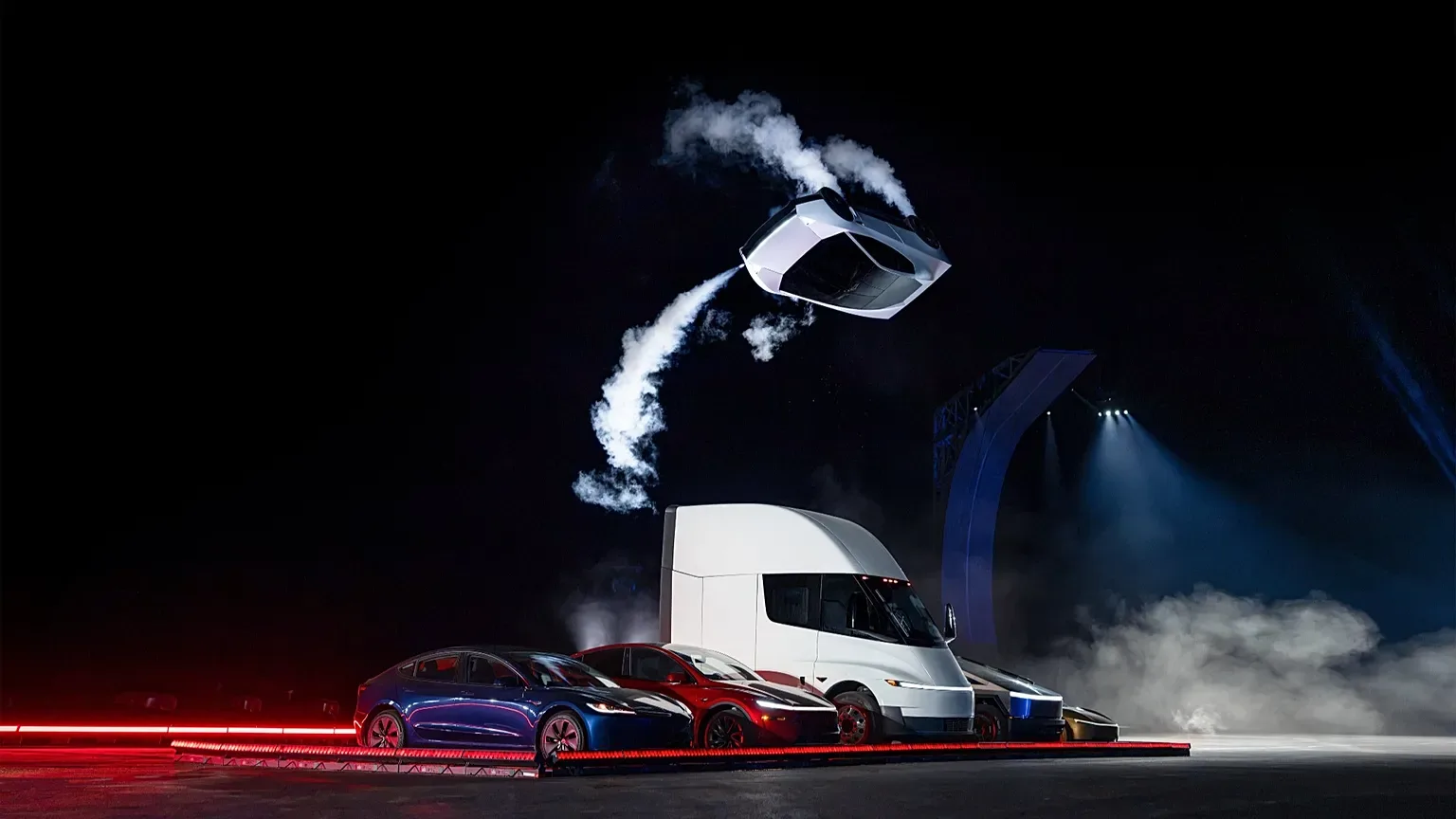
Table of contents
- What Is Actually Real About Tesla’s Flying Car?
- Is the Viral Tesla Flying Car Video Fake?
- How Would Tesla’s Flying Roadster Work?
- When Will Tesla’s Flying Car Be Available?
- Could Tesla’s Flying Car Be Legal to Drive and Fly?
- What the Tesla Flying Car Means for the Future of Transportation
- The Bottom Line
- Frequently Asked Questions
Tesla has unveiled a Roadster concept with a proposed rocket-powered flight capability, but that does not mean a fully operational flying car is commercially available.
The company’s October 15, 2026, demonstration showed a prototype performing airborne stunts, while a separate viral video depicting a Tesla flying between city buildings was identified as AI-generated.
What Is Actually Real About Tesla’s Flying Car?
Tesla’s flying-car claims have moved beyond speculation, but important distinctions remain between a public demonstration, a working prototype and a production-ready vehicle.
On October 15, 2026, Tesla presented its next-generation Roadster at a SpaceX facility in Texas.
CEO Elon Musk described the vehicle as capable of flight, drawing attention to technology designed to combine a high-performance electric sports car with rocket-inspired propulsion.
The demonstration attracted widespread attention because footage showed the vehicle launching into the air and performing aerial maneuvers.
Independent reporting and footage from attendees supported the authenticity of the event.
However, the demonstration did not establish that the Roadster can sustain controlled flight over long distances or operate as an ordinary aircraft.
Tesla’s official Roadster website describes a high-performance model equipped with cold-gas thrusters and a more advanced configuration called the Rocket.
The company states that the Rocket version can generate forward and upward acceleration, as well as lateral rotational movement.
These are significant engineering claims, but they should not be confused with independent verification of every advertised capability.
Is the Viral Tesla Flying Car Video Fake?
Some videos circulating online are genuine recordings of Tesla’s demonstration, while others misrepresent what happened.
A particularly important example appeared on social media on October 20, 2026.
The footage purported to show a Tesla Roadster flying from a rooftop between tall buildings in a city.
A fact-check published by Lead Stories on October 21 identified that specific video as AI-generated.
The footage did not match Tesla’s actual demonstration, which took place at a SpaceX facility in McGregor, Texas.
AI-detection tools also flagged the circulating clip as likely synthetic.
This distinction matters: a fake video does not prove that every Tesla flying-car demonstration is fake. Conversely, authentic footage of a vehicle briefly leaving the ground does not prove that the vehicle is capable of sustained flight.
Readers should assess each video individually, checking its original source, location, publication date and consistency with footage from independent witnesses.
How Would Tesla’s Flying Roadster Work?
Tesla’s proposed flying configuration combines automotive engineering with propulsion technology more commonly associated with aerospace applications.
The company describes two important systems.
Cold-gas thrusters: These devices generate thrust by releasing pressurized gas.
Arranged around a vehicle, they can produce forces that change its direction, attitude or vertical movement.
Unlike conventional jet engines, cold-gas thrusters do not rely on combustion within the propulsion device.
A suction and ground-sealing system: Tesla also describes a system intended to generate strong aerodynamic downforce by managing airflow beneath the vehicle.
This is designed to improve grip and, according to the company, can hold the car upside down under certain conditions.
The suction system and thrusters serve different purposes.
The former is intended to improve contact with a surface, while the latter would provide propulsion for the proposed airborne maneuvers.
Although these technologies are grounded in established physical principles, their integration into a road-going vehicle presents substantial engineering challenges.
These include energy and propellant requirements, vehicle stability, thermal and mechanical stresses, emergency control, landing behavior and protection for occupants and bystanders.
The fact that a propulsion system can lift or rotate a vehicle does not automatically make that vehicle a practical aircraft.
When Will Tesla’s Flying Car Be Available?
Tesla has indicated that the next-generation Roadster is expected to enter production in 2028.
That timeline should be treated as a company projection rather than a guaranteed delivery date.
The company’s website distinguishes between different configurations, including a Thrust version and the more specialized Rocket version.
Tesla describes the Rocket configuration as available by invitation only and explicitly states that it is not approved for public-road use.
These restrictions are important because a vehicle designed to perform airborne maneuvers may face requirements beyond those governing conventional electric cars.
Potential buyers should also distinguish between placing a reservation, receiving a production vehicle and obtaining permission to use its flight capabilities.
These are separate milestones, and a reservation alone does not establish that the technology is commercially ready.
As of October 22, 2026, the announced capabilities and future production plans do not establish that consumers can purchase and legally operate a fully certified flying Roadster.
Could Tesla’s Flying Car Be Legal to Drive and Fly?
Legal approval is one of the biggest unanswered questions surrounding the concept.
A conventional passenger car must satisfy the applicable vehicle safety and road-use requirements in the jurisdiction where it operates.
An aircraft must meet separate aviation requirements, which may cover airworthiness, operating permissions, pilot qualifications and restrictions on where flights can take place.
A vehicle that combines both functions could encounter overlapping regulatory requirements.
The precise rules would depend on its final design, its actual flight capabilities and the country in which it is operated.
In the United States, the Federal Aviation Administration oversees civil aviation, while road-vehicle requirements fall under a different regulatory framework.
The fact that a vehicle has been demonstrated publicly does not, by itself, establish compliance with either framework.
Tesla’s stated restriction against public-road use for the Rocket configuration is therefore a meaningful limitation.
Buyers and observers should not assume that a demonstration establishes permission to fly above public roads, residential areas or populated locations.
What the Tesla Flying Car Means for the Future of Transportation
Tesla’s Roadster proposal sits at the intersection of electric vehicles, aerospace propulsion and experimental vehicle design.
However, it differs from electric vertical takeoff and landing aircraft, commonly called eVTOLs.
Those vehicles are designed specifically for flight and may be developed for passenger transportation, air taxis or other aviation applications.
Tesla’s approach, by contrast, centers on a sports car that the company says can also perform airborne maneuvers through specialized propulsion equipment.
The distinction affects everything from vehicle architecture and operating procedures to safety certification and practical transportation use.
A sports car capable of short airborne maneuvers is not necessarily a replacement for an aircraft, nor does it demonstrate that flying cars will soon become a routine form of urban transportation.
The most meaningful future evidence will be independently verifiable flight testing, clear technical specifications, a confirmed production schedule and regulatory approval appropriate to the vehicle’s intended use.
The Bottom Line
Tesla’s flying Roadster is not simply a fictional invention, but the strongest claims about its capabilities still require careful interpretation.
The company has demonstrated a prototype and announced plans for a specialized rocket-powered configuration; it has not thereby established that a fully certified flying car is ready for everyday transportation.
The most reliable approach is to distinguish verified demonstration footage from fabricated social-media videos, company claims from independently established performance, and announced production targets from confirmed commercial availability.