


Deel HR starts at $5 per employee, making global HR management more accessible
 Published byEvander ThorneSoftware ReviewerEvander ThorneSoftware Reviewer Verified authorEvander Thorne is a Software Reviewer and IT Management Specialist at Desking, specializing in enterprise software, IT service management, project management, and busine…Author Profile

Ad disclaimer For links on this page, DESKING APP may earn a commission from the provider. This supports our work and has no influence on our editorial rating.
Deel HR is a global human resources information system built for companies managing employees, contractors and employer of record workers across borders. Its $5 Core plan makes centralized workforce administration accessible, but the real advantage is its connection to Deel’s international employment infrastructure. Businesses operating mainly in one country may find better focused alternatives.
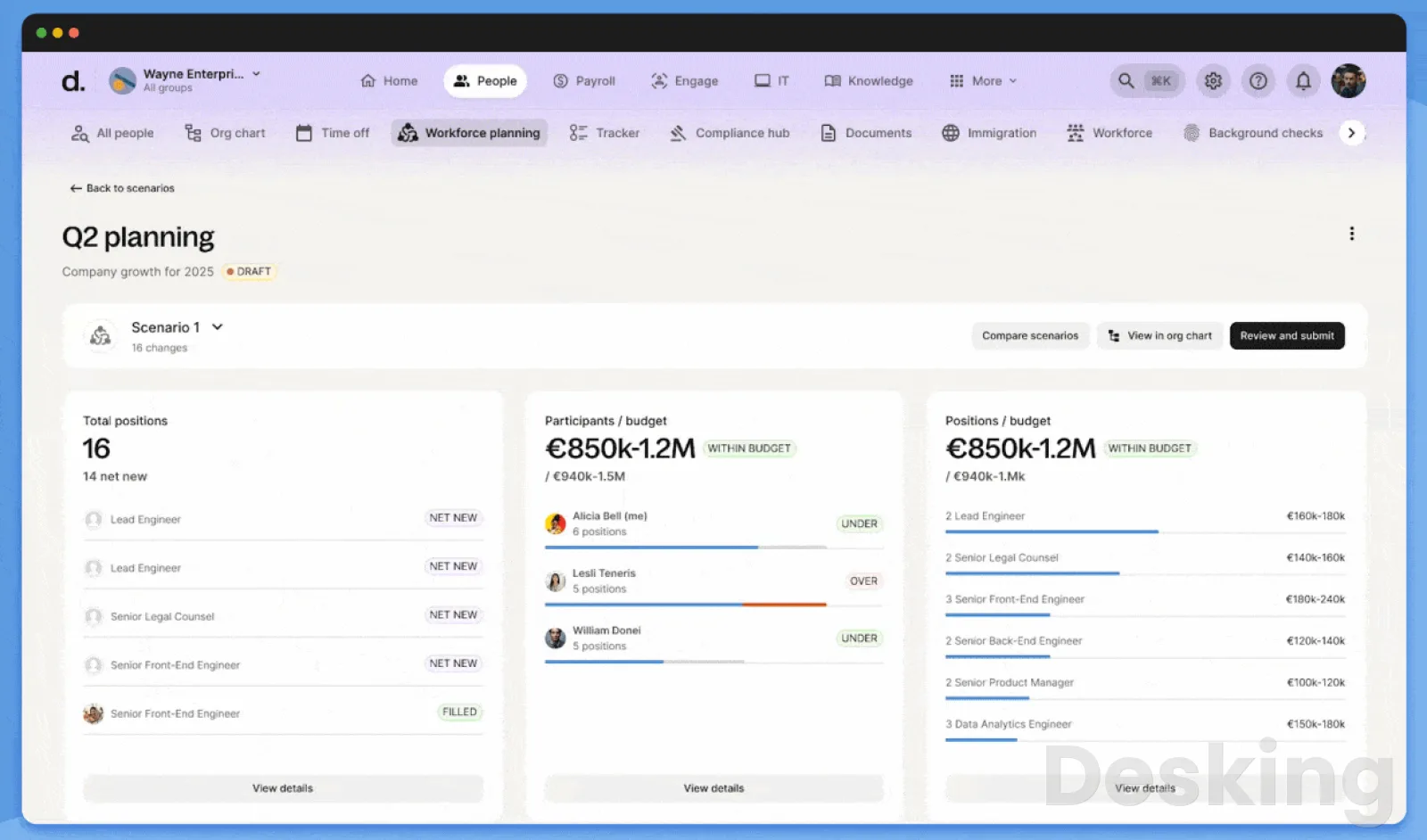
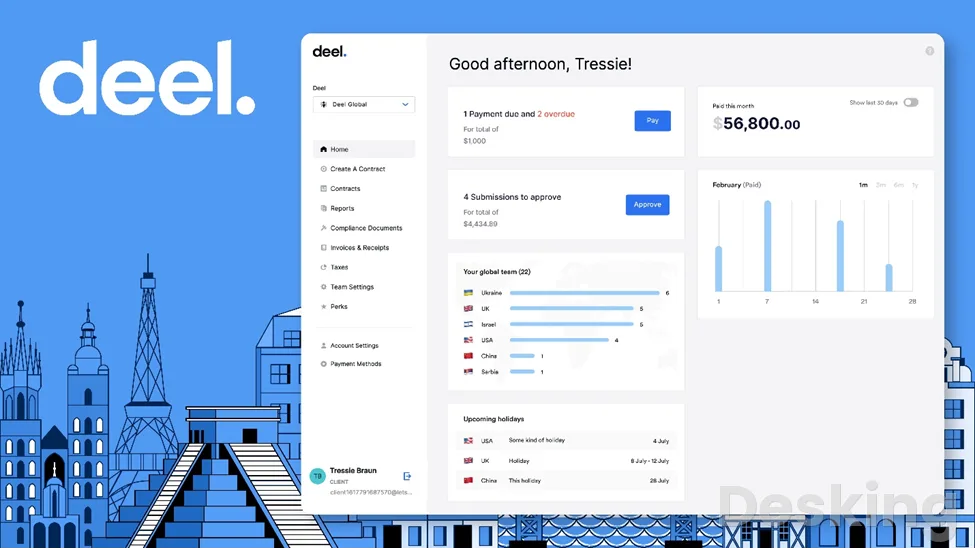
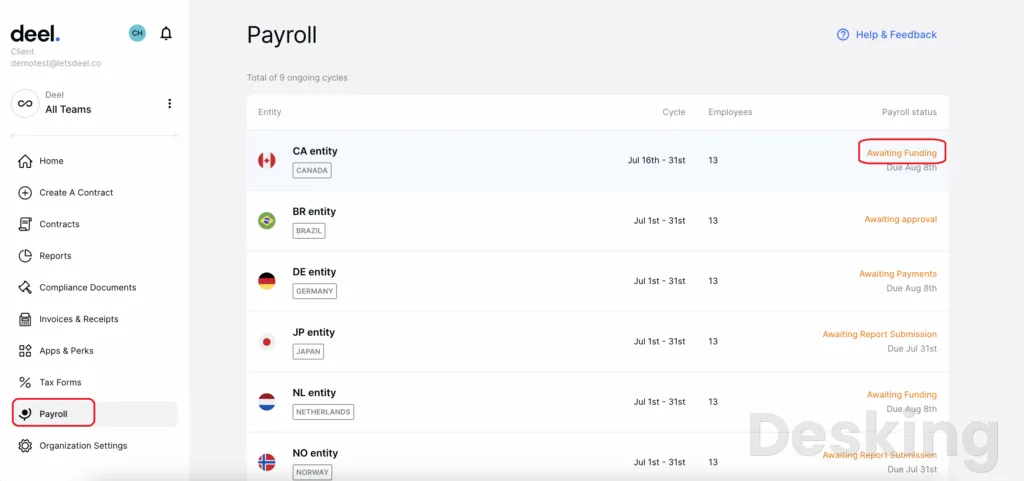
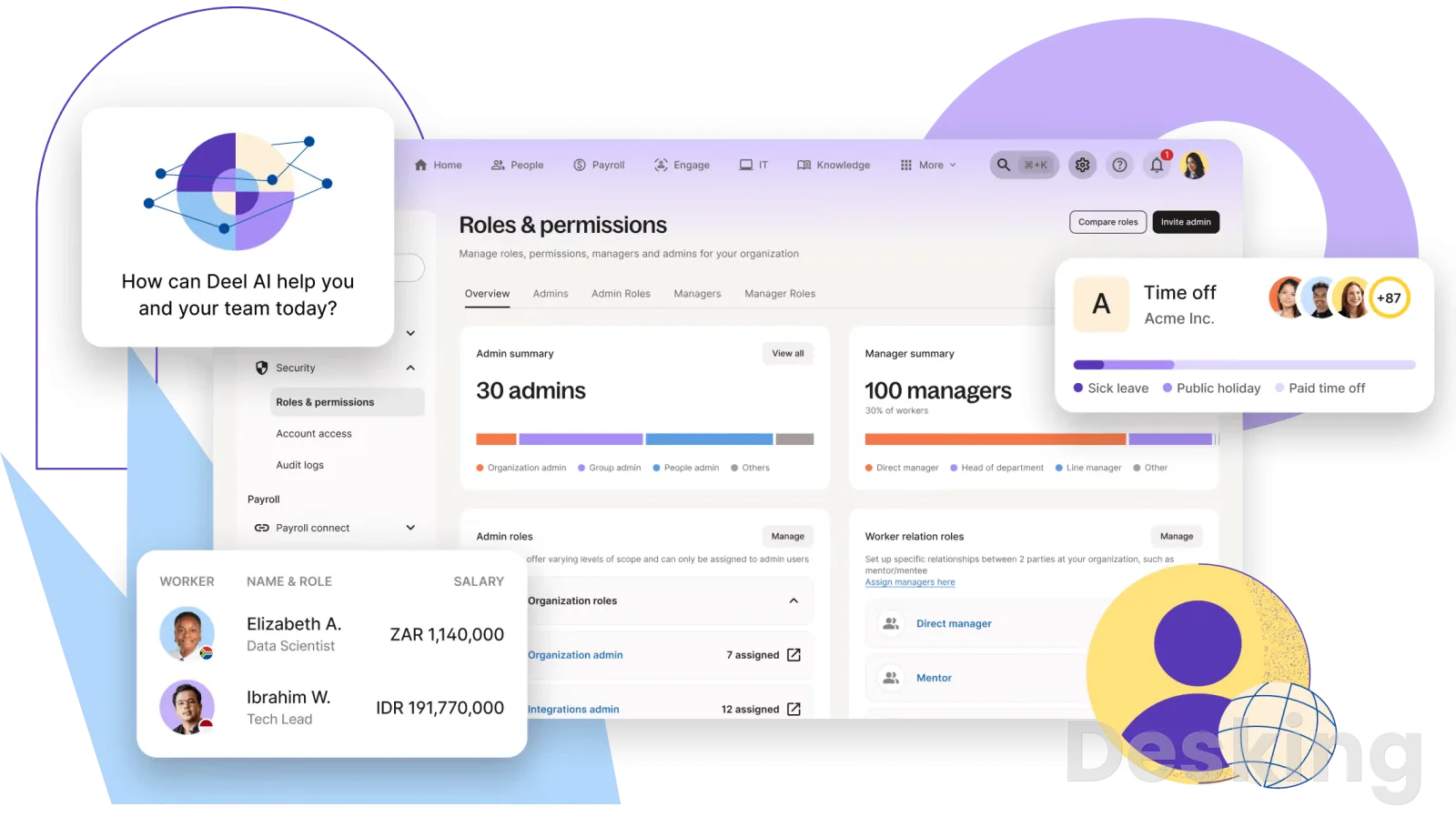
Table of contents
- 1. What is Deel HR
- 2. How Deel HR organizes employee management
- 3. Core HR features
- 4. Advanced and Elite capabilities
- 5. Integrations and API access
- 6. Ease of use and implementation
- 7. Security and international compliance
- 8. Deel HR pricing
- 9. Deel HR alternatives
- 10. What users say about Deel HR
- 11. Who should use Deel HR
- Frequently Asked Questions
1. What is Deel HR
Deel HR is a cloud based human resources information system that centralizes employee records, organizational structures, onboarding, time off, approvals and workforce administration across multiple countries.
It is developed by Deel, a privately held global HR and payroll technology company founded in 2019 by Alex Bouaziz and Shuo Wang.
Headquartered in San Francisco, Deel grew from an international contractor hiring service into a wider employment platform, supporting more than 40,000 businesses and operations across 150 countries.
Its investors include Coatue, which led a $425 million funding round in June 2026 at a reported $5.5 billion valuation.
The distinction between Deel and Deel HR is important.
Deel is the wider commercial platform, covering contractor management, employer of record services, global payroll, US payroll, IT administration and other workforce services.
Deel HR is the people management layer within that ecosystem.
It can operate as a standalone HRIS, but its strongest commercial proposition appears when an organization also uses Deel to employ or pay people in different jurisdictions.
The product is therefore best understood as a global workforce management system rather than a conventional US focused HR database.
Deel HR has three published HRIS tiers: Core at $5 per person per month, Advanced at $19 and Elite at $29.
Core covers the daily administration of employee information, time off, workflows and reporting.
Advanced adds performance, learning and engagement functions, while Elite introduces compensation management and headcount planning.
This structure is unusually easy to understand compared with HR platforms that require a sales conversation before revealing even their starting price.
The central buying question is whether international workforce administration is important enough to justify choosing Deel over a more traditional HRIS.
A company with employees in several countries, contractors and employer of record workers has a different administrative problem from a US business with one office and a conventional payroll provider.
Deel's country aware workforce model addresses the former particularly well.
The latter may find that BambooHR or another domestic HR platform offers a more appropriate set of HR functions.
2. How Deel HR organizes employee management
The HRIS starts with a central employee record.
Profiles, documents, organizational structure and job information are stored in one system, giving administrators a consistent place to maintain workforce data.
Changes to employee information can feed into connected processes rather than requiring administrators to update several separate records.
This matters when a company changes someone's manager, location, role or employment status and needs those details reflected in related workflows.
The organizational chart gives managers and HR staff a view of reporting relationships and responsibilities.
It is more useful than a static directory because it forms part of the wider workforce record.
Job architecture and employee profiles also help establish consistent information across different business units.
For a company with multiple legal entities, locations and worker types, the ability to manage these records together is more important than the visual appearance of the chart.
Deel supports direct employees, independent contractors and employer of record workers within its wider workforce environment.
That is a meaningful distinction from HR products designed primarily around conventional employees.
An international company can maintain a broader view of its workforce without treating every contractor or foreign employee as an administrative exception.
The platform's country specific policies and employment workflows are intended to account for local requirements across more than 150 countries.
The benefit is not that one HRIS automatically makes every employment arrangement legally simple.
Employment classification, local contracts, payroll obligations and statutory benefits still depend on the country and the type of engagement.
Deel's advantage is that its employment services and HR records are designed to work together.
Buyers should still establish which responsibilities remain with their own legal entities, which are handled by Deel and which require separate professional advice.
3. Core HR features
Deel HR Core is the foundation of the platform.
At $5 per person per month, it includes worker profiles, organizational charts, documents, workflows, time off, time tracking, approvals and reporting.
This is a competitive starting point for businesses that need an HR database without immediately purchasing performance management or compensation planning.
The low entry price is especially relevant to companies that want to replace spreadsheets and scattered employee files before investing in more advanced HR processes.
The following table separates the three published HRIS tiers by their principal capabilities.
It is important to distinguish these HRIS packages from Deel's separately priced payroll, contractor and employer of record services, which are not automatically included simply because a company subscribes to Deel HR.
| Capability | Core | Advanced | Elite |
|---|---|---|---|
| Employee profiles | Yes | Yes | Yes |
| Organizational charts | Yes | Yes | Yes |
| Employee documents | Yes | Yes | Yes |
| Workflows and approvals | Yes | Yes | Yes |
| Time off management | Yes | Yes | Yes |
| Time tracking | Yes | Yes | Yes |
| HR reporting | Yes | Yes | Yes |
| Performance management | No | Yes | Yes |
| Employee learning | No | Yes | Yes |
| Engagement tools | No | Yes | Yes |
| Compensation planning | No | No | Yes |
| Salary bands | No | No | Yes |
| Headcount planning | No | No | Yes |
The practical decision is straightforward.
Core is sufficient when the main objective is to establish a structured employee database and manage routine administration.
Advanced becomes relevant when performance reviews, learning and engagement are part of the HR department's regular work.
Elite is intended for organizations that also need structured compensation decisions and workforce planning.
A company should not pay for Elite simply because it expects to grow; it should have a real requirement for its additional planning capabilities.
Employee workflows
Workflow automation is one of the stronger reasons to choose Deel HR instead of maintaining employee administration through spreadsheets.
Administrators can automate onboarding and employee changes, assign tasks, send personalized emails and apply logic and filters to different processes.
Roles, permissions and approval rules determine who can access information and who can authorize particular actions.
Managers can also approve requests through Slack or mobile access, reducing the need to keep every approval inside the main web interface.
A useful example is the employee onboarding process.
A new hire can be added to the workforce record, assigned the appropriate tasks and connected to the relevant documents and policies.
The same employee information can then support subsequent changes, such as a new job title, reporting manager or work location.
This is more reliable than asking separate administrators to update independent systems, provided the company has configured the relevant fields and approval responsibilities correctly.
Offboarding deserves equal attention.
A departure can involve document collection, changes to access, final administrative tasks and coordination with IT.
Deel's wider product ecosystem can connect employee lifecycle events to IT processes, including device and software provisioning.
However, companies should confirm which actions are available through their selected HRIS configuration and which depend on separate Deel IT services or integrations.
Time off and time tracking
Deel HR supports time off policies, requests, balances and approval processes.
Administrators can assign approvers to policies and determine which workers are covered.
The system also supports country specific leave requirements, an important consideration when employees work under different statutory rules.
Time tracking covers hours recorded by workers in different working environments, while overtime calculations can support the associated workforce administration.
The details of leave configuration matter more than the existence of a request button.
A company may need separate policies for statutory leave and additional company vacation, particularly when its payroll categories treat those absences differently.
Deel's help documentation also explains that workers may be allowed to request leave before it has accrued if the administrator enables negative balances in the relevant policy.
These settings should be reviewed before rollout because a poorly configured policy can create payroll and balance discrepancies.
4. Advanced and Elite capabilities
Advanced and Elite extend Deel HR beyond employee administration.
Advanced introduces performance management, learning and engagement capabilities.
These functions are relevant to HR departments that need to manage review cycles, employee development and feedback without maintaining separate applications for every process.
They also make Deel more competitive with established midmarket HR platforms, although buyers should assess the maturity of individual functions rather than assuming that every module has the same depth.
Elite adds compensation management and headcount planning.
This is a different kind of value from the administrative tools in Core.
Salary structures, pay bands and workforce planning affect budgeting, recruitment decisions and internal compensation consistency.
Organizations with established compensation cycles may find these tools more useful than businesses that only need a directory and leave calendar.
The additional monthly cost is justified when the HR department will actively use the planning functions.
The table below identifies the paid capabilities that change the buying decision.
These are package differences within Deel HR, not additional charges for Deel's separate employment services.
| Resource | Unlocking tier | Published monthly price |
|---|---|---|
| Employee records and workflows | Core | $5 per person |
| Organizational charts and documents | Core | $5 per person |
| Time off and time tracking | Core | $5 per person |
| Performance management | Advanced | $19 per person |
| Learning management | Advanced | $19 per person |
| Employee engagement | Advanced | $19 per person |
| Compensation management | Elite | $29 per person |
| Salary bands and planning | Elite | $29 per person |
| Headcount planning | Elite | $29 per person |
The jump from Core to Advanced is substantial, so buyers should identify the performance and learning processes they intend to run before upgrading.
The difference between Advanced and Elite is more specialized: compensation and headcount planning are valuable when the organization has recurring salary reviews, budget controls and workforce forecasts.
For a smaller business with informal pay decisions, Elite may add cost without solving an immediate operational problem.
5. Integrations and API access
Deel's integration strategy is built around connecting HR data to payroll, IT, finance and other workforce applications.
Its marketplace includes integrations for HR platforms such as BambooHR, HiBob, Personio and Workday, alongside tools for finance, identity management and employee services.
This matters because a global HRIS rarely exists in isolation.
Companies may already have systems for accounting, payroll, recruitment, device management and employee benefits that need to exchange selected information with Deel.
Integration depth varies.
A connection may synchronize employee profiles, map fields, transfer time off information or automate a larger part of the employment lifecycle.
These are not interchangeable capabilities.
For example, the documented Personio integration supports employee data synchronization and time off management for specified worker types, while the Personio Global Payroll Connect integration covers additional payroll and employment data.
Buyers should confirm sync direction, frequency, supported contract types and the fields exchanged before assuming that a marketplace listing means full two way synchronization.
Deel also publishes an HRIS API for companies that need programmatic access to workforce data.
The API documentation covers people records, personal information, leave requests, organizational structures and custom fields.
That makes Deel more suitable for organizations with internal engineering resources or specialist applications that need a direct connection to HR data.
It does not mean that every integration can be built without development work or that every API operation is included in the base subscription.
Documentation
A sensible integration review should cover four areas before signing:
- Employee data: Confirm which system owns each employee field and how changes are synchronized.
- Time off: Verify how leave balances, requests and approval statuses move between connected systems.
- Payroll: Establish whether compensation changes and approved working hours transfer automatically or require manual handling.
- Access control: Check the permissions required to install, configure and maintain each integration.
For companies already using Workday, Personio or another established HRIS, Deel may function as a global employment and payroll layer rather than a complete replacement.
That can be the right architecture, but it should be deliberate.
Running two systems with overlapping employee records without clear ownership creates duplicate administration and inconsistent data.
6. Ease of use and implementation
Deel HR's appeal is partly its attempt to reduce the number of separate administrative systems used by global companies.
The interface brings employee profiles, organizational information, documents, workflows and time off into a shared environment.
Employees can access their own tasks and submit requests, while managers receive approval responsibilities.
The arrangement is easier to manage when the company has consistent policies and a clear structure for employee data.
Implementation still requires preparation.
HR teams need to collect employee information, review existing records, map fields, establish reporting relationships and configure leave policies.
The migration process is not simply a matter of uploading a spreadsheet and inviting employees.
Historical records, custom fields, employment types and existing approval arrangements need to be considered before the system becomes the main HR record.
Deel describes a migration process that includes a readiness checklist, field mapping support and validation before go live.
It also describes implementation assistance for more complex migrations.
This is useful for organizations moving from an established HRIS, but the level of assistance should be confirmed in the commercial proposal.
Buyers should establish whether migration support is included in their package, whether historical documents are covered and who is responsible for checking imported records.
A practical rollout should follow a controlled sequence:
- Export employee profiles, organizational data, documents and leave information from the existing HR system.
- Identify the authoritative source for each field, especially where payroll and HR records overlap.
- Map employee types, locations, reporting relationships and custom fields to Deel's structure.
- Configure roles, permissions, approval rules and country specific time off policies.
- Import a representative group of records and validate the results before importing the full workforce.
- Invite employees in phases and monitor access, requests and approval workflows after launch.
This approach reduces the risk of importing incorrect leave balances or assigning managers to the wrong employees.
It also gives HR administrators a chance to test the actual workflow before the entire workforce depends on it.
For companies with several legal entities, a phased rollout is preferable to a single launch across every country.
7. Security and international compliance
Deel's international focus makes data protection and employment compliance central purchasing issues.
HR systems hold personal information, employment documents, compensation records and other sensitive material.
Deel states that its security program includes SSL encryption, two factor authentication, ISO 27001 certification, SOC 2 and GDPR compliance.
Those claims are relevant to enterprise procurement, but buyers should request the applicable security documentation and establish which legal entity and service components are covered by each assurance.
International compliance is a more complicated matter than storing employee information in a country aware system.
Leave entitlements, employment contracts, payroll taxes and statutory benefits vary by jurisdiction.
Deel's country specific policies and employment services can reduce the amount of local administration required, but the exact scope depends on whether the worker is a direct employee, an independent contractor or an employee of record.
Those arrangements carry different responsibilities and should not be treated as equivalent.
The platform's value is strongest when companies need to manage these different worker types in one environment.
However, a business should not assume that subscribing to the $5 Core HRIS plan automatically includes employer of record services, local payroll processing or legal representation.
These are separate commercial services with their own pricing and contractual terms.
HR and finance leaders should assess the complete employment arrangement, not just the HRIS subscription.
8. Deel HR pricing
Deel HR has three published tiers with straightforward per person monthly pricing.
Core costs $5, Advanced costs $19 and Elite costs $29.
This makes the base product accessible to smaller organizations, while the higher tiers target companies with more developed performance, learning and compensation processes.
The prices should not be confused with the wider Deel service catalogue, where contractor management, employer of record and payroll services have separate charges.
| Plan | Price per person per month | Main purpose |
|---|---|---|
| Core | $5 | Employee administration |
| Advanced | $19 | Performance and learning |
| Elite | $29 | Compensation and workforce planning |
For a company with 50 people, Core costs $250 per month, Advanced costs $950 and Elite costs $1,450, before any separately purchased services or applicable taxes.
At 100 people, the corresponding monthly figures are $500, $1,900 and $2,900.
The difference becomes meaningful as headcount grows, which is why the choice should be based on the actual HR processes in use rather than a general preference for the highest tier.
The Core plan is the most sensible starting point for businesses that need a centralized HR record and basic workflow automation.
Advanced is appropriate when performance reviews, learning and employee engagement are active programs.
Elite is a more specialized purchase for organizations with formal compensation planning and headcount forecasting.
Deel's separate payroll and employment services should be priced independently when calculating the total cost of operating the platform.
9. Deel HR alternatives
Deel competes with several established HR platforms, but the strongest alternative depends on the company's workforce structure.
BambooHR is a direct option for businesses seeking conventional employee administration and HR processes.
Rippling is relevant to companies that want HR and IT administration closely connected.
HiBob is aimed at organizations that want a modern HRIS with a stronger emphasis on employee experience and people management.
Deel's advantage is its connection to global employment and payroll services.
The following comparison uses published starting prices where available.
BambooHR publishes Core pricing, Deel publishes its HRIS tiers, while HiBob and Rippling generally require a quote for the relevant configuration.
Feature comparisons should be treated as product positioning, not a substitute for checking the exact modules in a sales proposal.
| Product | Starting HR price | Free plan | Global workforce focus | Core HR | Performance tools |
|---|---|---|---|---|---|
| Deel HR | $5 per person/month | No | Yes | Yes | Advanced tier |
| BambooHR | $10 per person/month | No | Limited | Yes | Pro tier |
| Rippling | Quote required | No | Yes | Yes | Available modules |
| HiBob | Quote required | No | Yes | Yes | Available modules |
BambooHR
BambooHR is a strong choice for US businesses that want a traditional HR platform with employee records, reporting, hiring, onboarding and time off administration.
Its published Core price starts at $10 per employee per month, with Pro at $17 and Elite at $25.
The higher packages add performance management, employee engagement, compensation planning and more advanced analytics.
BambooHR also lists payroll, benefits administration and time and attendance as additional solutions.
The key difference is the operating model.
BambooHR is particularly attractive when the main requirement is domestic HR administration and a familiar package structure.
Deel is more compelling when employee records must coexist with contractors and employer of record workers across multiple countries.
A US company with little international employment activity should compare BambooHR carefully rather than paying for global employment infrastructure it may never use.
Rippling
Rippling is a relevant alternative for businesses that want HR and IT processes connected.
Its proposition extends beyond employee records into identity, devices, application access and workforce administration.
That makes it attractive to companies that want employee lifecycle changes to trigger changes in technology access and equipment management.
Deel also has a connection to IT administration through Deel IT, but the exact service configuration and costs need to be evaluated separately.
The choice depends on which operational problem takes priority.
Rippling deserves attention when IT provisioning and system access are central to the HR project.
Deel is the more natural fit when international employment, contractor administration and global payroll are the defining requirements.
Buyers should compare implementation costs, module pricing and the depth of integrations rather than relying on a headline HRIS rate.
HiBob
HiBob, commonly known through its product name Bob, targets growing and midsize organizations that need employee management, performance, compensation and people analytics.
Its pricing is customized according to company size and selected modules, with no standard public starting figure on its pricing page.
That makes a direct cost comparison with Deel's published Core plan difficult before a quote is obtained.
HiBob is worth evaluating when employee experience, performance processes and people management are more important than international employment services.
Deel has the stronger case when a business needs direct coordination between HR records and its global employment infrastructure.
Companies should ask both vendors to demonstrate the same workflows, particularly employee changes, time off, reporting and integration with payroll.
10. What users say about Deel HR
G2 lists Deel HR with a 4.8 out of 5 rating from more than 1,500 reviews in its product listing.
That is a strong aggregate score, although the review pool includes different company sizes and users with different Deel services.
The written feedback is more useful than the headline rating because it reveals where the platform works well and where its modules still require attention.
One midmarket HR and systems reviewer described the appeal of having several processes connected:
The best thing about Deel is having everything in one platform.
Verified reviewer on G2, HR and Systems Partner, mid market company
This is the central argument for Deel HR.
The product can reduce the need to maintain disconnected systems for employee information, onboarding and related employment tasks.
However, centralization does not guarantee that every module is equally mature.
A product can be effective as a core HRIS while still needing refinement in performance management or specialized workflows.
A different reviewer identified problems with the Advanced performance and career functions:
The performance and career features in Engage still feel less mature than the core HRIS.
Verified reviewer on G2, Product Owner, small business
The same review described difficulties with review assignments, deadline changes and career paths.
These are meaningful complaints for HR departments that depend on formal performance cycles.
They matter less to a company purchasing Core for employee records and leave administration, but they should be part of any evaluation of Advanced or Elite.
Another reviewer described the difficulty of keeping up with platform changes:
it can be hard to keep up with every update
Verified reviewer on G2, HR and Systems Partner, mid market company
Frequent product changes can be positive when they add useful functionality, but they also create training and change management work.
HR administrators need to know when a workflow or interface changes, especially when employees and managers use the system every day.
Deel should be assessed not only on its release pace but on how effectively those changes are communicated to customers.
There is also negative feedback about payroll configuration and support.
One small business reviewer described unresolved problems involving hourly employee billing and onboarding.
That complaint concerns the wider Deel service experience rather than proving a defect in the Core HRIS itself, but it is relevant for customers considering several Deel products together.
The lesson is to test the complete workflow that will be purchased, including payroll handoffs and support escalation, rather than judging the HRIS in isolation.
11. Who should use Deel HR
Deel HR is best suited to companies with an international workforce, particularly those employing a mix of direct employees, contractors and employer of record workers.
The Core plan is a practical option for organizations that need a central employee database, time off administration and workflows without paying for performance and compensation modules.
The value increases when the company also uses Deel's international employment and payroll services.
It is less compelling for a business that operates in one country and needs advanced domestic payroll, benefits administration or complex workforce scheduling.
Those requirements may be better served by a dedicated HR and payroll platform.
BambooHR is a credible option for domestic HR administration, Rippling deserves consideration when IT automation is a priority, and HiBob is relevant for businesses that emphasize employee experience and structured people management.
A buyer should also separate the needs of HR from the needs of finance and IT.
Deel HR can centralize employee information, but the wider ecosystem may require additional services, integrations and implementation work.
The best decision is to map the employee lifecycle first, identify which systems own each process and then price the required Deel modules against alternatives.
Key features
- Employee profile management
- Global workforce directory
- Organizational chart management
- Employee document storage
- Automated onboarding workflows
- Employee offboarding workflows
- Custom employee data fields
- Role based permissions
- Manager approval workflows
- Country specific leave policies
- Time off request management
- Employee time tracking
- Overtime calculation support
- Workforce reporting and analytics
- Performance review management
- Employee learning programs
- Employee engagement management
- Compensation planning tools
- Salary band management
- Headcount planning capabilities
- Deel HRIS API access
- HR integration marketplace
Pricing
- Employee profiles and organizational charts
- Document management and employee records
- Time off and time tracking
- Workflows approvals and reporting
- Core workforce administration tools
- Everything included within Core
- Performance reviews and goal management
- Employee learning and development
- Engagement surveys and feedback
- Advanced employee experience management
- Everything included within Advanced
- Compensation management and planning
- Salary bands and pay structures
- Headcount planning and forecasting
- Advanced workforce planning capabilities
Pros & cons
Pros
- Affordable Core HRIS entry pricing
- International workforce administration support
- Direct employee and contractor records
- Country specific leave policies
- Centralized employee document management
- Automated onboarding and offboarding workflows
- Flexible approval and permission controls
- Integrated organizational chart management
- Three clearly priced HRIS tiers
- Published API for custom integrations
- Connected global payroll ecosystem
- Multiple HR modules available
Cons
- Advanced modules increase subscription costs
- Payroll requires separate paid services
- Performance tools need further refinement
- Frequent interface changes require adaptation
- Some workflows require manual verification
- Integration capabilities vary between applications
- Complex migrations require careful preparation
- Not ideal for domestic only businesses
- Specialist scheduling capabilities remain limited
- Support quality varies between experiences
- Advanced configuration requires administrator involvement
- Global services create pricing complexity
Who makes Deel HR
Desking App is an independent publication. We are not the developer or publisher of Deel HR and we never collect personal or payment details for it. Sign up and pay only on the official site.
Deel HR is available on
3 platformsDeel HR specs
- Platforms: Web browser, iOS and Android access
- Free plan: No
- Starting price: $5 per person / month
- Integrations: 150+ marketplace integrations
- Support: Help center, email and customer support
- Best for: International employees and contractors
Our verdict
Deel HR earns its place through international workforce administration, accessible Core pricing and connected employment services. Choose Core for employee records and workflows, Advanced for performance management, or Elite for compensation planning. Domestic businesses should compare BambooHR first. We rate it 8.6 out of 10. Start with Core and expand only when required.
View PlansFrequently Asked Questions
What is Deel HR used for?
How much does Deel HR Core cost?
How do employees request time off in Deel?
Can Deel HR manage contractors and direct employees together?
Does Deel HR integrate with Workday?
Can a company connect Personio to Deel?
What is the difference between Deel HR Advanced and Elite?


Sources7
- BambooHR on HR software pricing
- Deel Developer Documentation on HRIS API
- Deel Help Center on Personio integrations
- Deel Marketplace on HR integrations
- Deel on global HR solutions
- Deel on HRIS features and pricing
- Sacra on Deel company profile
External pages are independent third-party sources. Desking App does not control or endorse their content and accepts no responsibility for it. Visiting them is at your own responsibility and risk.
Reader reviews
Be the first to review