Anthropic Mathematician and Claude Prove Riemann Hypothesis as Two Groups Verify the Proof
 Published byNoura Mint ElySenior Technology ReporterNoura Mint ElySenior Technology ReporterNoura Mint Ely is a Senior Technology Reporter at Desking, covering the latest developments in technology, artificial intelligence, enterprise software, cybersecurity, a…Author Profile
Ad disclaimer For links on this page, DESKING APP may earn a commission from the provider. This supports our work and has no influence on our editorial rating.

Table of contents
- Two organizations report independent verification
- How Claude contributed to the mathematical discovery
- What the Riemann Hypothesis actually establishes
- The 17 million lines of Lean code
- Anthropic had previously reported mathematical progress
- The Clay Mathematics Institute has not awarded the prize
- What the discovery means for AI research
- What happens next
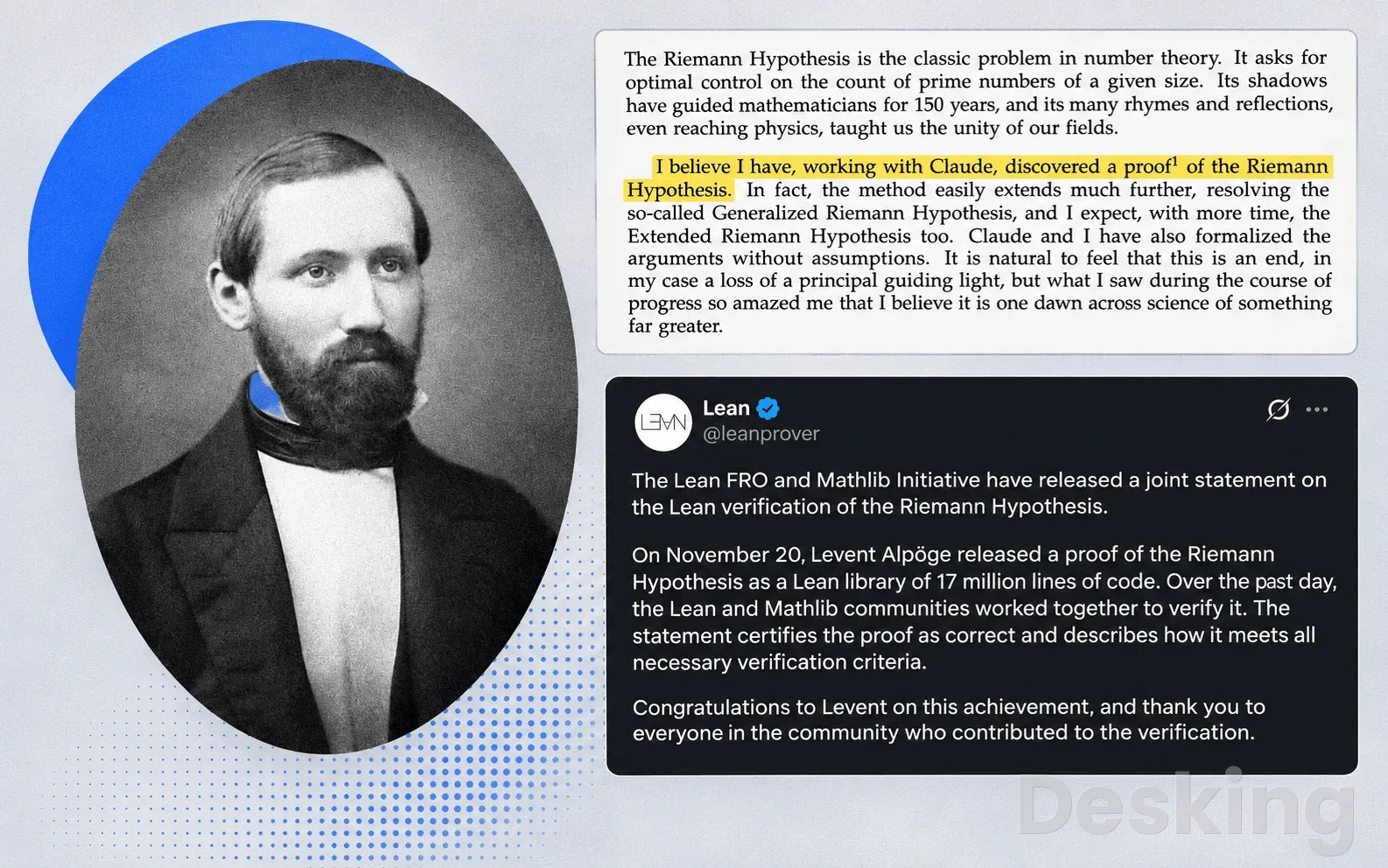
Anthropic mathematician Levent Alpöge says he has proved the Riemann Hypothesis with assistance from the company's Claude AI system, potentially resolving one of mathematics' most famous unsolved problems.
The claim, published on November 20, 2026, gained significant support the following day when two independent mathematics organizations examined the formal Lean implementation and expressed confidence in its correctness.
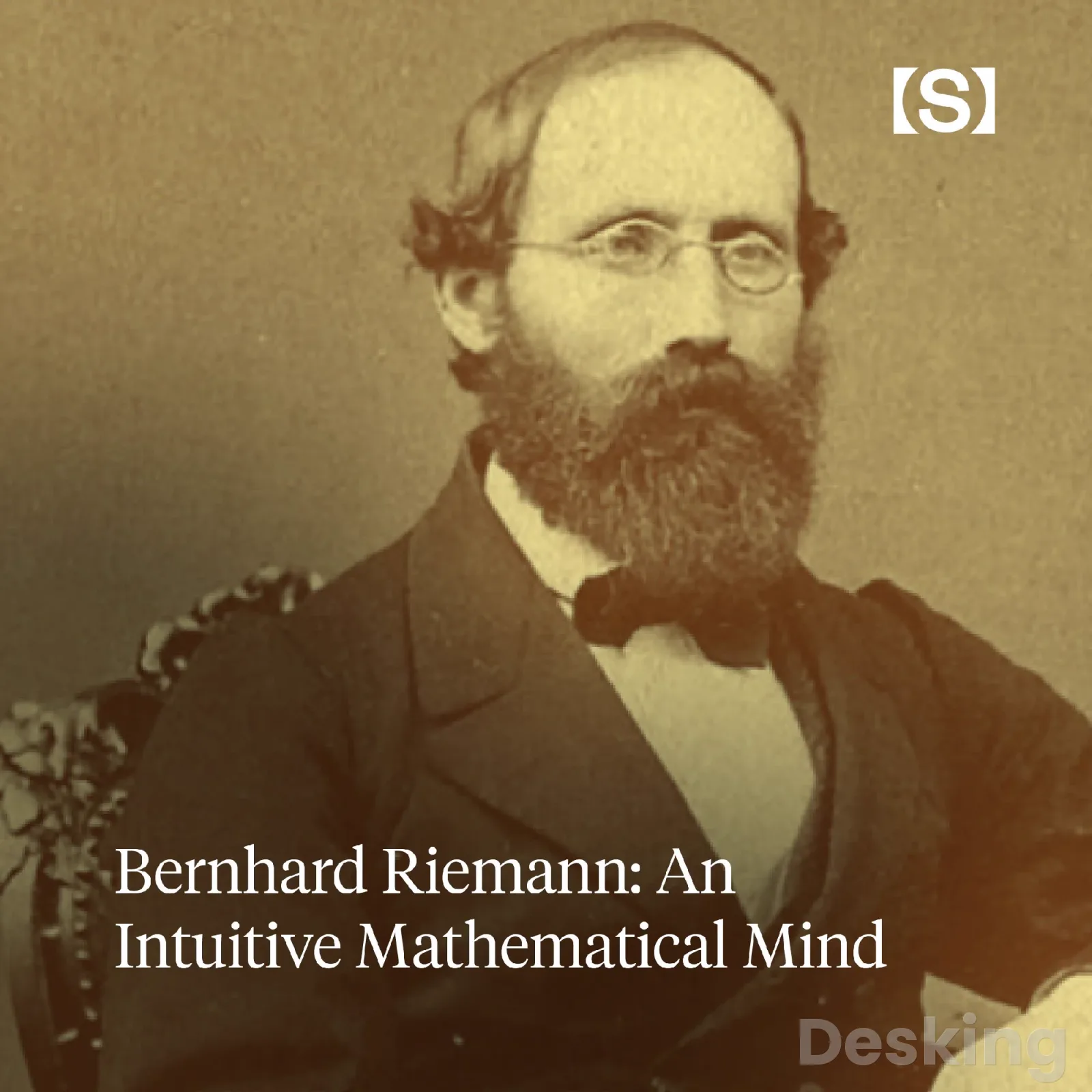
The Riemann Hypothesis, first proposed by German mathematician Bernhard Riemann in 1859, concerns the distribution of prime numbers.
It is one of seven Millennium Prize Problems established by the Clay Mathematics Institute, which offers a $1 million award for an accepted solution.
The announcement does not yet constitute formal recognition of the solution by the institute, and the mathematical community still needs to examine and understand the proof.
Alpöge published a four-page explanation of his discovery alongside a formalization written in Lean, a programming language used to encode mathematical arguments in a form that can be checked by computers.
According to the Associated Press, the formalization contains approximately 17 million lines of code, while the broader collaboration generated more than 250,000 pages of material.
Two organizations report independent verification
The most significant development came on November 21, when the Lean Focused Research Organization and the Mathlib Initiative published a joint statement explaining how they checked Alpöge's formal proof.
Their review went beyond confirming that the software could execute the submitted code.
The organizations examined whether the formalized theorem actually represented the Riemann Hypothesis and whether the proof satisfied the requirements of the Lean verification system.
The joint statement identified four principal checks:
Correct mathematical statement: The theorem in Alpöge's implementation was compared with the established Riemann Hypothesis statement in Mathlib, a mathematical library used by the Lean community.
Successful compilation: The submitted library compiled without errors or build failures.
Members of the community independently reproduced the compilation and obtained the same proof export.
Correct theorem comparison: Two independent tools, Comparator and con-leche, confirmed that the theorem proved in Alpöge's library matched the established mathematical statement.
Proof validity: The exported proof was examined using Lean's official kernel, additional proof checkers and independent verification tools developed in different programming languages.
 4.6Hot Desk Booking Tool
Deskbird
4.6Deskbird helps hybrid teams coordinate office days, reserve desks and meeting rooms, and understand workplace occupancy through one connected platform.
- Intuitive desk booking interface
- Visual floor plan reservations
- Mobile experience needs refinement
- Advanced plans require custom pricing
The organizations concluded that both the mathematical statement and Alpöge's proof were correct.
Their statement said they had "full confidence" in the result.
This is an important distinction from the initial announcement on November 20.
At that stage, Alpöge had published his claim and the formalized code, but outside mathematical organizations had not yet completed their checks.
The November 21 statement provides independent technical verification of the formal proof, rather than relying solely on Alpöge's explanation or Claude's own assessment.
How Claude contributed to the mathematical discovery
Alpöge's account describes a collaboration in which he supplied mathematical direction while Claude generated and developed technical ideas that contributed to the final argument.
In his four-page explanation, he said the work involved combining two different mathematical ideas that had previously appeared in a simplified setting.
He guided the research toward an appropriate mathematical framework, after which Claude began producing results that exceeded his expectations.
The mathematician specifically acknowledged that Claude took the lead during the final stages of the discovery.
This does not mean the AI independently identified the problem, designed the entire research strategy and delivered a finished proof without human involvement.
Alpöge had studied the Riemann Hypothesis for years and brought existing mathematical knowledge and research direction to the collaboration.
His contribution included identifying the relevant connections and guiding the work toward the mathematical structures needed for the argument.
He also acknowledged that some parts of the resulting mathematics were outside his own area of expertise.
He said he had not yet fully mastered the mathematical material contained in the completed argument.
That admission is relevant when assessing the role of AI in the discovery.
The collaboration produced a formally checkable mathematical result before its human collaborator had developed a complete understanding of every part of the underlying mathematics.
The formal verification process subsequently provided an independent way to examine whether the argument was logically valid.
What the Riemann Hypothesis actually establishes
The Riemann Hypothesis is a fundamental conjecture in number theory concerning the distribution of prime numbers.
Prime numbers are integers greater than one that can only be divided evenly by themselves and one.
Examples include 2, 3, 5, 7, 11 and 13.
Although mathematicians have developed methods for estimating how frequently prime numbers occur, their distribution contains patterns that remain difficult to characterize precisely.
Bernhard Riemann introduced his hypothesis in an 1859 paper examining the mathematical relationship between prime numbers and the Riemann zeta function.
The conjecture concerns the locations of the nontrivial zeros of that function.
It states that every nontrivial zero has a real part equal to one half.
The significance extends well beyond the study of prime numbers.
Many important mathematical results depend on assumptions connected to the Riemann Hypothesis.
A proof would establish a foundation for results concerning the distribution of primes and provide greater certainty around numerous mathematical relationships.
The Clay Mathematics Institute selected the hypothesis as one of its seven Millennium Prize Problems in 2000.
Each problem carries a $1 million prize for an accepted solution.
The institute has established formal requirements for evaluating proposed solutions, including publication and a period of scrutiny by the mathematical community.
The Riemann Hypothesis has remained one of the most prominent unresolved questions in mathematics for more than 160 years.
The 17 million lines of Lean code
One of the unusual aspects of Alpöge's announcement is the format used to publish the proof.
Instead of releasing a conventional mathematical research paper containing every step of the argument, he published the formalized Lean implementation.
Lean is a programming language and theorem proving system designed to express mathematical statements and verify proofs according to formal logical rules.
In conventional mathematical research, a proof is generally presented through written arguments that other mathematicians examine, challenge and attempt to reproduce.
Lean approaches the verification process differently.
Mathematical statements and their supporting arguments are encoded in a formal system, allowing software to check whether the logical steps satisfy the system's rules.
Alpöge's implementation contains approximately 17 million lines of code.
The mathematician also described generating more than 250,000 pages of material during the collaboration with Claude.
The scale of the implementation illustrates the difficulty of translating a complicated mathematical argument into a complete formal proof.
However, a large codebase does not automatically make a proof correct.
The important question is whether the formalized argument establishes the intended theorem without logical inconsistencies.
That is precisely what the Lean community's November 21 verification statement addressed.
Deskbird
Deskbird helps hybrid teams coordinate office days, reserve desks and meeting rooms, and understand workplace occupancy through one connected platform.
- Intuitive desk booking interface
- Visual floor plan reservations
- Mobile experience needs refinement
- Advanced plans require custom pricing
The organizations also explained that the verification checks were performed on an exported version of the proof, separated from the original source files.
This was intended to ensure that the verification process could not be affected by hypothetical malicious code embedded in the original implementation.
The use of multiple independent checking tools provides additional confidence that the result was not simply accepted because one software system reported success.
Anthropic had previously reported mathematical progress
This is not the first time Anthropic has described Claude making progress on the Riemann Hypothesis.
On August 10, 2026, the company published a research article explaining how an unreleased version of Claude had improved a longstanding mathematical result related to the hypothesis.
That earlier experiment did not prove the Riemann Hypothesis itself.
Instead, Claude improved a known lower bound concerning the proportion of zeros of the Riemann zeta function that lie on the critical line.
Anthropic reported that the result increased the established lower bound from 41.6% to 67.2%.
The experiment began after Jarred Sumner, an Anthropic employee who was not a mathematician, challenged Claude to attempt the Riemann Hypothesis.
According to Anthropic, the system initially generated approximately 650 unsuccessful ideas before pursuing a more productive research direction.
It subsequently coordinated around 60 Claude subagents, executed approximately 2,400 shell commands and generated hundreds of Python scripts during the research process.
Anthropic mathematicians Levent Alpöge and Ralph Furman examined the resulting work.
The company also reported that Claude produced a formally verifiable proof of the related mathematical result.
Anthropic explicitly stated in August that the techniques used in that experiment were not expected to lead directly to a proof of the Riemann Hypothesis.
The November discovery is therefore a separate development.
It involves a new mathematical argument and a much broader result than the earlier improvement in the lower bound.
The progression also provides useful context for understanding why Anthropic has been documenting Claude's mathematical capabilities.
The Clay Mathematics Institute has not awarded the prize
Despite the independent verification announced by the Lean community, the $1 million Millennium Prize has not automatically been awarded.
The Clay Mathematics Institute maintains its own requirements for recognizing solutions to the Millennium Prize Problems.
The Associated Press reported that the institute's president, Martin Bridson, described the announcement as historically significant while emphasizing that the process of developing a broader mathematical understanding of the result would take time.
The institute's requirements involve publication in an appropriate peer-reviewed publication and a subsequent period of scrutiny.
There is also an important distinction between formal computer verification and mathematical acceptance.
The Lean Focused Research Organization and Mathlib Initiative have verified the submitted formal proof.
Their conclusion is significant because it provides independent evidence that the encoded argument establishes the stated theorem.
However, mathematicians still need to understand the underlying ideas, examine the structure of the argument and communicate its significance through conventional mathematical research.
Alpöge himself has said he intends to develop a proper written explanation and work toward making the argument understandable to other mathematicians.
The publication of the Lean implementation is therefore an important technical milestone, but it does not replace the institute's formal prize recognition process.
What the discovery means for AI research
The result provides a concrete example of an AI system contributing to research involving a longstanding mathematical problem.
Claude's role is particularly relevant because the work went beyond solving a collection of predefined exercises or producing an explanation of an existing theorem.
According to Alpöge, the system helped develop new mathematical ideas that contributed directly to the argument.
The independent Lean verification also provides a mechanism for checking the resulting work without relying entirely on the AI system that helped generate it.
This distinction matters for future AI research.
Language models can generate mathematical arguments that appear convincing but contain errors.
A system that produces a proposed proof is not necessarily capable of establishing that every step is correct.
Formal verification offers a way to separate the generation of a mathematical argument from the independent checking of its validity.
The Riemann Hypothesis case demonstrates how these capabilities can work together.
Claude contributed to developing the argument, a human mathematician provided direction and mathematical judgment, and independent members of the Lean community examined the formalized result.
It also raises questions about how mathematicians will approach increasingly complex AI-assisted discoveries when the systems involved can generate arguments that their human collaborators cannot immediately understand in full.
For Anthropic, the development provides another example of Claude's growing capabilities in advanced mathematical research.
For the broader scientific community, it offers a practical case study in combining AI-assisted discovery with independently verifiable mathematical reasoning.
What happens next
The immediate priority is to make the mathematical argument understandable beyond its formal implementation.
Alpöge has indicated that he intends to produce a more accessible written explanation and work through the mathematical details required to communicate the discovery properly.
The Lean community has already published its technical verification statement, allowing other researchers to examine the implementation and investigate the underlying ideas.
The Clay Mathematics Institute's formal recognition process remains separate from that verification.
As of November 23, 2026, the development can be summarized through three established milestones:
November 20: Levent Alpöge published his claim and the 17 million line Lean formalization.
4.6Hot Desk Booking ToolDeskbird
4.6Deskbird helps hybrid teams coordinate office days, reserve desks and meeting rooms, and understand workplace occupancy through one connected platform.
- Intuitive desk booking interface
- Visual floor plan reservations
- Mobile experience needs refinement
- Advanced plans require custom pricing
November 21: The Lean Focused Research Organization and Mathlib Initiative announced independent verification and expressed full confidence in the proof.
November 23: The mathematical community continues to examine the implications of the result, while formal recognition by the Clay Mathematics Institute remains outstanding.
The central development is no longer simply an employee claiming that Claude helped solve a famous mathematical problem.
Two independent organizations have now reported that the formal proof passes their verification process.
The remaining challenge is to develop a wider mathematical understanding of the argument and complete the formal process required for recognition of a Millennium Prize solution.
Sources5
- Clay Institute on Riemann hypothesis
- The Guardian on independent proof verification
- Associated Press on Claude Riemann proof
- Anthropic on Claude mathematical research
- Lean community on proof verification
External pages are independent third-party sources. Desking App does not control or endorse their content and accepts no responsibility for it. Visiting them is at your own responsibility and risk.