Apple’s First Foldable iPhone Arrives at $1,999 as Limited Supply Delays Buyers
By Noura Mint Ely · October 23, 2026
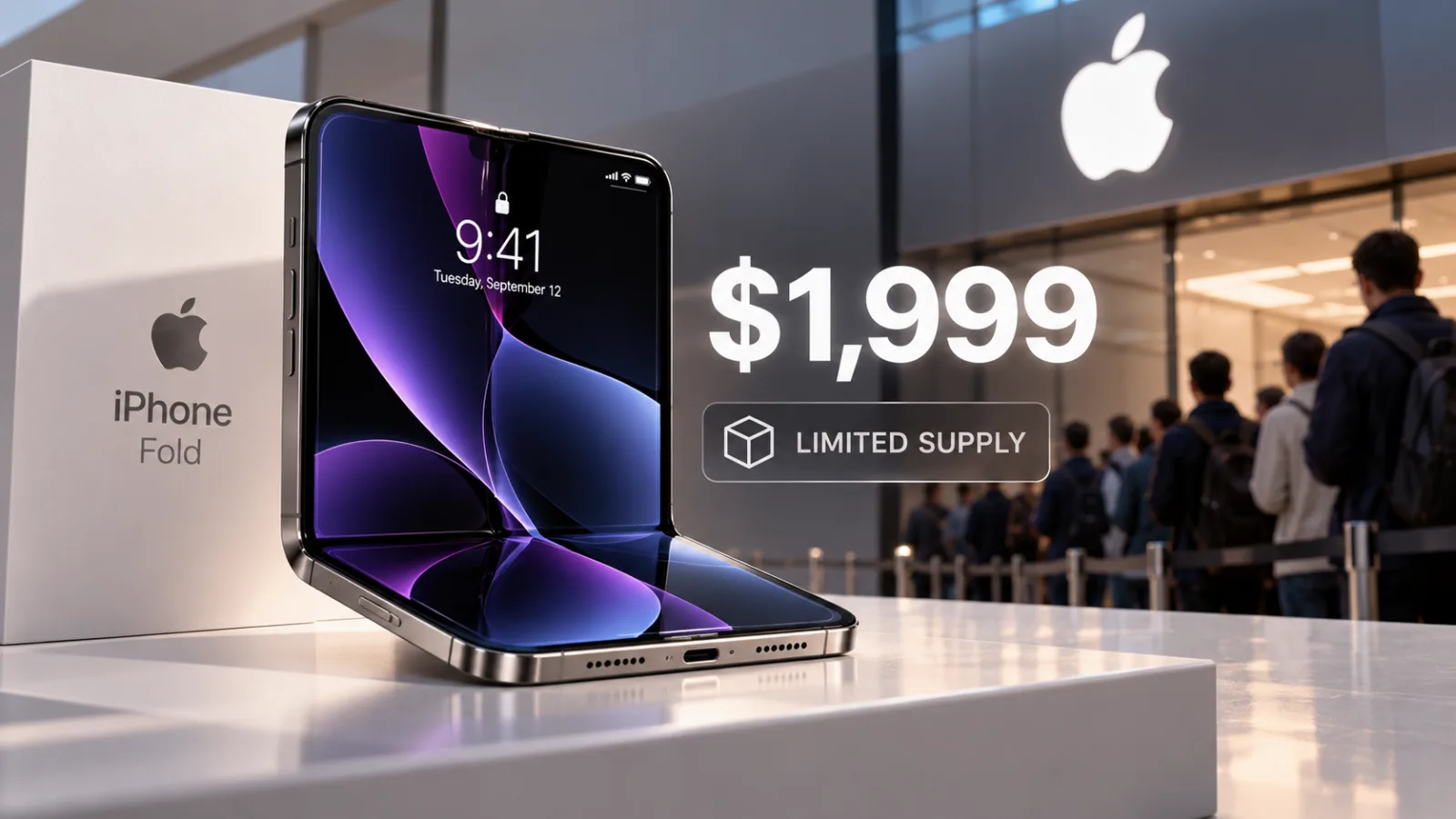
Table of contents
Apple began selling its first foldable smartphone, the iPhone Duo, on Friday, October 23, 2026, with a starting price of $1,999 in the United States.
The launch marks Apple's entry into the premium foldable-phone market, but limited inventory and strong preorders have made the device difficult to obtain, with delivery estimates extending into January 2027 for some customers.
The launch spans more than 70 countries and regions, including the United States, United Kingdom, Australia, China, Japan and several European markets.
Apple plans to expand availability to another 28 countries and regions on October 30.
However, retail stock is limited, and access to walk-in purchases varies by market.
The iPhone Duo is an important test for Apple under CEO John Ternus, who took over leadership of the company in September.
Samsung and Huawei have sold foldable smartphones for years, making Apple's entry a challenge not only in hardware design but also in convincing mainstream customers that a folding phone justifies its premium price.
Why the iPhone Duo Is Difficult to Buy
Apple opened preorders on October 16, one week before the retail launch.
Delivery estimates reportedly moved to late January within minutes as demand exceeded the initial supply available for online orders.
Apple described the response as extraordinary, according to Reuters.

Hostinger VPS
Hostinger VPS delivers KVM virtualization, NVMe storage and full root access at prices that undercut most competing cloud providers.
- Strong price to specification ratio overall
- NVMe storage included on every tier
- Renewal rates climb steeply after promo
- Self managed means security is your job
The company has limited preorders to two devices per customer.
It has also restricted walk-in availability in certain markets, directing buyers in countries including China, France, Hong Kong, India and Japan to order online rather than rely on finding a device in a store.
These restrictions reflect a launch in which supply has not kept pace with initial demand.
They do not, by themselves, establish how many units Apple has sold or how long shortages will continue.
The limited inventory has also created opportunities for resellers.
Reuters reported that some buyers in Hong Kong planned to resell their devices at a premium, illustrating how scarce launch-day stock can create a secondary market before regular retail availability stabilizes.
What Buyers Get for $1,999
The iPhone Duo starts at $1,999 for 256GB of storage, placing it among the most expensive mainstream smartphones on the market.
Apple also offers 512GB, 1TB and 2TB configurations, with the price increasing for higher storage capacities.
The device has two displays.
When folded, its 5.4-inch outer screen is designed for conventional smartphone use.
Opening the phone reveals a 7.6-inch inner display intended for viewing content, gaming and working across applications.
Apple says the design uses a precision hinge and grade 5 titanium construction.
The inner display includes a specialized nano-texture finish intended to reduce glare and make the crease less noticeable.
The device is powered by Apple's A20 Pro chip and uses a dual-battery architecture with a custom-designed vapor chamber for thermal management.
The wider screen is the central selling point.
A foldable phone can provide more room for reading, multitasking and media consumption without requiring users to carry a separate tablet.
However, the benefit depends on how well applications adapt to the larger display and whether users find the device practical when folded.
The price also raises the stakes for Apple.
Hostinger VPS
Hostinger VPS delivers KVM virtualization, NVMe storage and full root access at prices that undercut most competing cloud providers.
- Strong price to specification ratio overall
- NVMe storage included on every tier
- Renewal rates climb steeply after promo
- Self managed means security is your job
Customers paying nearly $2,000 will expect the hinge, display, battery and software experience to justify the premium over a conventional iPhone.
Early Reviews Highlight Both Progress and Compromises
Initial reviews have praised the iPhone Duo's design and its relatively unobtrusive hinge, addressing one of the longstanding concerns surrounding foldable smartphones: the visible crease in the flexible display.
However, reviewers have also identified trade-offs.
Reuters reported concerns about camera limitations, including the absence of a telephoto lens, as well as compatibility issues involving third-party applications that have not been fully adapted to the new screen dimensions.
These limitations matter because Apple is entering a market in which customers already have alternatives from established foldable-phone manufacturers.
A larger screen alone may not persuade users to switch if they have to compromise on camera capabilities, familiar applications or everyday convenience.
Apple's challenge is to demonstrate that its integration of hardware and software provides a more compelling experience than simply offering a phone that folds open.
Can Apple Make Foldable Phones Mainstream?
Apple's entry could broaden the market for foldable smartphones, which have remained a smaller segment of the overall phone industry despite years of development by competitors.
Research firm IDC expects Apple to capture 44% of the foldable-phone market by value and 31% by unit volume in 2026, according to Reuters.
IDC also forecasts that Apple could become the market leader in both value and units shipped by 2027.
These are forecasts, not confirmed sales results.
The distinction between revenue share and unit share is important.
A company can capture a larger portion of market value by selling expensive devices without selling the largest number of phones.
Apple's premium pricing could therefore help it gain a substantial financial position even if foldable phones remain a relatively small part of the broader smartphone market.
The first launch will not settle whether foldable devices become mainstream.
Longer-term adoption will depend on reliability, durability, software support, pricing and whether consumers find the larger display useful enough to justify the additional cost.
What Buyers Should Know Before Ordering
Customers considering the iPhone Duo should check delivery estimates and local store availability before making plans to purchase it on launch day.
Apple has confirmed limited retail inventory, but stock varies by country and individual store.
Buyers should also compare the different storage configurations and consider whether they need the larger capacity.
The starting price covers 256GB, while higher-capacity versions cost more.
Hostinger VPS
Hostinger VPS delivers KVM virtualization, NVMe storage and full root access at prices that undercut most competing cloud providers.
- Strong price to specification ratio overall
- NVMe storage included on every tier
- Renewal rates climb steeply after promo
- Self managed means security is your job
The total cost may also increase with accessories, taxes and local pricing differences.
For people who primarily use their phones for messaging, calls, social media and casual browsing, a conventional iPhone may offer better value.
The Duo is more likely to appeal to early adopters, power users and customers who will regularly benefit from its larger inner display.
As with any new foldable device, buyers should also consider long-term durability, repair costs and the availability of service in their region.
Early enthusiasm does not replace the evidence that comes from months or years of ordinary use.
Sources
- Apple Newsroom — September 9, 2026. Official announcement confirming the iPhone Duo's design, displays, processor, storage options, $1,999 starting price and international availability schedule.
- Reuters — October 23, 2026. Launch-day reporting on global availability, limited supply, preorder delays, early reviews and Apple's competitive position.
- Macworld — October 22, 2026. Background on preorder delivery estimates, retail availability and the launch schedule across markets.
- Investing.com, citing Reuters — October 23, 2026. Additional reporting on limited retail inventory, early reviews and IDC's market-share forecasts.
- MacRumors — September 9, 2026. Earlier reporting on expected pricing, storage configurations and the product's development ahead of Apple's official announcement.