Apple Unveils 14-Inch MacBook Pro With M6, 24-Hour Battery Life and Faster On-Device AI
By Noura Mint Ely · October 27, 2026
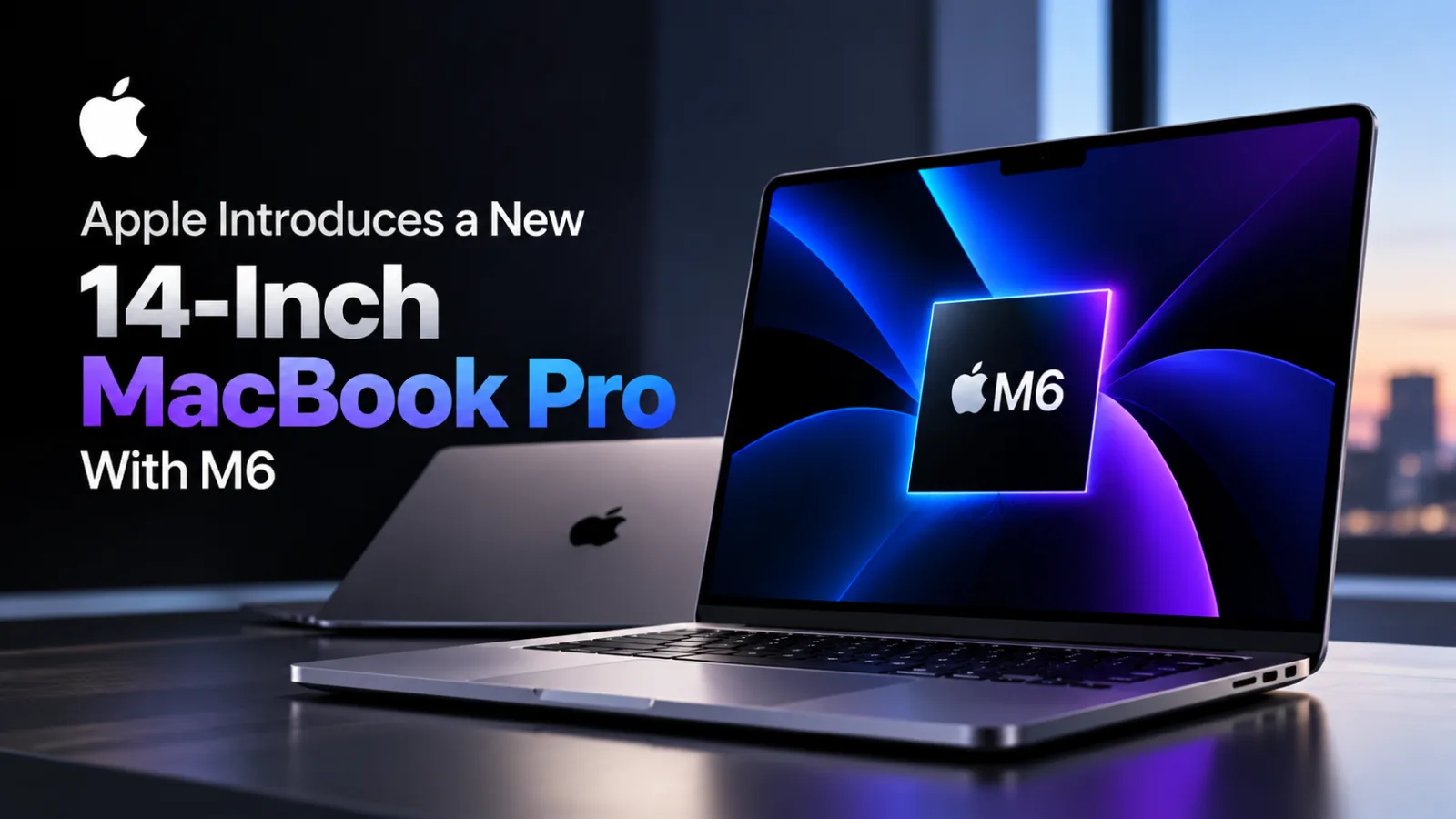
Table of contents
- Display, ports and wireless connectivity
- Battery life and charging
- macOS 27 brings Apple's latest AI features
- How the M6 MacBook Pro compares with the M5 and M1 models
- Apple M6 MacBook Pro price and availability
- Environmental materials and design
- Who should buy the new M6 MacBook Pro?
- Key facts
- Sources
- Frequently Asked Questions
M6 delivers more processing power for professional workloads
The M6 chip is the defining upgrade in the new 14-inch MacBook Pro.
Apple has increased the CPU and GPU core counts to 12 each, added Neural Accelerators to every GPU core, and introduced a dual 16-core Neural Engine.
The GPU is designed to accelerate graphics-intensive work, including 3D rendering, visual effects, image processing, and games.
Neural Accelerators are specialized hardware components that help execute certain machine-learning operations, while the Neural Engine is designed to handle supported AI workloads efficiently.
For developers and AI users, the practical significance is the ability to perform more processing directly on the laptop.
Compatible applications can use the chip to run language models locally, process images, and execute other AI tasks without sending every operation to a remote cloud service.
Local processing can offer privacy and responsiveness advantages, but the benefits depend on the application, model size, memory requirements, and workload.
It does not mean every AI feature runs entirely offline or that cloud computing is no longer necessary.
Apple says the M6 MacBook Pro provides up to 25% faster on-device AI performance than the M5 model and up to 13 times faster AI performance than the 13-inch MacBook Pro with M1.
These figures use different comparison systems and should not be interpreted as a universal speed increase across all applications.
Unified memory and storage options
The new laptop starts with 16GB of unified memory, configurable up to 32GB.
Unified memory is shared by the CPU, GPU, and other components rather than being divided into separate pools of conventional system RAM and dedicated graphics memory.
This architecture can benefit workloads that move large amounts of data between processing components.
However, memory capacity still matters.
Users working with large language models, complex video projects, extensive development environments, or large datasets may benefit from configuring more memory before purchasing.
Apple specifies memory bandwidth of up to 170GB per second.
Memory bandwidth measures how quickly data can move between the chip and memory; it is different from memory capacity and should not be confused with SSD storage speed.
The new model is available with storage configurations up to 4TB.
Buyers should consider both capacity and memory when choosing a configuration, because internal memory is not equivalent to replaceable laptop RAM.
For professionals, the best configuration depends on the work being performed.
General office work, web development, and light creative tasks may not require the maximum specification.
Heavy video editing, large software builds, advanced 3D projects, and local AI experimentation can place greater demands on memory and storage.
Display, ports and wireless connectivity
The 14-inch MacBook Pro retains Apple's Liquid Retina XDR display, which supports peak HDR brightness of up to 1,600 nits.
Apple also offers an optional nano-texture finish designed to reduce reflections and glare in challenging lighting conditions.
The display is relevant to photographers, video editors, designers, and other professionals who need a high-quality screen.
However, the usefulness of the nano-texture option depends on the working environment, and buyers should evaluate the additional cost against their actual needs.
Connectivity includes Wi-Fi 7 and Bluetooth 6.
The laptop also has three Thunderbolt 4 ports, HDMI, MagSafe 3 charging, an SDXC card slot, and a headphone jack.
The inclusion of these ports makes the machine practical for users who regularly connect external displays, storage devices, cameras, audio equipment, and other peripherals.
Apple says the laptop supports up to two external displays.
The 12-megapixel Center Stage camera is designed to keep users framed during video calls.
The system also includes a three-microphone array and a six-speaker sound system with Spatial Audio.
Together, these features position the laptop for hybrid work, content creation, software development, and professional use without requiring a large collection of adapters for common connections.
Battery life and charging
Apple rates the M6 MacBook Pro for up to 24 hours of battery life, describing it as the longest battery life ever offered in a Mac.
Battery life is one of the most important specifications for professionals who work away from a desk.
A longer runtime can reduce dependence on power outlets during travel, meetings, classes, and fieldwork.
The 24-hour figure is a manufacturer estimate rather than a guarantee for every workload.
Actual results depend on screen brightness, wireless activity, applications, background processes, and the amount of processing being performed.
Video editing, gaming, and sustained AI workloads can consume more power than light productivity tasks.
The laptop supports fast charging, with Apple stating that it can reach up to 50% charge in approximately 30 minutes when paired with a compatible higher-wattage USB-C power adapter, such as its 96W adapter.
For buyers, the combination of battery life and performance matters more than either specification alone.
The relevant question is whether the laptop can sustain the intended workload for long enough without requiring frequent charging.
macOS 27 brings Apple's latest AI features
The M6 MacBook Pro ships with macOS 27, which Apple calls Golden Gate.
The operating system introduces additional AI features, including an updated Siri experience and tools integrated into supported applications.
Apple says Siri can use personal context to help users find information across messages, email, photos, and other content.
The company also describes new capabilities involving Spotlight, systemwide menus, and on-screen context.
Apple Intelligence features are intended to make supported tasks easier to perform within the operating system and compatible applications.
Some operations can run on the device, while others may rely on server-side models.
Availability is not universal.
Apple says feature access depends on factors including language, region, device compatibility, and the particular feature.
Some AI capabilities may also be subject to usage limits.
The distinction matters for buyers choosing a computer specifically for AI.
The M6 provides the hardware platform, but the actual experience depends on software support, the availability of individual features, and the computational demands of the task.
Users who primarily need conventional productivity applications may not benefit equally from the new AI capabilities.
Developers, researchers, and creative professionals who regularly use compatible AI tools may have more reason to prioritize the additional processing hardware.
How the M6 MacBook Pro compares with the M5 and M1 models
The strongest upgrade case depends on which Mac a person currently owns.
Upgrading from an M5 MacBook Pro
Apple's comparison with the M5 model indicates up to 30% faster graphics performance and up to 25% faster on-device AI workloads.
Apple also reports that the dual 16-core Neural Engine can deliver up to 1.9 times the performance of the previous comparison configuration.
These are meaningful potential gains for supported workloads, but they do not establish that every application will run 25% or 30% faster.
Users whose current M5 machines already handle their work comfortably may see less practical value from upgrading immediately.
The starting price is another consideration.
Buyers should compare the complete configurations, including memory and storage, rather than basing a decision on chip performance alone.
Upgrading from an M1 MacBook Pro
Apple claims substantially larger gains for customers moving from the M1 generation.
Its published figures include up to 11 times faster graphics performance and up to 13 times faster AI performance compared with the 13-inch MacBook Pro with M1.
The company also reports faster performance for selected tasks such as code compilation, image processing, and ray-traced rendering.
These comparisons make the M6 particularly relevant to owners of older Intel-based Macs or early Apple silicon systems who now need greater performance, longer battery life, or newer connectivity.
Nevertheless, an upgrade should be based on the user's actual workload.
A machine that already meets everyday requirements may not need replacing solely because a newer processor is available.
Apple M6 MacBook Pro price and availability
The 14-inch MacBook Pro with M6 starts at $1,999 in the United States, with an education price of $1,899 for eligible buyers.
Preorders open on October 28, 2026, in 35 countries and regions, including the United States.
Apple says availability at retail locations and delivery to customers begins November 6.
The laptop is offered in Space Black and Silver.
Buyers can configure the system with up to 32GB of unified memory and up to 4TB of storage.
Apple also lists an Apple Upgrade leasing option in the United States starting at $38.99 per month for 36 months, excluding taxes and trade-in credit.
Leasing is subject to eligibility and approval, and the customer does not automatically own the device at the end of the lease.
Education pricing, trade-in offers, financing, and leasing terms are separate from the standard retail price.
Customers should check the applicable terms before making a purchasing decision.
The $1,999 starting price places the new machine in the premium laptop category.
Its value depends on whether users need the performance, display, connectivity, battery life, and software capabilities it provides.
Environmental materials and design
Apple says the new MacBook Pro contains 45% recycled material overall.
The enclosure uses 100% recycled aluminum, while the battery uses 100% recycled cobalt.
Apple also says multiple capacitors use 100% recycled tantalum.
The company reports that 60% of the electricity used in its supply chain for the product comes from renewable sources, such as wind and solar.
These figures form part of Apple's broader environmental commitments.
They describe material sourcing and manufacturing energy rather than establishing the product's complete environmental impact across manufacturing, transport, use, and disposal.
Apple says the laptop is designed to be durable and repairable.
Consumers evaluating long-term value should consider not only the initial purchase price but also the expected service life, repair options, software support, and configuration required for future workloads.
Who should buy the new M6 MacBook Pro?
The new model is most relevant to users who can make practical use of its performance improvements.
Developers may benefit from faster code compilation, demanding local development environments, and compatible AI workflows.
Video editors and designers may value the faster GPU, Liquid Retina XDR display, and connectivity for external equipment.
AI practitioners may benefit from Neural Accelerators and the Neural Engine when running supported workloads locally, although memory capacity and model requirements remain important constraints.
Business professionals and students may value the combination of performance, battery life, display quality, and portability, but should assess whether a MacBook Pro is necessary for their workloads or whether a less expensive computer would suffice.
For existing M5 owners, the decision is more nuanced.
Apple's performance claims indicate improvements, but the practical value depends on whether those improvements affect daily work enough to justify the cost.
For owners of older Intel-based Macs or M1 systems, the combination of newer hardware, longer claimed battery life, Wi-Fi 7, and additional AI capabilities may make the upgrade more compelling.
It depends on the workload.
Users who need more graphics or AI performance may benefit, while those whose current M5 laptop already meets their needs may not see enough practical improvement to justify an immediate upgrade.
Key facts
Announcement: October 27, 2026.
Starting price: $1,999 in the United States.
Processor: Apple M6 with a 12-core CPU and 12-core GPU.
Memory: 16GB unified memory standard, configurable up to 32GB.
Battery life: Up to 24 hours, according to Apple.
Preorders: October 28, 2026.
Availability: November 6, 2026.
Connectivity: Wi-Fi 7, Bluetooth 6, and three Thunderbolt 4 ports.
Sources
- Apple Newsroom — Official M6 MacBook Pro announcement, October 27, 2026. Specifications, Apple's performance claims, battery estimate, macOS features, environmental information, pricing, and availability.
- https://www.apple.com/newsroom/2026/10/apple-introduces-the-new-14-inch-macbook-pro-with-m6/
- MacRumors — M6 14-Inch MacBook Pro: Pre-Orders and Release Date Announced, October 27, 2026. Independent coverage of the preorder schedule, starting price, memory, storage, and colors.
- https://www.macrumors.com/2026/10/27/m6-14-inch-macbook-pro-pre-orders-release-date/
- Reuters — Apple launches M6 MacBook Pro and iMac, pitches faster on-device AI, October 27, 2026. Independent reporting on Apple's product announcement, AI positioning, pricing, and availability.
- https://www.reuters.com/business/retail-consumer/apple-launches-m6-macbook-pro-imac-pitches-faster-on-device-ai-2026-10-27/