Apple Unveils iPad mini With A20 Pro and OLED Display
By Noura Mint Ely · October 26, 2026
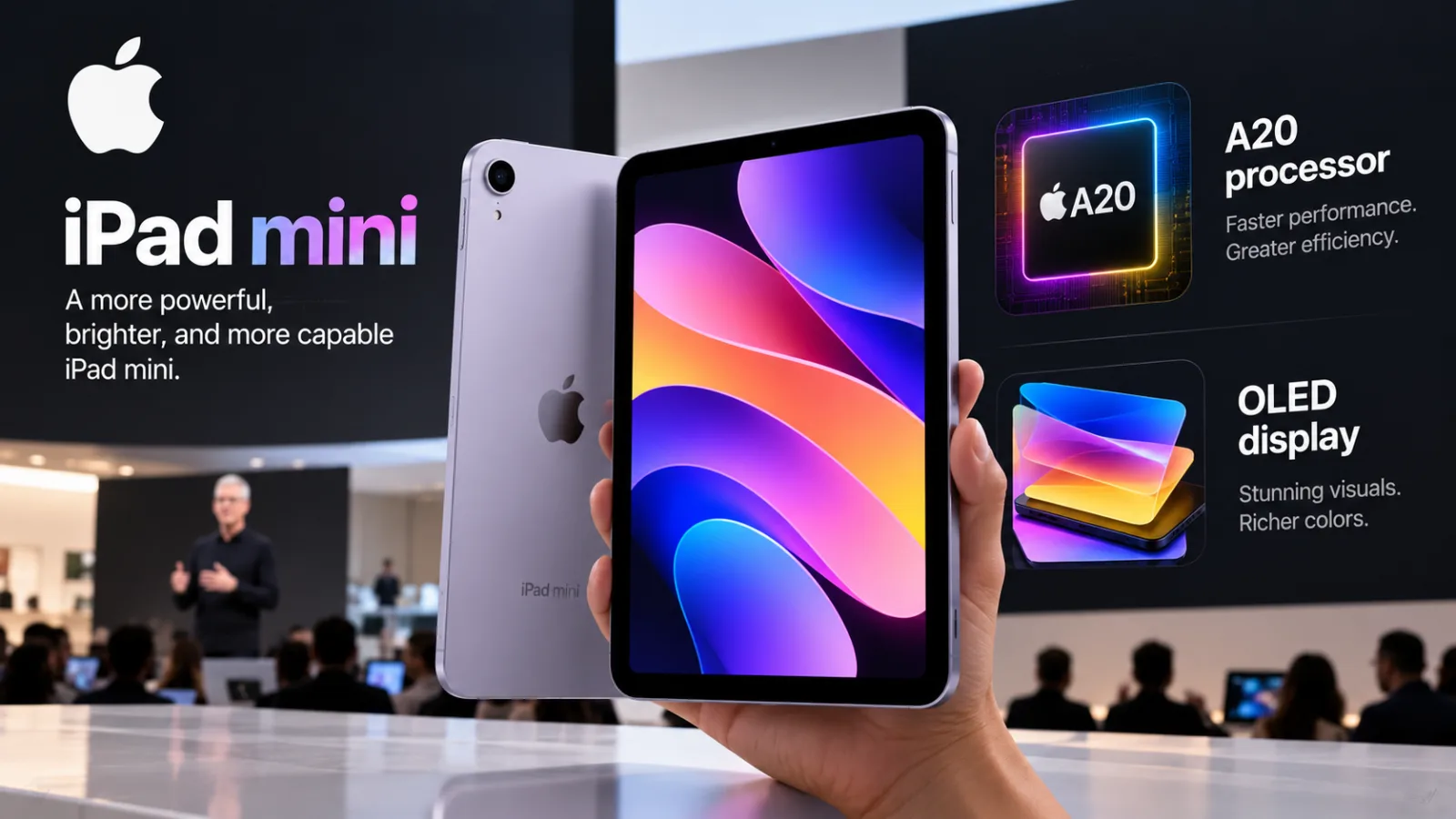
Table of contents
- An 8.5-inch OLED display fits into the same compact design
- A20 Pro brings more processing power and AI capabilities
- A thinner body adds water and dust resistance
- The front camera moves to the landscape edge
- iPad mini price and release date
- What the update means for the iPad mini lineup
- Frequently Asked Questions
Apple has unveiled a major update to the iPad mini, replacing the previous generation's LCD screen with OLED technology and upgrading the processor to the A20 Pro.
Announced on October 26, 2026, the new tablet also introduces a larger display, improved wireless connectivity, a landscape-oriented front camera and resistance to water and dust.
The changes target users who want a compact tablet for work, reading, gaming, creative tasks and AI-powered features without moving to a larger iPad.
An 8.5-inch OLED display fits into the same compact design
The new iPad mini features an 8.5-inch Super Retina XDR OLED display, up from the previous model's 8.3-inch screen.
Apple says it achieved the increase without expanding the tablet's overall footprint by reducing the bezels around the display by 24%.
OLED technology allows individual pixels to control their own light output.
Compared with a conventional LCD panel, this can produce deeper blacks, stronger contrast and more distinct differences between bright and dark areas of an image.
These characteristics can improve the experience of watching video, viewing photographs, reading content and working with visual material.
Apple specifies a resolution of 2,316 by 1,512 pixels at 326 pixels per inch, a contrast ratio of 2,000,000:1 and peak HDR brightness of up to 1,200 nits.
Full-screen brightness for HDR content is rated at up to 600 nits, while the display can dim to as little as one nit for use in darker environments.
The screen also supports the P3 wide color gamut and True Tone.
A nano-texture glass option is available on the 256GB and 512GB configurations.
The surface is designed to reduce glare in bright environments, which may be useful for people working outdoors or under strong lighting.
It is an optional display treatment rather than a standard feature across every model.
There is one important limitation for buyers who prioritize smooth scrolling: the new iPad mini does not include Apple's ProMotion technology.
Its display supports refresh rates of up to 60Hz, according to The Verge's report on Apple's specifications.
The OLED upgrade therefore improves contrast and image quality without bringing the adaptive high-refresh-rate experience available on certain higher-end Apple devices.
A20 Pro brings more processing power and AI capabilities
The tablet is powered by Apple's A20 Pro chip, rather than a standard A20 processor.
Apple says the chip incorporates Neural Accelerators in each GPU core and a Neural Engine designed to support machine-learning workloads.
The processor is intended to handle demanding applications while supporting Apple's expanding on-device AI capabilities.
Apple uses different CPU configurations depending on storage capacity.
The 128GB and 256GB models have a five-core CPU, consisting of two performance-oriented cores and three efficiency cores.
The 512GB model has a six-core CPU, with two performance cores and four efficiency cores.
All configurations have a seven-core GPU, according to Apple's technical specifications.
The chip upgrade is relevant to more than traditional performance.
Apple's latest iPad mini runs iPadOS 27 and supports the next generation of Apple Intelligence features, including a redesigned Siri AI experience.
Apple says the software can use personal context to help users find information, answer questions and understand what is displayed on the screen.
Actual feature availability may depend on language, region, software version and other requirements.
For users, the practical question is how consistently those capabilities improve everyday tasks.
A more powerful processor can provide the hardware foundation for AI features, but the quality of the experience also depends on software design, model capabilities and which functions are available on the device.
A thinner body adds water and dust resistance
Apple has reduced the tablet's thickness to 5.4 millimeters.
The new model is available in midnight and starlight finishes, with storage options of 128GB, 256GB and 512GB.
Despite the larger screen, the device retains the compact dimensions that distinguish the iPad mini from Apple's larger tablets.
Another major change is its IP67 rating for water and dust resistance.
Under the applicable test conditions, this rating means the device can withstand immersion in up to one meter of water for up to 30 minutes.
It does not mean the tablet is waterproof under every condition, and resistance can diminish through normal wear.
Users should still follow Apple's care and handling guidance rather than deliberately exposing the device to water.
Apple has also introduced an Acoustic Display audio system.
Instead of relying solely on conventional speaker openings, the system uses the display assembly as part of its acoustic design.
Apple says this approach produces fuller bass and clearer high frequencies while supporting the device's redesigned enclosure.
The combination of a thinner body, a larger display and improved resistance could make the tablet more practical for people who carry it throughout the day.
Professionals working in the field, healthcare settings or mobile environments may particularly value its portability, although suitability will depend on their specific requirements and workplace policies.
The front camera moves to the landscape edge
The new iPad mini includes a 12-megapixel Center Stage front camera positioned along the landscape edge of the tablet.
This placement is designed to make video calls feel more natural when the device is held horizontally, as the camera is better aligned with the user's position during meetings and video conversations.
The rear camera is also a 12-megapixel unit, with support for recording 4K video at up to 60 frames per second.
The front camera supports 1080p video recording at up to 60 frames per second.
These capabilities provide options for video calls, content creation and capturing footage without requiring a larger tablet.
Wireless connectivity receives an upgrade as well.
Apple's specifications list its N1 wireless networking chip, Wi-Fi 7 and Bluetooth 6.
Cellular models use Apple's C2 modem, according to The Verge.
These technologies can improve connectivity in compatible environments, although real-world speeds depend on network availability, infrastructure and service-provider support.
Apple rates battery life at up to 10 hours of web browsing or video playback over Wi-Fi.
Actual battery life will vary with settings, signal strength, applications and workload.
iPad mini price and release date
The new iPad mini starts at $699 in the United States for the Wi-Fi model with 128GB of storage.
The Wi-Fi + Cellular version starts at $849.
The higher-capacity configurations cost more, and customers choosing the nano-texture display option must select one of the supported storage tiers.
Apple will begin accepting preorders on Wednesday, October 28, 2026.
Availability begins Friday, November 6, when the tablet is scheduled to reach customers and Apple Store locations.
The company has announced midnight and starlight as the available finishes.
The starting price is a substantial increase over the previous generation's $499 U.S. starting price, as reported by The Verge.
Buyers therefore face a different decision than simply choosing between two processor generations: they must determine whether OLED, the A20 Pro chip, improved connectivity and added durability justify the higher entry cost.
The new model is likely to appeal most to people who specifically want a small, highly portable tablet.
Users who mainly browse the web, read documents or stream video may find that an older iPad mini remains sufficient for their needs, depending on its condition and price.
Those who value display quality, newer AI features or the updated design have stronger reasons to consider the new version.
What the update means for the iPad mini lineup
The announcement marks a significant hardware change for Apple's smallest mainstream iPad.
The previous generation, released in 2024, introduced the A17 Pro chip and support for Apple Pencil Pro while retaining an LCD display.
The 2026 model changes several core components at once, including the screen technology, processor, enclosure and connectivity.
The move to OLED brings the iPad mini closer to the display technology already used in Apple's iPad Pro range, although the new mini does not offer every premium display feature.
Its 60Hz refresh rate, for example, distinguishes it from devices that support ProMotion.
The A20 Pro chip and iPadOS 27 also place greater emphasis on AI-enabled tasks.
However, hardware capability alone does not guarantee that every new AI feature will be available in every country or language.
Buyers should check Apple's regional software and feature requirements before making a purchase decision.
For Apple, the announcement strengthens the iPad mini's position as a compact tablet for users who prioritize portability but still want modern display technology and processing power.
Whether the higher price represents good value will depend on how much buyers benefit from the specific upgrades.