Starlink Seems to Be Working Normally Again in Ukraine After More Than a Week of Restrictions
By Noura Mint Ely · October 26, 2026
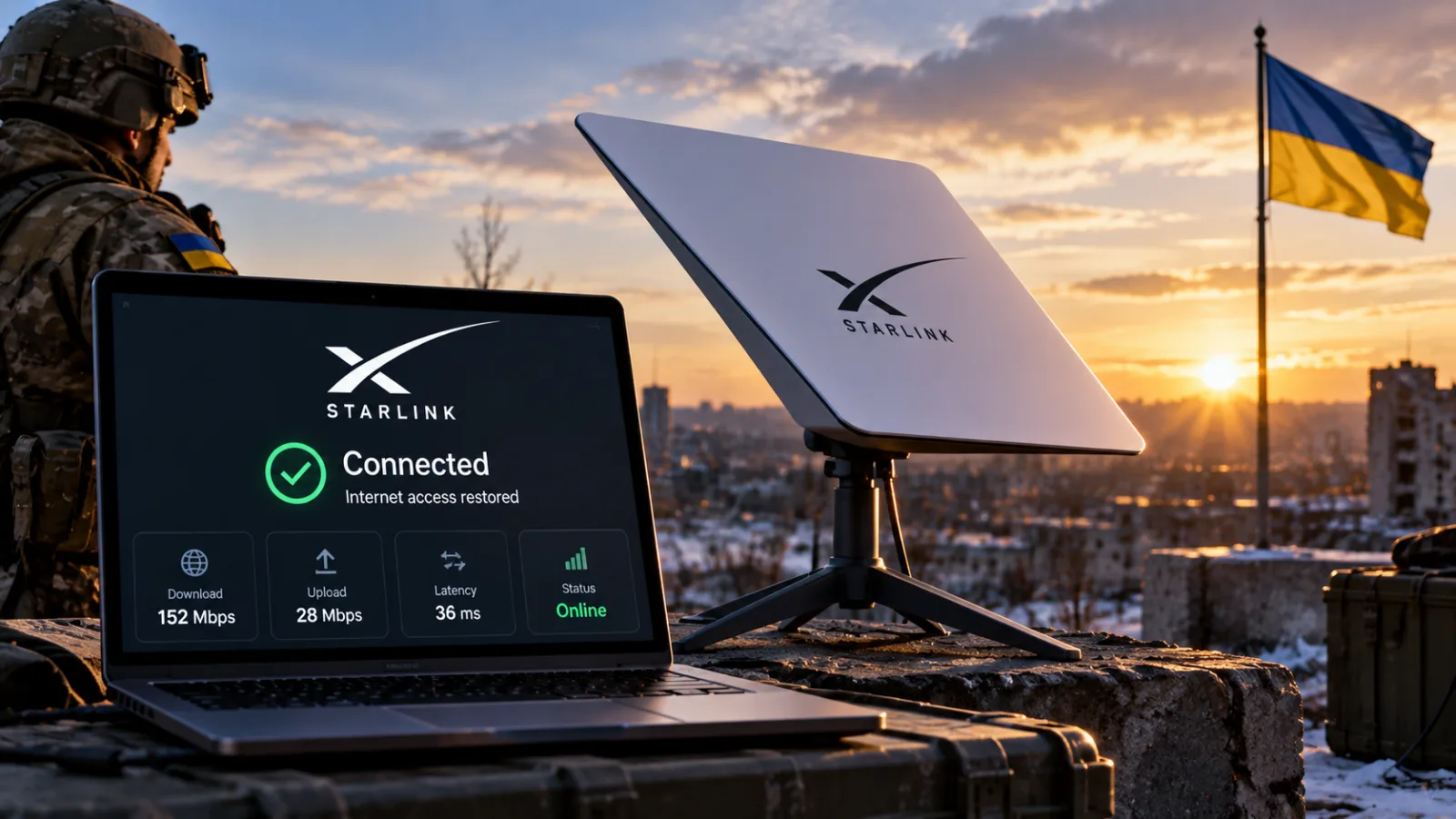
Table of contents
Ukraine says Starlink is working normally again after more than a week of restrictions that disrupted military operations, with the country's Defense Ministry reporting stable satellite connections at speeds exceeding 400 kilometers per hour on October 24.
President Volodymyr Zelenskyy confirmed the restoration of high-speed connectivity for Starlink and Starshield, the military-focused satellite communications system associated with SpaceX.
The Ukrainian government says the restored performance is important for frontline logistics, communications and the operation of drones used to intercept Russian aerial threats.
The restoration follows days of uncertainty after Ukrainian military units experienced connectivity restrictions affecting fast-moving equipment.
Although the services appear to have returned to the speeds needed for these operations, the circumstances surrounding the restrictions remain disputed.
Ukraine Confirms That Satellite Speeds Have Recovered
Ukraine's Ministry of Defence said on October 24 that its monitoring systems had recorded the restoration of Starlink and Starshield operating speeds.
The ministry reported that connections remained stable when equipment was moving faster than 400 km/h.
Zelenskyy said the restoration began overnight and that, by the morning of October 24, connection speeds were sufficient for military use.
He thanked American officials and other international partners for helping address the problem.
The announcement marked a significant change from the preceding days, when Ukrainian officials reported restrictions that interfered with satellite connectivity on fast-moving drones.
However, the restoration announcement should not be interpreted as proof that every terminal, military unit or Starlink-connected device in Ukraine has experienced uninterrupted service.
The public statements focused on restored operating speeds and monitoring results rather than a comprehensive, independently verified assessment of every system in use.
Why Starlink Restrictions Mattered to Ukraine's Military
Starlink is a satellite internet service operated by SpaceX, the aerospace company founded by Elon Musk.
Its network has become an important communications resource in Ukraine, where conventional infrastructure can be damaged or disrupted during Russia's full-scale invasion.
Starshield is a separate, military-focused system designed for government and defense applications.
Although the two systems are related, they are not interchangeable in every respect, and their control arrangements differ.
Musk has said that Starshield is controlled by the U.S. government.
The distinction matters because the recent restrictions affected more than ordinary internet access.
Ukrainian officials reported problems with satellite connections used by fast-moving military equipment, including drones involved in frontline operations.
Satellite communications can allow operators to exchange information with remotely controlled equipment over long distances.
When a connection becomes unreliable or unavailable, operators may lose control of a drone or struggle to maintain the communications needed to complete a mission.
During the disruption, Ukrainian commanders reported interrupted missions and lost drones.
Restrictions on high-speed connectivity also complicated efforts to use interceptor drones against Russian attack drones, including jet-powered versions of the Shahed family.
Restoring reliable communications therefore matters to Ukraine's ability to coordinate operations as well as to its broader battlefield logistics.
What Caused the Starlink Restrictions?
The precise circumstances surrounding the restrictions became a source of disagreement between SpaceX and Ukrainian officials.
On October 25, Musk acknowledged that SpaceX had restricted Starlink access in Ukraine.
He argued that the Ukrainian military had violated the service's terms by using commercial Starlink for offensive drone strikes and said the company had closed that loophole.
Musk also distinguished Starlink from Starshield, saying that the U.S. government controls the military-focused system and determines how it is used.
Ukrainian officials disputed Musk's account.
Serhii Beskrestnov, an adviser on military technology to Zelenskyy, argued that restrictions already imposed on commercial Starlink in Ukraine made it technically unsuitable for the deep and medium-range strikes described by Musk.
According to Beskrestnov, commercial Starlink-connected drones were subject to speed restrictions within Ukraine and could not operate over Russian territory.
Other Ukrainian figures also argued that missions requiring satellite communications relied on Starshield rather than civilian Starlink terminals.
These competing accounts leave important questions unanswered.
Musk publicly acknowledged that SpaceX had imposed restrictions on Starlink, but the available statements do not establish every technical or administrative decision involved in the separate Starshield disruption.
Nor do they independently resolve the competing claims about how Ukrainian forces used the systems.
The distinction is important: an acknowledgment that restrictions were imposed does not, by itself, verify every explanation offered for why they were introduced or how they affected individual military operations.
Did the U.S. Government Order the Restrictions?
The episode also raised questions about the relationship between Washington, SpaceX and Ukraine's access to satellite communications.
Reports before the restoration suggested that diplomatic contacts involving U.S. President Donald Trump and Musk might have played a role in resolving the disruption.
However, public accounts of the discussions differed, and the White House denied that the U.S. government had ordered the restrictions.
The technical and diplomatic issues also unfolded amid broader tensions between Kyiv and Washington over military assistance and efforts to negotiate an end to the war.
On October 25, Reuters reported that Zelenskyy said U.S. warnings about imminent Russian ballistic missile strikes had also been fully restored.
He linked the improvements to discussions with U.S. special envoy Steve Witkoff in Oslo, although that account does not independently establish the precise chain of decisions behind the Starlink and Starshield changes.
The wider context underscores why reliable satellite communications have strategic significance for Ukraine.
Access to these systems depends not only on the technology itself but also on the decisions of the organizations and governments that operate or control it.
What the Restoration Means for Ukraine
The return of high-speed connectivity should help Ukrainian forces resume operations that depend on stable satellite communications while reducing some of the difficulties reported during the restrictions.
The Defense Ministry specifically highlighted the importance of restored speeds for drone operations, frontline logistics and communications.
Zelenskyy also pointed to the role of satellite connectivity in defending against jet-powered Russian drones.
Nevertheless, restored connectivity does not automatically resolve the broader vulnerability exposed by the disruption.
The episode demonstrated that a communications service supplied by a private company can have direct implications for military operations when armed forces depend on it.
For Ukraine, the immediate priority is to maintain reliable connectivity across the systems used by its forces.
The longer-term challenge is ensuring that essential communications remain dependable even when technical restrictions, commercial decisions or geopolitical disagreements threaten access.
As of October 26, Ukrainian authorities have publicly reported restored operating speeds, but the available information does not establish a permanent guarantee against future restrictions or disruptions.