How Many Subscribers Do You Need to Get Paid on YouTube?
By Eva Elekcha · October 31, 2026
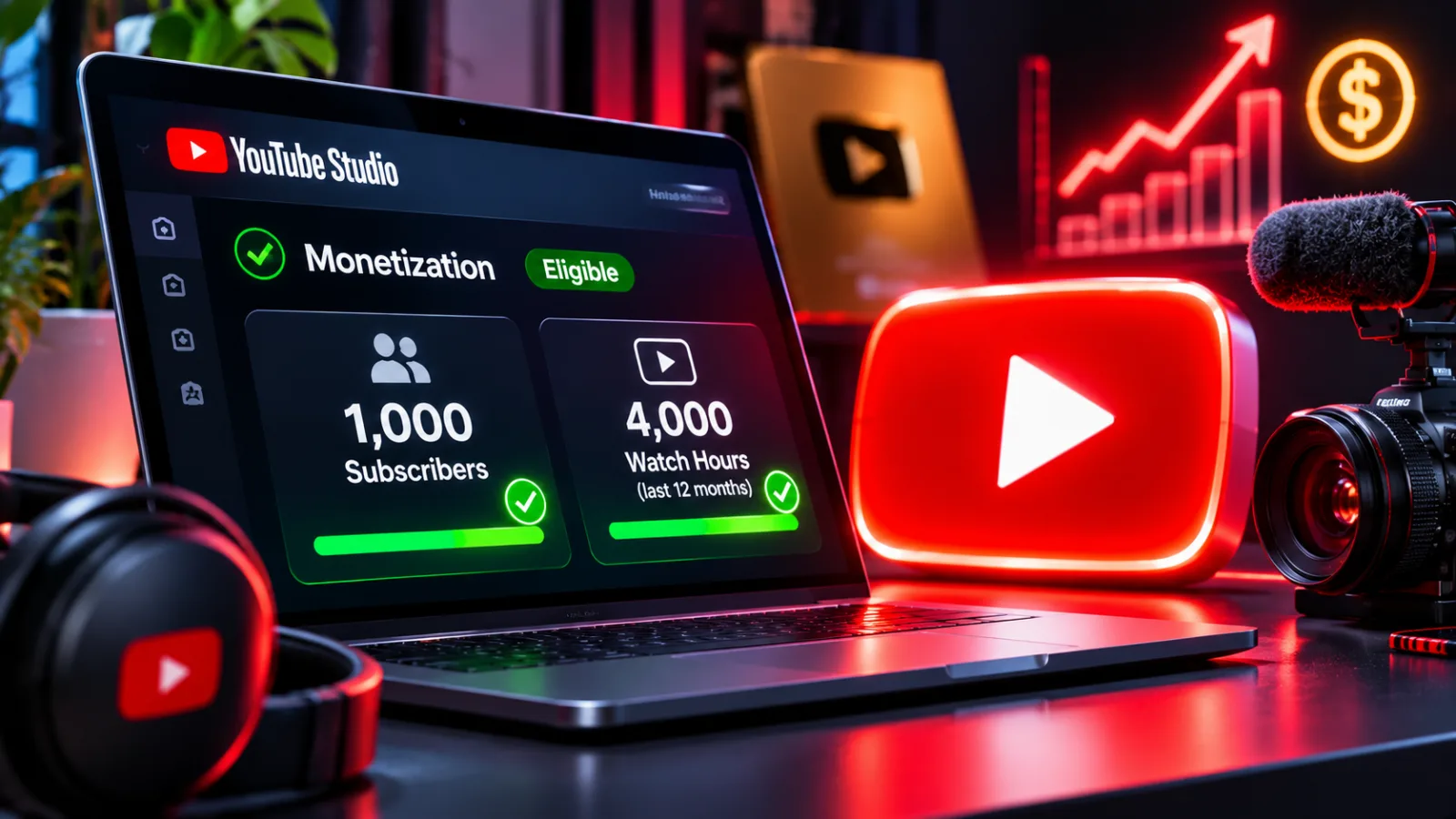
Table of contents
- The two subscriber milestones that determine your options
- What actually counts toward YouTube monetization?
- Why reaching 1,000 subscribers does not guarantee payment
- How to apply when your channel qualifies
- Which path makes more sense: long-form videos or Shorts?
- How much money can you make with 1,000 subscribers?
- The payment process begins after monetization is enabled
- What creators should do before chasing the subscriber milestone
- Important update: YouTube has announced higher advertising thresholds for new applicants in 2027
You need at least 1,000 subscribers to qualify for YouTube's standard advertising revenue program, plus either 4,000 valid public watch hours from long-form videos within 12 months or 10 million qualified public Shorts views within 90 days. However, eligible creators in supported countries can access certain monetization features earlier, starting at 500 subscribers.
Reaching either threshold does not guarantee acceptance: YouTube still reviews each channel for compliance with its monetization policies.
That distinction matters because YouTube has more than one way for creators to earn money.
Some features let eligible channels receive financial support from viewers or promote products before they qualify for advertising revenue.
Others, including revenue sharing from ads shown on regular videos and Shorts, require the higher threshold.
For anyone building a channel, the practical question is not simply how many subscribers are needed.
It is which monetization level the channel can qualify for, what activity counts toward eligibility, and what must happen before YouTube starts paying.
The two subscriber milestones that determine your options
YouTube's Partner Program, commonly called YPP, has two important eligibility levels for creators who want to monetize their channels.
The first is an expanded entry level that begins at 500 subscribers in eligible countries.
The second is the standard threshold for advertising revenue, which requires 1,000 subscribers and an additional watch-time or Shorts-view target.
At 500 subscribers: Earlier access to selected earning features
Eligible creators can apply for the expanded YouTube Partner Program after reaching all of the following requirements:
At least 500 subscribers.
At least three valid public uploads within the previous 90 days.
Either 3,000 valid public watch hours from long-form videos during the previous 12 months or 3 million qualified public Shorts views during the previous 90 days.
This level can unlock eligible features such as channel memberships, Super Chat, Super Stickers, Super Thanks, and certain YouTube Shopping options.
Individual features have their own requirements, and availability depends on the creator's location, channel status, and other eligibility conditions.
The important limitation is that 500 subscribers alone does not qualify a channel for YouTube advertising revenue sharing.
A creator must also meet the applicable activity thresholds, apply, and be accepted into the program.
This earlier entry point can still be valuable.
A channel with an engaged audience may be able to generate support through memberships or other eligible features before it qualifies for advertising revenue.
At 1,000 subscribers: Eligibility for advertising revenue sharing
The standard advertising-revenue threshold requires 1,000 subscribers and one of two performance targets:
Long-form video route: 4,000 valid public watch hours within the previous 12 months.
YouTube Shorts route: 10 million qualified public Shorts views within the previous 90 days.
Creators who meet the relevant requirements can apply for the YouTube Partner Program.
Acceptance is not automatic, and channels must comply with YouTube's monetization policies and other account requirements.
Once accepted and properly enrolled in the relevant monetization features, eligible creators can earn revenue from ads shown on long-form videos and Shorts, as well as qualifying YouTube Premium viewing.
Other earning options may also be available.

Archie
Archie helps employees find desks, coordinate office days and book rooms while giving workplace managers clearer visibility into attendance, space availability…
- Visual maps simplify desk discovery
- Resource based pricing supports shared seating
- Minimum monthly charges affect small offices
- Enterprise pricing requires a custom quotation
The two routes are alternatives, not cumulative requirements.
A creator pursuing the long-form route does not need 10 million Shorts views, while a creator pursuing the Shorts route does not need 4,000 long-form watch hours.
Both routes require the 1,000-subscriber threshold.
What actually counts toward YouTube monetization?
A common source of confusion is the difference between the numbers displayed in YouTube Analytics and the activity YouTube counts for Partner Program eligibility.
Not every view or hour contributes to the required totals.
YouTube distinguishes qualifying public viewing activity from activity that does not meet its criteria.
Watch hours must come from eligible public content
For the 4,000-hour route, eligible watch time must come from public long-form videos.
Certain archived livestreams can count when they meet YouTube's requirements.
Watch time from the following does not count toward the public watch-hour threshold:
Private videos.
Unlisted videos.
Deleted videos.
Views generated through advertising campaigns.
YouTube Shorts watched in the Shorts Feed.
Livestreams that are not archived as eligible video-on-demand content.
This distinction can change a channel's monetization timeline.
A creator might see substantial total watch time in Analytics but have a lower qualifying total in the Earn section of YouTube Studio.
For example, imagine a channel accumulates 4,500 total watch hours across public videos, unlisted uploads, and Shorts.
That headline figure does not establish eligibility.
The creator must check how much of the activity qualifies under YouTube's rules.
The relevant measure is the qualifying watch time used by YouTube to assess Partner Program eligibility, not simply the largest watch-hour number visible in a dashboard.
Shorts views follow a different calculation
Shorts creators can pursue the 10-million-view route, but views must satisfy YouTube's qualification rules.
YouTube's guidance distinguishes qualified public Shorts views from activity involving private, unlisted, or deleted Shorts, views generated through advertising campaigns, and certain other excluded activity.
Its August 2026 explanation also clarifies that qualified Shorts views are based on engaged views, excluding loops.
That means a channel should not assume every view displayed across its content contributes to the Shorts eligibility threshold.
The two monetization routes also use different measurement periods.
Long-form watch hours are measured over the previous 12 months, while Shorts views are measured over the previous 90 days.
Creators therefore need to monitor the appropriate rolling period rather than rely on lifetime totals.
Why reaching 1,000 subscribers does not guarantee payment
Subscriber count is only one part of YouTube's eligibility assessment.
A channel can reach 1,000 subscribers and still be ineligible for advertising revenue sharing if it has not met the applicable watch-time or Shorts-view requirement.
Even after meeting both numerical thresholds, the creator must satisfy additional conditions.
YouTube's published requirements include following the channel monetization policies, operating in a country or region where YPP is available, having no active Community Guidelines strikes, enabling two-step verification, having access to advanced features, and linking an active AdSense for YouTube account or setting one up during the application process.
The channel must also pass YouTube's review.
Reviewers assess the channel as a whole, including whether its content complies with monetization policies.
Reaching the threshold therefore creates an opportunity to apply; it does not guarantee acceptance.
Content originality and policy compliance matter alongside audience growth.
A channel that relies heavily on reused material, repetitive uploads, or content that violates monetization rules may encounter problems during review even if its audience is large.
Creators should read YouTube's current monetization policies before applying, particularly if their videos use third-party footage, music, compilations, or material that has been substantially reused.
How to apply when your channel qualifies
You do not need to submit an application simply because your subscriber count reaches a milestone.
First, check the channel's eligibility status in YouTube Studio.
The process is straightforward:
Sign in to the Google account associated with your YouTube channel.
Open YouTube Studio.
Select Earn from the navigation menu.
Review your subscriber count and the qualifying watch-hour or Shorts-view totals shown there.
If the channel is eligible, select Apply Now.
3.9Hot Desk Booking ToolArchie
3.9Archie helps employees find desks, coordinate office days and book rooms while giving workplace managers clearer visibility into attendance, space availability…
- Visual maps simplify desk discovery
- Resource based pricing supports shared seating
- Minimum monthly charges affect small offices
- Enterprise pricing requires a custom quotation
Review and accept the applicable base terms.
Set up an AdSense for YouTube account or link an existing active account through YouTube Studio.
Wait for YouTube to review the application.
If the channel has not reached the required threshold, the Earn section can help you track progress.
Eligible creators may also be able to request a notification when they qualify.
Once accepted, creators must complete the relevant monetization steps and enable the features they want to use.
Being accepted into YPP does not mean every monetization feature is automatically available or activated.
YouTube can continue reviewing channels after acceptance.
Maintaining compliance is therefore an ongoing responsibility rather than a one-time requirement.
Which path makes more sense: long-form videos or Shorts?
Neither route is universally easier.
The right choice depends on the type of content a creator can consistently produce and the way viewers respond to it.
Long-form videos may suit channels built around tutorials, product reviews, educational material, commentary, gaming, and detailed demonstrations.
Their eligibility route is based on watch time accumulated over 12 months.
For example, a tutorial channel might attract fewer views than a viral Shorts account but generate substantial viewing time when people watch detailed guides from beginning to end.
That can make the long-form route a sensible goal for its publishing strategy.
Shorts may suit creators who can produce concise, compelling videos that reach large audiences.
The trade-off is the scale of the requirement: 10 million qualified public Shorts views within 90 days is a demanding target for a new channel.
A creator publishing Shorts should also understand that Shorts watch time does not count toward the 4,000-hour long-form requirement.
The two measurements cannot simply be combined to reach the watch-hour threshold.
Creators can publish both formats, but they should track each eligibility route separately in YouTube Studio.
A mixed strategy may help a channel reach different audiences, yet success with one format does not automatically satisfy the qualification metric for the other.
How much money can you make with 1,000 subscribers?
There is no fixed payment for having 1,000 subscribers.
YouTube does not pay a standard amount merely because a channel reaches that number.
Advertising income depends on factors such as monetized views, the audience, the content category, advertiser demand, viewer location, and the type of advertising involved.
The amount can vary considerably from one channel to another, even when subscriber counts are similar.
A channel with 1,000 subscribers might receive relatively few views after publishing a video.
Another channel with the same subscriber count might have a video that attracts a much larger audience.
Their advertising earnings could therefore be very different.
It is also important to distinguish subscribers from views and revenue.
Subscribers represent people who have chosen to follow a channel, but they do not guarantee that every new upload will be watched or monetized.
For creators who qualify for the program, YouTube offers more than one potential revenue source.
Depending on eligibility and feature availability, these may include advertising, YouTube Premium revenue, channel memberships, viewer contributions through Supers, and Shopping-related activity.
For a new creator, the most useful early goal is to build an audience that returns regularly and watches content that meets YouTube's policies.
Subscriber growth helps, but the relevant eligibility metrics and the channel's ability to attract genuine viewing activity are equally important.
The payment process begins after monetization is enabled
Qualifying for YPP and receiving a payment are separate steps.
After acceptance, creators must complete the applicable monetization setup, link their AdSense for YouTube account, provide any required payment and tax information, and meet Google's payment requirements.
Earnings must also reach the applicable payment threshold before a payout can be issued.
Payment timing and requirements depend on the account and payment settings.
Creators should check their AdSense for YouTube account rather than assume that reaching 1,000 subscribers triggers an immediate deposit.
This is particularly important for anyone budgeting around creator income.
Monetization eligibility establishes the ability to earn through approved features; it does not guarantee a particular amount of income or a payment on a specific date.
What creators should do before chasing the subscriber milestone
The practical approach is to treat subscriber growth as one part of a broader channel strategy.
First, decide which monetization route fits the content.
A channel that specializes in detailed tutorials may be better positioned to build qualifying long-form watch time, while a creator focused on short entertainment or quick demonstrations may pursue the Shorts-view route.
Next, publish original content consistently enough to learn which topics attract and retain the intended audience.
Consistency does not mean uploading low-quality videos simply to increase the number of posts.
The objective is to produce material viewers genuinely want to watch.
Archie
Archie helps employees find desks, coordinate office days and book rooms while giving workplace managers clearer visibility into attendance, space availability…
- Visual maps simplify desk discovery
- Resource based pricing supports shared seating
- Minimum monthly charges affect small offices
- Enterprise pricing requires a custom quotation
Finally, monitor the Earn section of YouTube Studio.
It is the most direct way to understand the channel's progress toward the applicable eligibility thresholds.
Use the qualifying totals shown there rather than relying exclusively on subscriber milestones, lifetime views, or total watch time.
The key takeaway is simple: 500 subscribers can open the door to selected earning features for eligible creators, while advertising revenue sharing generally requires 1,000 subscribers plus either 4,000 qualifying public watch hours or 10 million qualified public Shorts views. Meeting the numbers is only the beginning; YouTube must still approve the channel, and the creator must complete the necessary monetization setup.
Important update: YouTube has announced higher advertising thresholds for new applicants in 2027
YouTube announced on August 10, 2026, that new creators applying for advertising and YouTube Premium revenue sharing will face higher entry requirements beginning February 1, 2027.
Under the announced changes, new applicants will need 1,000 subscribers plus either 8,000 qualified watch hours over the previous 365 days or 20 million qualified Shorts views over the previous 90 days.
The lower entry requirements for eligible fan-funding and Shopping features will remain unchanged.
This changes the practical advice for readers preparing a new channel.
The familiar 1,000-subscriber, 4,000-watch-hour or 10-million-Shorts-view thresholds remain relevant through January 31, 2027, but creators planning to apply from February 1 onward should prepare for the new requirements.
Existing YPP participants will not be removed simply because they fall below the new entry thresholds.