Tesla and Turo Team Up to Let U.S. Renters Find Cars With Full Self-Driving
By Eva Elekcha · October 27, 2026
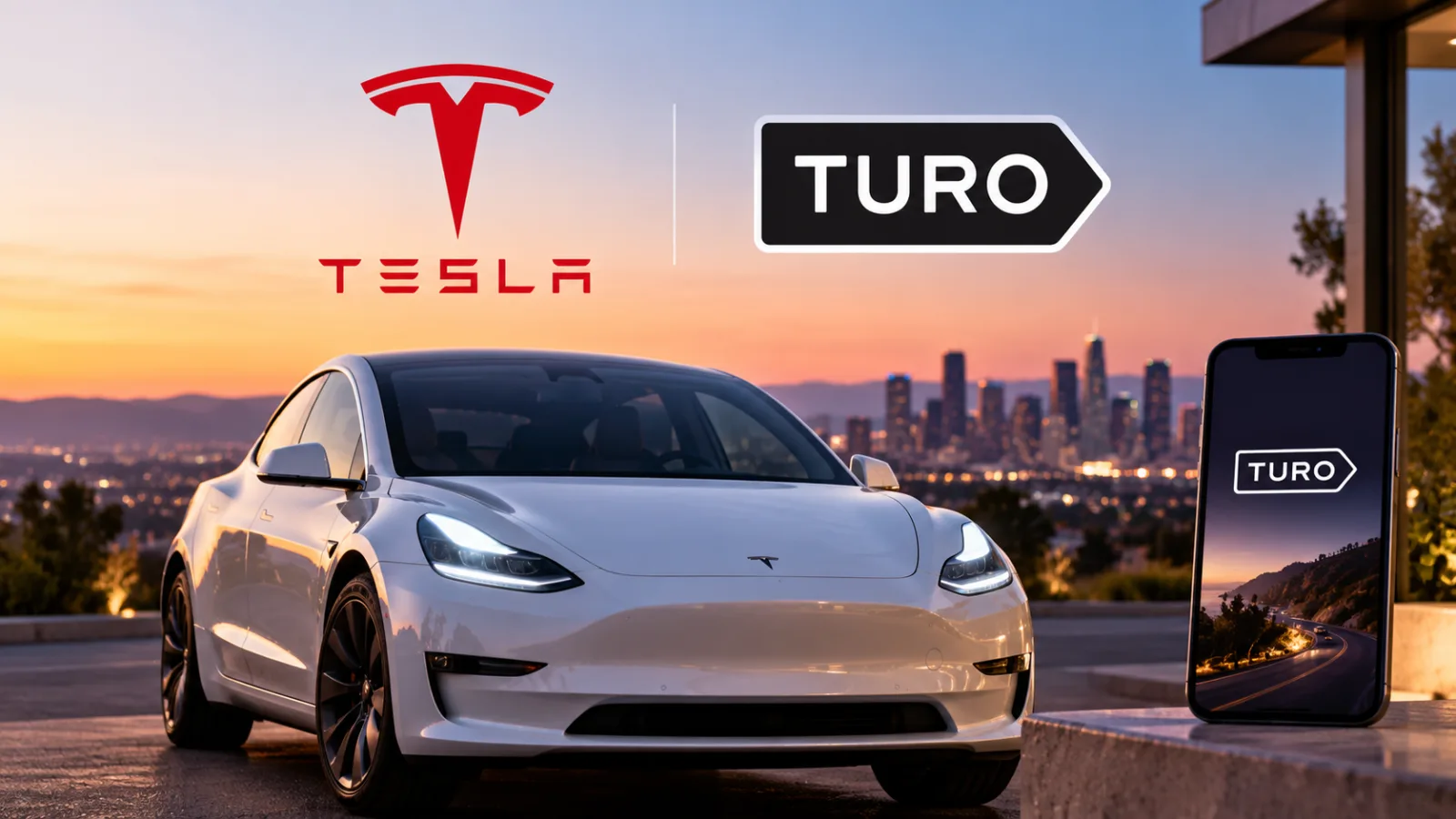
Table of contents
- How the Tesla–Turo Integration Will Work
- Eligible Turo Hosts May Get One Month of FSD for Free
- Why Tesla Is Using Rentals to Promote Its Driver-Assistance Software
- Tesla Model 3 and Model Y Already Have a Strong Presence on Turo
- What Renters Need to Know Before Booking an FSD-Enabled Tesla
- What the Partnership Means for the Rental and EV Markets
- Frequently Asked Questions
Tesla and Turo are expanding access to Tesla’s Full Self-Driving (Supervised) technology through a new rental-marketplace integration launching October 28, 2026. The partnership will let U.S. customers search for Tesla vehicles with the driver-assistance feature active, while eligible Turo hosts may receive a complimentary one-month subscription trial.
Turo says the integration will verify feature status through a direct connection to Tesla’s systems.
The move gives drivers a way to experience Tesla’s software in a rental vehicle before deciding whether to buy a Tesla or pay for an FSD subscription.
It also gives Tesla another channel to put its driver-assistance technology in front of potential customers, while Turo can make participating listings easier to distinguish in its marketplace.
The key safety distinction is that Full Self-Driving (Supervised) is not autonomous driving. Tesla says the feature requires active driver supervision, and drivers must remain attentive and ready to take control at any time.
How the Tesla–Turo Integration Will Work
According to Turo’s announcement on October 26, the new experience is scheduled to launch in the United States on October 28.
Customers will be able to discover eligible Tesla rentals through dedicated merchandising in search results and vehicle listings.
The integration is designed to distinguish vehicles with FSD (Supervised) active from Tesla vehicles that do not currently have the feature enabled.
Turo says hosts can connect their Tesla accounts to their Turo accounts, allowing the platform to verify the vehicle’s FSD status.
If the feature is active and the account is linked, its status will be displayed automatically on eligible listings when the new experience launches.
This changes how renters identify vehicles with the software.
Instead of relying only on a host’s description or a manually added listing detail, the marketplace can use the connected account to confirm whether the feature is active.
Turo says thousands of FSD-enabled Teslas are already available on its platform.
The company has not published a complete breakdown of eligible vehicles by model, location, or host.
Eligible Turo Hosts May Get One Month of FSD for Free
Turo says eligible U.S. hosts may receive a complimentary one-month subscription to FSD (Supervised), beginning November 16, 2026.
The offer is subject to specific eligibility conditions.
To qualify, hosts must meet all the following requirements:
- Own the Tesla being listed; leased vehicles are excluded from the complimentary trial.
- List a Tesla equipped with eligible AI4 hardware.
- Have a Tesla vehicle listed or snoozed on Turo in the United States or Canada.
- Link their Tesla account to Turo.
- Have completed at least one trip as a Turo host.
- Not have an active FSD (Supervised) subscription when the complimentary subscription is provisioned.
- Not have a paid FSD (Supervised) subscription after October 26, 2026.
Turo says hosts who already had a paid subscription as of October 26 are not eligible for the one-month complimentary offer.
Hosts should review the full terms before assuming they qualify.
The offer could make it easier for eligible owners to try the feature on a qualifying vehicle.
It also connects the promotion to Turo’s rental marketplace, where the software’s availability can become part of a vehicle’s appeal to prospective renters.
However, the announcement does not establish how much additional rental income an individual host will earn.
Results will depend on factors such as local demand, vehicle availability, pricing, and the preferences of renters.
Why Tesla Is Using Rentals to Promote Its Driver-Assistance Software
The partnership comes as Tesla seeks to expand adoption of FSD (Supervised), a software package that can perform several driving tasks while requiring the driver to monitor the road.
Tesla describes the system as capable of handling functions such as lane changes, navigation-related maneuvers, and turns under active driver supervision.
The company explicitly states that these capabilities do not make its vehicles fully autonomous.
Allowing customers to rent a vehicle with the feature enabled creates another opportunity to experience the software outside a dealership demonstration or a personally owned Tesla.
That could help potential buyers understand how the system works in everyday driving, although the partnership does not guarantee that renters will become subscribers or vehicle purchasers.
The commercial logic is straightforward: people considering a paid driving feature may want to experience it before committing to a subscription.
Turo’s marketplace gives Tesla access to drivers who may not currently own one of its vehicles.
The partnership also arrives amid broader efforts by Tesla to increase interest in FSD.
TechCrunch reported on October 26 that Tesla had recently shared figures indicating that approximately 1.7 million customers worldwide had paid for the software.
That figure reflects Tesla’s reported customer count, not an independently audited measure of active use or current subscriptions.
For Tesla, rentals provide an additional way to introduce the feature to prospective customers.
For Turo, the integration adds a technology-specific discovery option to a marketplace where renters choose individual vehicles listed by hosts.
Tesla Model 3 and Model Y Already Have a Strong Presence on Turo
The integration builds on the popularity of Tesla vehicles on Turo.
According to the companies’ announcement, the Model 3 and Model Y ranked as the platform’s third- and fourth-most popular vehicle models year to date in 2026.
That existing demand gives Turo a potential audience for the new feature.
Rather than building an entirely new category of rental vehicles, the company can highlight a capability on Tesla listings already present in its marketplace.
The effect on bookings remains uncertain.
Turo has not published results showing how much the new FSD designation will increase rental demand, improve host earnings, or change customer conversion rates.
The integration may nevertheless make the listings more informative.
Renters who specifically want to experience Tesla’s driver-assistance software will have a more direct way to identify vehicles with the feature enabled, while other customers can continue choosing a rental based on price, location, vehicle type, and availability.
What Renters Need to Know Before Booking an FSD-Enabled Tesla
The new listing experience does not remove the driver's responsibility to operate the vehicle safely.
Tesla’s official documentation states that FSD (Supervised) requires a fully attentive driver who is ready to take over whenever necessary.
The system’s capabilities and availability may also depend on the vehicle, software, market, and applicable regulatory approvals.
Renters should understand several points before booking:
The feature is supervised. Drivers must continue paying attention to the road and remain prepared to steer, brake, or otherwise take control.
Availability must be confirmed. A listing’s feature status depends on the vehicle’s eligibility, account connection, and whether FSD is active.
Renters should confirm the details with the host before the trip.
Drivers should review the instructions. Turo encourages guests to consult Tesla’s FSD (Supervised) support materials and safety guidance before pickup.
The platform says renters may also be offered a Tesla-created tutorial.
Local laws still apply. Drivers must follow the applicable traffic laws and any restrictions governing the use of driver-assistance systems in the location where they drive.
A rental does not make the system autonomous. The feature name should not be interpreted as permission to stop supervising the vehicle, turn attention away from driving, or assume the car can handle every situation without intervention.
These distinctions matter because the ability to find and rent an FSD-enabled Tesla is a marketplace feature, not a change to the technology’s safety requirements.
What the Partnership Means for the Rental and EV Markets
The Tesla–Turo integration connects two parts of the automotive market: vehicle access and software-enabled features.
Traditional rental searches usually emphasize vehicle categories, models, pricing, and availability.
Adding a verified driver-assistance feature gives customers another criterion to consider when choosing a car.
For Tesla, the arrangement could broaden exposure to FSD among people who are curious about the software but are not ready to purchase a vehicle or pay for a recurring subscription.
For Turo hosts, it offers a standardized way to identify qualifying vehicles instead of relying on manually written descriptions or custom listing details.
There are limits to what can be concluded from the launch announcement.
Neither company has yet demonstrated the effect of the integration on rental bookings, FSD subscription conversions, or long-term vehicle sales.
The program’s commercial impact will depend on whether customers actively seek out the feature and whether hosts see enough demand to justify any associated costs or operational changes.
The launch also does not mean every Tesla on Turo will offer FSD.
The listing experience depends on vehicle eligibility, an account connection, and an active feature status.
Renters should check the individual listing and confirm availability rather than assuming that all Tesla rentals include the software.
For now, the confirmed change is narrower but meaningful: beginning October 28, Turo plans to make verified FSD (Supervised) status easier for U.S. renters to discover, while offering a qualifying group of hosts a one-month trial beginning November 16.