Why There Was Never a Touchscreen MacBook: Apple's Design Philosophy Explained
By Eva Elekcha · October 22, 2026
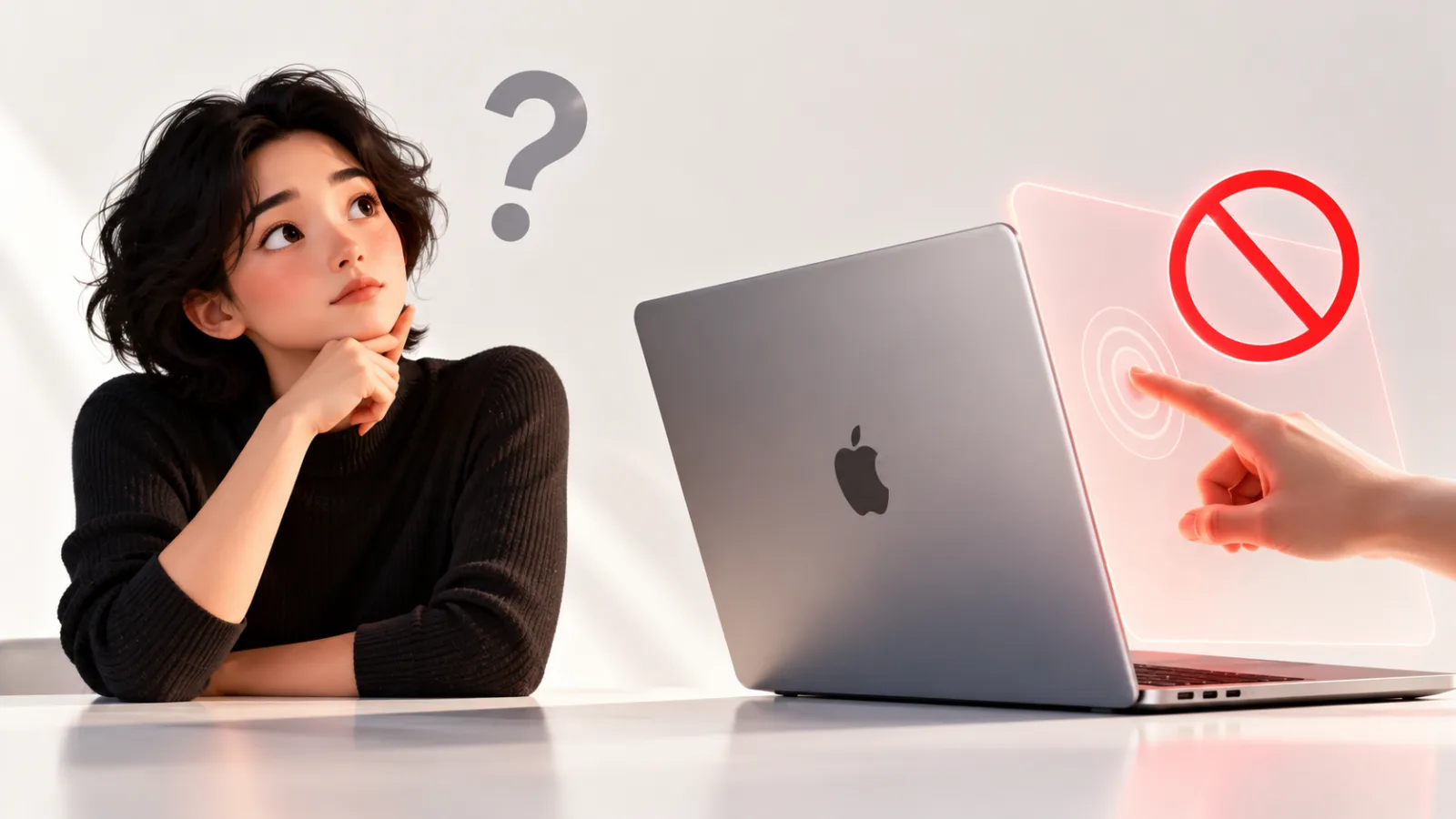
Table of contents
For years, Apple resisted adding a touchscreen to the MacBook, arguing that a traditional laptop works best with a keyboard and trackpad rather than a display users must repeatedly reach toward.
That long-standing philosophy may be approaching a turning point: Bloomberg reported on October 19, 2026, that Apple had announced an October 28 event at which it plans to introduce its first touchscreen MacBook Pro.
The product has not yet been unveiled, so its final specifications, pricing and availability remain unconfirmed.
The potential change is significant because it would mark a departure from a design principle associated with Apple co-founder Steve Jobs.
For more than a decade, the company developed separate interaction models for the Mac and iPad, even as Windows laptop manufacturers increasingly adopted touchscreens and convertible designs.
Steve Jobs Identified an Ergonomic Problem With Touchscreen Laptops
Apple's position dates back at least to October 18, 2010, when Jobs discussed the drawbacks of touch-enabled laptop displays during an earnings call.
His central concern was ergonomics.
A laptop screen typically sits upright, requiring users to lift their arms away from the keyboard and trackpad to touch controls.
Repeating that movement throughout a working day can cause shoulder and arm fatigue, an issue often described as "gorilla arm."
The concern was not that touchscreen technology was impossible.

Justworks
Justworks combines payroll, HR guidance, compliance support and employee benefits, helping US businesses simplify employment administration while giving teams …
- Published pricing for core plans
- Payroll and HR in one
- Payroll plan has base fee
- Benefits premiums increase total costs
It was that a feature could be technically practical yet uncomfortable as the primary input method for a device used for hours at a time.
Phones and tablets offered a different experience.
Users could hold them, tilt them and interact directly with content without keeping their arms extended toward a fixed vertical display.
That distinction helped shape Apple's approach: touch should complement a device's intended use rather than automatically become part of every screen.
Why Apple Kept the MacBook and iPad Different
The MacBook and iPad were designed around different assumptions about how people interact with computers.
The Mac emphasizes keyboard shortcuts, precise pointer control, window management and desktop applications.
These characteristics support demanding workflows such as software development, document production, financial analysis and professional editing.
The iPad emphasizes direct manipulation through finger gestures and Apple Pencil, with keyboards and trackpads available when users need them.
Combining these approaches is possible, but it creates interface challenges.
Desktop menus and small controls may work well with a pointer but be difficult to select accurately with a fingertip.
A touch-friendly interface may need larger targets, contextual controls and adjustments to how menus appear.
Apple's separation allowed each platform to develop around its main input method without requiring every Mac application to behave like an iPad app.
The Touch Bar Showed Apple's Interest in Touch Controls
Apple did experiment with touch-sensitive hardware on the MacBook Pro.
In October 2016, it introduced the Touch Bar, a narrow interactive strip above the keyboard that replaced the traditional function keys on selected models.
The strip could display controls that changed according to the application in use.
It offered an alternative to adding touch functionality across the main display.
However, the Touch Bar divided users.
Justworks
Justworks combines payroll, HR guidance, compliance support and employee benefits, helping US businesses simplify employment administration while giving teams …
- Published pricing for core plans
- Payroll and HR in one
- Payroll plan has base fee
- Benefits premiums increase total costs
Some valued its contextual shortcuts, while others preferred physical keys that could be located by touch without looking away from the screen.
Apple began removing the Touch Bar from higher-end MacBook Pro models in 2021 and discontinued the final Touch Bar-equipped MacBook Pro in 2023.
The experience demonstrated that touch controls alone do not guarantee a better workflow.
Why Apple May Finally Introduce a Touchscreen MacBook
The most important development is that Apple now appears prepared to revisit its earlier position.
Bloomberg has reported that the company is preparing touchscreen MacBook Pro models with OLED displays and an updated macOS interface.
Its October 19 report said the company plans to introduce its first touchscreen MacBook at an October 28 event.
These details remain attributed reporting until Apple officially presents the product. <Cite refs={["turn307867search2","turn307867search6"]}/>
The reported approach would not necessarily turn the MacBook into an iPad with a permanently attached keyboard.
Instead, touch could be added to the familiar Mac experience, allowing users to continue using the trackpad and keyboard while tapping selected controls when convenient.
That distinction would preserve much of the Mac's established workflow while giving users another way to interact with the display.
It would also reflect a broader change in computing.
Modern users increasingly switch between typing, tapping, drawing and gesturing, depending on the task.
Apple's decision may indicate that the benefits of adding touch have become more compelling than the concerns that previously kept it away from the Mac.
What This Means for MacBook Buyers
As of October 22, 2026, consumers should distinguish between the reported upcoming product and the MacBooks currently available.
Apple has not yet publicly confirmed the final specifications, price or shipping date of a touchscreen MacBook Pro.
For buyers who need a computer immediately, the decision should still depend on performance, battery life, software requirements and budget rather than an unannounced feature.
Users who regularly draw, annotate documents or manipulate objects directly on screen may find a touchscreen useful.
Justworks
Justworks combines payroll, HR guidance, compliance support and employee benefits, helping US businesses simplify employment administration while giving teams …
- Published pricing for core plans
- Payroll and HR in one
- Payroll plan has base fee
- Benefits premiums increase total costs
Those who primarily type, code or work with spreadsheets may continue to rely on the keyboard and trackpad for most tasks.
Apple's long resistance to touchscreen MacBooks was rooted in ergonomics and a deliberate separation between its product families, not an inability to build touch hardware.
If the reported October launch proceeds, the change will suggest that Apple believes it can add touch without abandoning the core Mac experience.
The decisive question is no longer simply whether Apple will put a touchscreen on a MacBook.
It is whether the company can make that touchscreen useful enough to justify changing a design philosophy it maintained for more than a decade.