AI Could Speed Up COBOL Modernization, but Replacing Legacy Systems Remains Complex
By Eva Elekcha · October 26, 2026
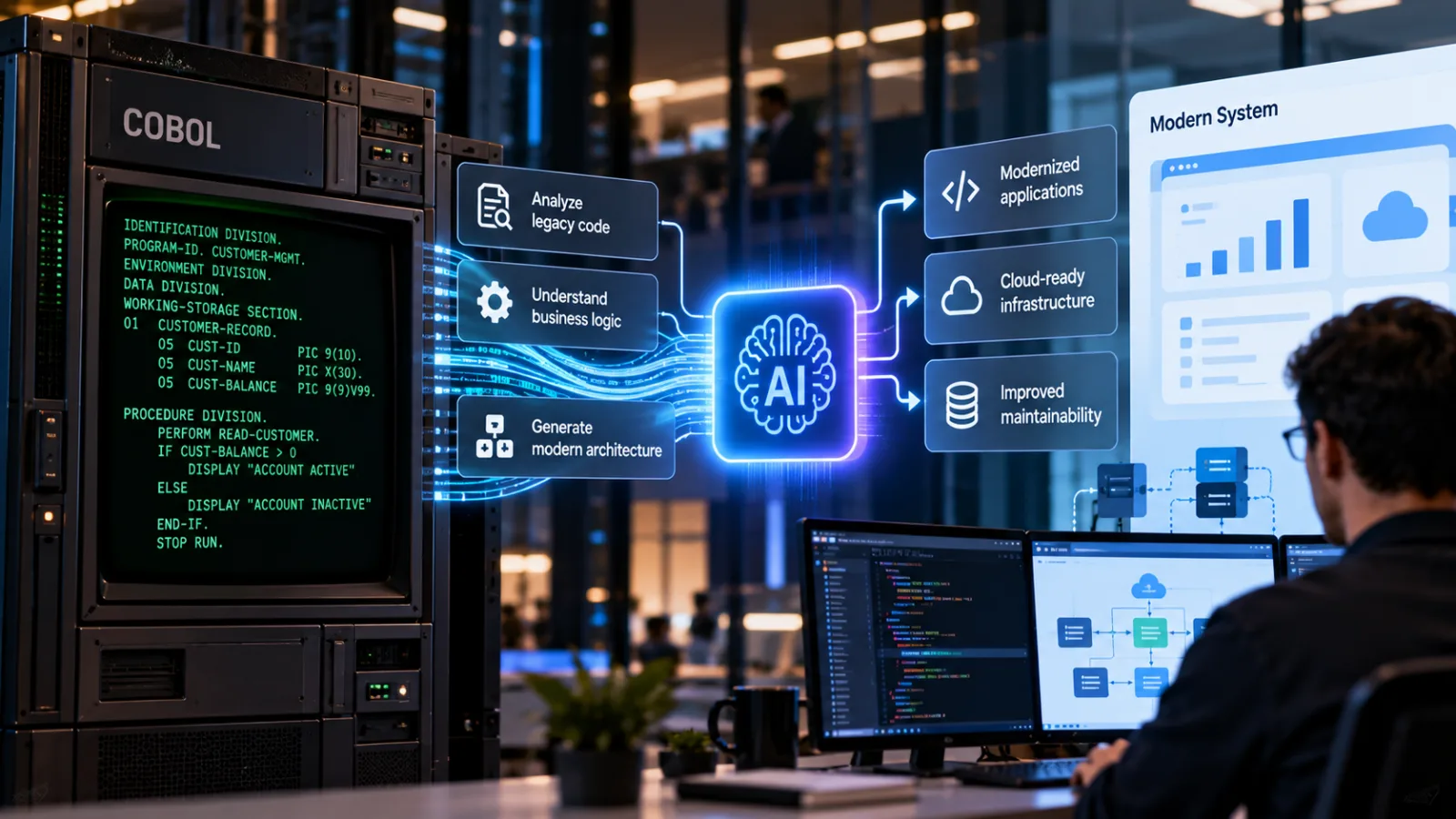
Table of contents
- Why COBOL systems are difficult to modernize
- How AI can change the modernization process
- IBM, Anthropic and AWS are taking different approaches
- Why translating COBOL is not the same as modernizing a system
- How organizations can modernize legacy systems more safely
- What comes next for AI-powered COBOL modernization?
- Frequently Asked Questions
Artificial intelligence could significantly accelerate the modernization of legacy COBOL systems, as technology companies introduce tools designed to help developers understand decades-old code, map application dependencies and migrate business logic into newer software architectures.
The shift gained attention in February 2026, when Anthropic published guidance describing how its Claude Code coding tool could assist with COBOL modernization.
IBM has also developed AI-assisted modernization products for its mainframe systems, while Amazon Web Services offers tools intended to help organizations transform legacy mainframe applications.
The growing range of options could help banks, insurers, government agencies and other organizations address a longstanding challenge: updating critical software without disrupting the services that depend on it.
However, AI-assisted modernization does not mean that complex legacy systems can be safely replaced with a single automated conversion.
Organizations must account for undocumented business rules, data structures, integrations, regulatory obligations and operational requirements that may have accumulated over decades.
Why COBOL systems are difficult to modernize
COBOL, short for Common Business-Oriented Language, is a programming language developed in the late 1950s for business data processing.
It remains in use in established enterprise environments, including systems that process financial transactions, insurance operations and government workloads.
The challenge is not simply that COBOL is old.
Many organizations rely on applications that have been modified repeatedly over many years, often by different development teams.
Documentation may be incomplete, and some essential business rules may be embedded in code rather than recorded in formal specifications.
A seemingly small change can therefore affect other parts of a system in unexpected ways.
A payment-processing application, for example, may depend on shared data definitions, scheduled batch jobs, transaction-processing components and downstream reporting systems.
Modernization teams must understand these relationships before changing the underlying software.
Without that knowledge, translating a program into a newer language can preserve its apparent functionality while introducing subtle errors in calculations, data handling or business processes.
The shortage of developers with deep experience in older enterprise systems can make the work more difficult.
Organizations may need to reconstruct the reasoning behind legacy code while maintaining the existing application and meeting ongoing operational demands.
This combination of technical complexity, limited documentation and specialized expertise has made large-scale modernization expensive and difficult to plan.
How AI can change the modernization process
AI coding assistants can help reduce the amount of manual investigation required before developers begin changing a legacy application.
Anthropic's February 2026 guidance on COBOL modernization describes using Claude Code to examine large codebases, map dependencies, document workflows and identify potential risks.
The company argues that automating parts of this discovery work could help organizations move through modernization projects more quickly.
Several activities are particularly suited to AI assistance.
Code analysis and documentation: AI tools can summarize what individual programs appear to do, identify relationships between components and generate documentation from existing source code.
This can help engineers investigate systems whose original documentation is incomplete.
Dependency mapping: Modernization teams need to understand how programs interact with databases, files, scheduled jobs and external services.
AI-assisted analysis can help identify these connections and highlight areas requiring closer inspection.
Test generation: AI can help create test cases based on existing code, documented requirements and known examples of system behavior.
These tests can support comparisons between the original application and a proposed replacement.
Code translation: AI coding tools can assist with translating COBOL routines into languages such as Java or with restructuring existing COBOL code.
The generated output still needs to be checked for functional correctness, maintainability and compatibility with the target environment.
Technical debt analysis: By examining repeated patterns, tightly coupled components and outdated implementation choices, AI can help teams identify parts of an application that may benefit from refactoring or replacement.
These capabilities are most useful when they reduce the time developers spend understanding existing software.
They do not remove the need for architectural decisions, domain expertise or rigorous validation.
IBM, Anthropic and AWS are taking different approaches
The market for AI-assisted modernization is developing around several distinct strategies.
Organizations do not necessarily need to replace COBOL to benefit from AI, and vendors are targeting different parts of the modernization process.
Anthropic's approach emphasizes using Claude Code to investigate existing applications, understand their logic and support implementation work.
Its February guidance proposes incremental modernization, with developers validating each component before moving on to more complex parts of a system.
IBM is pursuing modernization within its existing mainframe ecosystem.
In July 2026, the company announced IBM COBOL Elevate for z/OS, a product designed to combine performance optimization, compiler upgrades and AI-assisted remediation for organizations running COBOL applications on IBM Z.
IBM said version 1.1 was planned for availability beginning September 18, 2026.
IBM's approach matters because modernization does not always require moving applications to a different programming language or infrastructure.
Some organizations may achieve their objectives by improving performance, updating compilers, restructuring selected components or extending the useful life of existing systems.
Amazon Web Services is also pursuing a broader transformation strategy.
In a May 2026 technical article, AWS described combining AWS Transform for mainframe with an agentic coding tool such as Claude Code to extract business rules from legacy applications and use them as a foundation for designing new cloud-native services.
These approaches address related but different problems: analyzing code, optimizing existing applications, translating programs and redesigning entire systems.
Choosing between them depends on the organization's goals, infrastructure, risk tolerance and technical constraints.
Why translating COBOL is not the same as modernizing a system
A central issue in the debate is the difference between converting source code and reproducing an application's complete behavior in a new environment.
A successful translation may produce code that looks correct and passes basic tests.
That does not automatically mean the replacement system can handle every production scenario, maintain the same performance under heavy workloads or integrate correctly with existing databases and services.
In February 2026, IT Pro reported concerns from IBM executives about treating code translation as equivalent to full platform modernization.
IBM's position was that decades of hardware-software integration, performance tuning and operational experience cannot simply be recreated by moving code to a new language or platform.
That argument highlights a genuine engineering challenge, even as AI tools improve.
Legacy applications often rely on behavior that is not fully documented in the source code.
Timing assumptions, data formats, transaction boundaries, recovery procedures and dependencies on external systems can all affect whether a migration succeeds.
AI-generated code can also contain errors, misunderstand requirements or produce tests that fail to cover important business scenarios.
Human review remains necessary, particularly when a system processes payments, determines insurance claims or supports public services.
The strongest modernization programs therefore treat AI as a way to accelerate investigation and implementation, rather than as a substitute for engineering accountability.
How organizations can modernize legacy systems more safely
Organizations considering AI-assisted COBOL modernization should begin with a clear understanding of the system they intend to change.
The first step is to establish an inventory of applications, dependencies, data stores, batch jobs, interfaces and operational requirements.
Teams need to understand which components are business-critical, which have adequate documentation and which present the greatest migration risks.
Next, they should select a bounded component for an initial assessment.
A well-defined reporting process or relatively isolated business function may provide a more manageable starting point than a central transaction-processing engine.
AI tools can then help document the selected component, identify dependencies, propose changes and generate preliminary tests.
Experienced engineers and business specialists must review the findings, particularly where code embodies rules that are not documented elsewhere.
Before deployment, the original and modernized implementations should be compared against representative inputs and expected outputs.
Testing should include normal operations, edge cases, invalid data, high-volume workloads, failure recovery and relevant security controls.
For high-risk systems, teams may also need formal methods or specialized validation techniques.
Where feasible, organizations can run the old and new implementations in parallel, compare results and introduce the replacement incrementally.
Rollback procedures should be established before production changes begin.
Finally, teams should measure more than the number of lines converted or the speed at which code is generated.
Useful indicators include functional correctness, test coverage, performance, reliability, maintainability, migration cost and the time required to resolve defects.
These controls help determine whether AI is delivering genuine modernization value instead of simply moving technical debt into a new environment.
What comes next for AI-powered COBOL modernization?
The next stage will depend on how well AI-assisted tools perform against real enterprise workloads, not just isolated code samples or demonstrations.
Organizations will need evidence that the tools can handle complex dependencies, preserve business rules and meet operational requirements at a reasonable cost.
They will also need to decide how much of the modernization process can be automated without weakening security, auditability or change control.
Vendor announcements demonstrate growing investment in the field, but they do not establish that every COBOL system can now be modernized quickly or inexpensively.
Results will vary according to application complexity, the quality of existing documentation, the target architecture and the level of testing required.
For organizations that cannot justify a complete rewrite, AI may still offer value by making legacy applications easier to understand, improving documentation, supporting compiler upgrades and helping teams maintain systems while planning longer-term changes.
The most significant shift may therefore be a reduction in the cost of understanding legacy software.
If AI tools can make that work faster and more consistent, organizations may be able to evaluate modernization projects that previously appeared too expensive.
Whether those projects succeed will continue to depend on careful engineering, business knowledge and evidence that the replacement behaves as required.