Anthropic Files for IPO and Plans Nasdaq Listing as ANT
By Halen Girji Alexandro · October 26, 2026
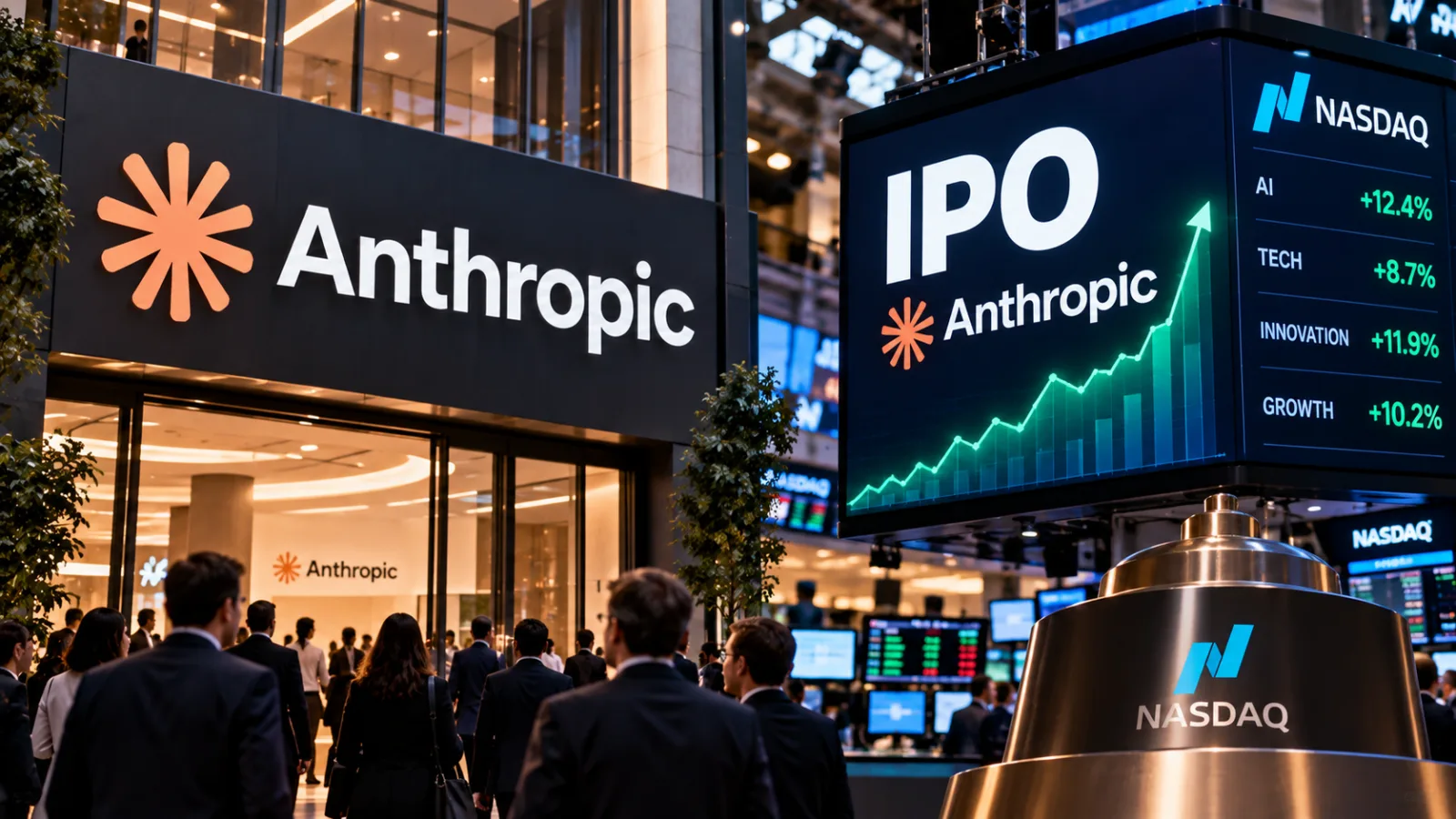
Table of contents
- Anthropic's IPO filing reveals rapid revenue growth
- Enterprise customers are a major part of Anthropic's business
- What the public filing means for the planned listing
- Anthropic's governance structure will matter to public investors
- AI safety risks are part of the investment case
- What happens next?
- Frequently Asked Questions
Anthropic has publicly filed for an initial public offering (IPO), moving the artificial intelligence company behind Claude closer to entering the stock market.
The company submitted its registration statement to the U.S. Securities and Exchange Commission (SEC) on October 26, 2026, and intends to list its Class A common stock on the Nasdaq Global Select Market under the ticker symbol ANT.
The filing is a significant step for Anthropic, which has become one of the leading developers of advanced AI models and enterprise AI services.
However, the company has not yet disclosed the number of shares it plans to offer or the proposed price range.
Its registration statement must also become effective before the securities can be sold.
Anthropic's IPO filing reveals rapid revenue growth
Anthropic reported approximately $16.3 billion in revenue for the first six months of 2026, compared with roughly $1.2 billion during the same period in 2025, according to its registration filing, as reported by TechCrunch.
The figures point to a sharp expansion in demand for the company's AI products and services.
The company's financial results also show why revenue growth alone does not establish whether an AI business is financially sustainable.
Anthropic reported an operating loss of approximately $693 million for the first half of 2026, an improvement from the $2.1 billion operating loss recorded in the corresponding period a year earlier.
Its reported net loss, however, reached approximately $80.7 billion.
TechCrunch reported that noncash accounting adjustments associated with convertible debt were a major factor behind that figure.
These measures represent different aspects of financial performance.
Operating loss reflects the gap between operating revenue and operating expenses, while net loss includes other items, such as certain financing-related accounting adjustments.
A large net loss therefore does not necessarily mean that the company spent an equivalent amount of cash during the period.
Nevertheless, Anthropic still faces the challenge of demonstrating that its growing business can produce sustainable profits.
The company acknowledged in its filing that it may not achieve or maintain profitability.
Enterprise customers are a major part of Anthropic's business
Anthropic's registration statement also provides insight into the scale of its enterprise business.
As of September 30, 2026, the company had more than 11,900 customers generating at least $100,000 in revenue over the preceding 12 months.
Approximately 1,900 customers generated at least $1 million over that period, while around 250 generated at least $10 million, according to TechCrunch's review of the filing.
The figures indicate that Anthropic's business extends beyond individual users interacting with Claude.
Companies are also purchasing its AI capabilities for professional and commercial applications.
Enterprise customers can be particularly important to an AI company's business model because they may purchase access to models through APIs, incorporate AI into internal workflows, or deploy AI tools across teams.
Those arrangements can create recurring demand, although customer concentration, usage patterns, infrastructure costs and contract terms all affect how much revenue translates into profit.
Anthropic's public-market debut will give investors an opportunity to evaluate the company's financial disclosures in greater detail.
It will also put greater scrutiny on the relationship between its revenue growth, computing expenses and long-term financial commitments.
What the public filing means for the planned listing
Anthropic previously announced on June 1, 2026, that it had confidentially submitted a draft Form S-1 registration statement to the SEC.
That submission allowed the company to begin the regulatory review process while retaining the option to pursue a public offering later.
The October 26 announcement confirms that the registration statement has now been filed publicly.
A Form S-1 is a registration document used by companies preparing to offer securities to the public in the United States.
It provides information that prospective investors can use to assess a company's business, financial condition, ownership, governance and risk factors.
Filing the document does not mean the IPO is complete.
The SEC review and registration process must progress before the shares can be sold, and the company must disclose the final offering terms.
Anthropic has named the Nasdaq Global Select Market as its intended listing venue and ANT as its proposed ticker symbol.
It has not yet confirmed the final offering price, the number of shares to be sold or the amount it expects to raise.
Goldman Sachs and Morgan Stanley are identified in reporting on the filing as leading underwriters for the proposed offering.
Underwriters help prepare the transaction, coordinate investor marketing and facilitate the sale of shares.
Anthropic's governance structure will matter to public investors
The IPO also raises questions about how Anthropic intends to preserve its mission while operating as a publicly traded company.
Anthropic is a public benefit corporation, a corporate structure that incorporates a public-benefit purpose alongside business objectives.
Its governance arrangements include a Long-Term Benefit Trust, which has authority to appoint a majority of the company's board, according to TechCrunch's account of the registration filing.
The filing also describes a structure under which Anthropic's seven co-founders will collectively control 50.1% of shareholder voting power through a Founder LLC.
The arrangement is designed to preserve founder influence over the company after the IPO, even as outside investors become shareholders.
This distinction matters because ownership and voting power are not always equivalent.
Public investors may own shares and have an economic interest in Anthropic without exercising voting control proportional to that ownership.
The structure also reflects a central tension in Anthropic's business: the company is seeking access to public capital while maintaining governance arrangements intended to protect its long-term mission, including its approach to AI safety.
For prospective investors, governance will be an important consideration alongside revenue growth, operating costs, competition and the company's ability to develop commercially successful AI systems.
AI safety risks are part of the investment case
Anthropic's public offering comes as the economic and societal implications of increasingly capable AI systems remain under intense debate.
The company has built its identity around developing advanced AI while emphasizing safety research and responsible deployment.
Its governance structure is intended in part to protect that mission, but a public listing could increase pressure to deliver growth, expand infrastructure and meet investor expectations.
That creates a question for shareholders: how will Anthropic balance commercial expansion with its stated safety commitments as competition intensifies?
The answer will depend on the company's governance arrangements, strategic decisions, product development and ability to manage risks associated with its technology.
Investors will also need to evaluate the possibility of regulatory changes, competitive pressure and unexpected costs as AI capabilities advance.
These are not merely abstract questions for a company developing frontier AI models.
They can affect its operating expenses, product availability, reputation and future growth opportunities.
Anthropic's disclosures provide investors with a starting point for evaluating those risks, but the IPO filing does not eliminate the uncertainty surrounding the long-term economics or societal consequences of advanced AI.
What happens next?
The immediate next step is the regulatory process required for the proposed offering to proceed.
Anthropic will need to establish the final terms of the transaction, including the number of shares offered and the price range, before the offering can be completed.
The company has not confirmed a final trading date or disclosed the final amount it intends to raise.
Any estimates of its eventual public-market valuation or total proceeds should therefore be treated as unconfirmed until formal offering terms are announced.
For the wider technology industry, Anthropic's IPO could become an important test of public-market appetite for companies developing advanced AI systems.
Investors will have to assess not only the potential for rapid revenue growth but also the cost of computing infrastructure, the path to profitability, governance arrangements and the risks associated with increasingly capable models.
The listing will also provide a new opportunity to compare the financial disclosures of a major AI developer with the expectations investors have formed around the industry's future.
For now, the central development is clear: Anthropic has taken a formal step toward the public markets, but the price, size and timing of its IPO remain unresolved.