Anthropic’s $83 IPO Price Falls Below Market as AI Investors Reassess Growth
 Published byEva ElekchaGrowth Strategy SpecialistEva ElekchaGrowth Strategy Specialist Verified authorEva Elekcha is a Digital Marketing and Growth Strategy Specialist at Desking, covering the strategies, technologies, and platforms that help businesses strengthen their …Author Profile
Ad disclaimer For links on this page, DESKING APP may earn a commission from the provider. This supports our work and has no influence on our editorial rating.

Table of contents
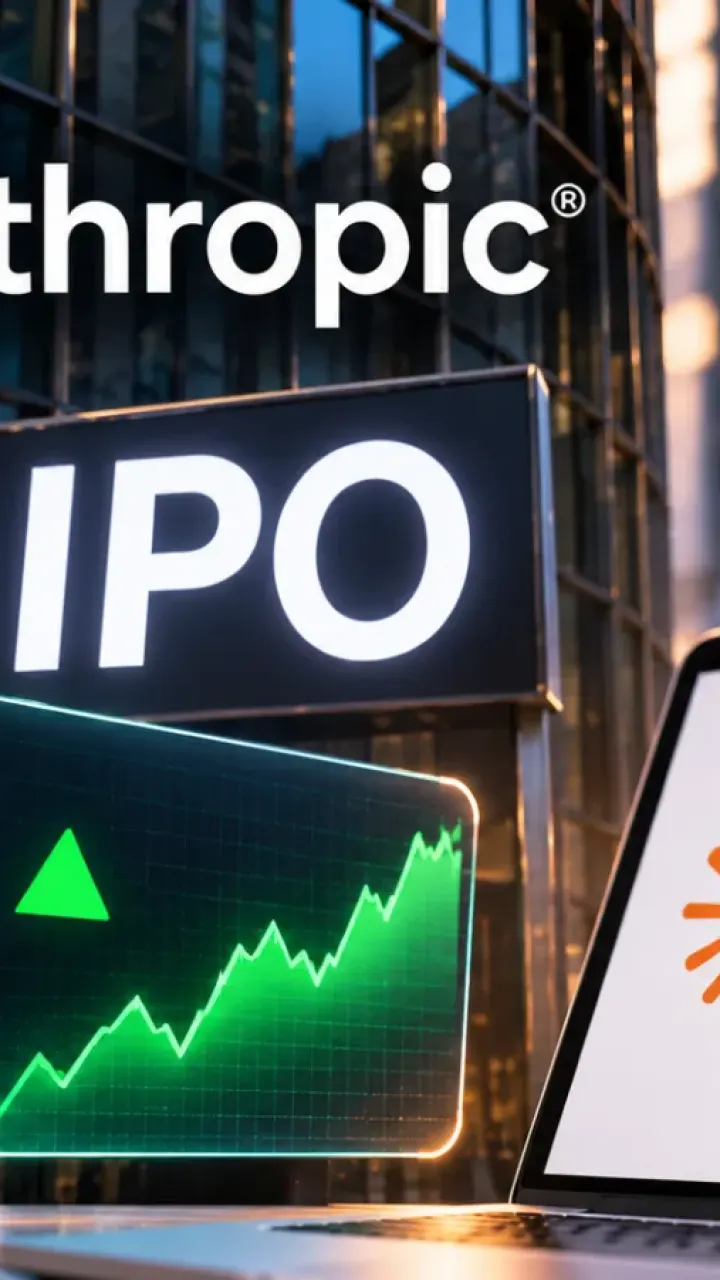
Anthropic’s shares fell below their $83 initial public offering price on Tuesday, November 24, just four trading sessions after the artificial intelligence company made its Nasdaq debut with a record breaking stock sale.
The shares closed at $81.91, down 6.5% for the day, after reaching an intraday low of $75.61.
By early Wednesday, November 25, they had fallen further to $77.41, according to MarketWatch.
The reversal has put the company’s $1.5 trillion fully diluted IPO valuation under immediate scrutiny.
Anthropic priced its shares above the expected range, attracted substantial institutional demand and completed an offering that generated approximately $93.5 billion in gross proceeds.
A separate $26 billion private placement brought the combined gross transaction value to approximately $119.5 billion.
The subsequent decline suggests that investors are willing to finance the AI industry at extraordinary scale, but remain sensitive to the price attached to its expected growth.
Anthropic’s stock trades on the Nasdaq Global Select Market under the symbol ANT.
Its listing on November 19 made it the first major frontier AI model developer to become publicly traded, giving investors a direct way to buy shares in a company whose business is built around developing and selling advanced AI systems.
The $83 price and record offering
Anthropic set its IPO price at $83 on Wednesday, November 18, above the preliminary range of $70 to $78 disclosed in its prospectus.
Reuters reported that the company increased the size of the offering by approximately 19%, to 980 million shares before the underwriters’ additional allocation.
The initial base offering was valued at approximately $81.34 billion.
The underwriters subsequently exercised their full option to purchase another 147 million shares.
Anthropic confirmed on November 20 that the completed public offering comprised 1.127 billion Class A shares, including shares sold by existing stockholders.
Gross proceeds reached approximately $93.5 billion before underwriting discounts, commissions and other expenses.
Anthropic received approximately $91.6 billion of that amount.
It received no proceeds from the shares sold by existing stockholders.
The transaction also included a separate private placement of 313.25 million Class N shares at the same $83 price.
Seven strategic investors participated: Advanced Micro Devices, Broadcom, Google, Micron, Microsoft, NVIDIA and TSMC Partners.
The placement generated approximately $26 billion, taking the combined gross proceeds from the public offering and private placement to approximately $119.5 billion.
Xero
Xero is a cloud accounting platform aimed at small and growing businesses, combining invoicing, bank reconciliation, expense management, financial reporting, a…
- Unlimited users on US plans
- Strong bank reconciliation workflows
- Early plan has strict limits
- Advanced features require higher tiers
The distinction between these figures matters.
The $93.5 billion represents the completed public offering, while the $26 billion came from a separate private transaction.
Reporting the original $81.34 billion base offering as the final public offering total would leave out the underwriters’ fully exercised option.
The scale of the transaction exceeded the previous record set by SpaceX, according to Reuters and The Associated Press.
It also gave the public markets an unusually large first opportunity to assess a major AI model developer through daily share trading.
What investors paid for
The $83 figure does not, by itself, describe Anthropic’s valuation.
The number of shares outstanding and the rights attached to each share determine the value represented by the offer price.
Reuters reported an approximately $1.5 trillion fully diluted valuation at the IPO price, compared with about $1.1 trillion on a non diluted basis.
That difference reflects the additional shares included in the fully diluted calculation, such as stock options and restricted stock units.
It is a significant distinction for investors comparing Anthropic with established technology companies.
A share price can look modest or expensive in isolation, but the total equity value provides the more useful measure of what the market is paying for the business.
The first trading session showed how quickly that valuation could change.
Anthropic shares opened at $111.50 on November 19, approximately 34% above the IPO price, and reached an intraday high of $115.10.
The stock later surrendered much of that initial gain, closing at $97.17, according to The Associated Press.
By Tuesday, November 24, the shares had fallen below their offer price for the first time.
MarketWatch reported a low of $75.61 and a closing price of $81.91.
The decline briefly pushed Anthropic’s market capitalization below $1 trillion, according to Dow Jones Market Data cited by the publication.
The movement is a reminder that an IPO price is the price at which shares are initially offered, not a floor guaranteed by the company or its underwriters.
Once trading begins, investors determine the market price through buying and selling.
Early demand can lift a stock sharply, while subsequent selling can remove those gains within days.
Revenue growth meets infrastructure costs
Anthropic’s prospectus provides a more useful explanation of the valuation debate than the share price alone.
The company reported revenue of $33.2 billion for the nine months ended September 30, 2026, compared with $2.5 billion in the corresponding period of 2025.
That represents an exceptional increase in reported business activity, although the company itself cautioned that recent growth rates may not be sustainable.
The company generated $17 billion in revenue during the third quarter of 2026.
Its operating loss for that quarter was $567 million, compared with an operating loss of approximately $3.1 billion in the same quarter of 2025.
For the first nine months of 2026, the operating loss was $1.26 billion, down from $5.22 billion in the corresponding period a year earlier.
Anthropic also reported adjusted operating income of $2.5 billion for the third quarter and $4.1 billion for the first nine months of 2026.
These are non GAAP measures defined by the company and should be considered alongside its reported operating losses, not as replacements for them.
The revenue figures show that demand for Claude and Anthropic’s enterprise services has expanded rapidly.
They do not establish that the company can sustain the same pace of growth or convert that revenue into long term profits.
The difference between revenue expansion and operating profitability is one of the central questions facing investors.
Infrastructure spending adds another layer.
Anthropic disclosed approximately $900.9 billion in aggregate committed spending through purchase commitments and lease agreements, substantially all related to computing and infrastructure.
The figure includes approximately $451.6 billion expected to be incurred before December 31, 2030, with most of the remainder expected between 2031 and 2045.
Xero
Xero is a cloud accounting platform aimed at small and growing businesses, combining invoicing, bank reconciliation, expense management, financial reporting, a…
- Unlimited users on US plans
- Strong bank reconciliation workflows
- Early plan has strict limits
- Advanced features require higher tiers
The company also estimated that approximately $70.7 billion of those commitments would fall due in the 12 months following September 30, 2026.
These commitments are not equivalent to an immediate cash payment or a single year expense.
They represent long term obligations and planned capacity arrangements that could affect future costs and liquidity.
The prospectus also disclosed that the company had $146.6 billion in liquidity as of September 30, before accounting for the proceeds of the IPO and private placement.
That figure included cash, short term investments and available credit.
The capital raised in November therefore gives Anthropic substantial additional financial resources, while its infrastructure commitments show why continued access to capital and efficient computing remain central to its business.
AI investment faces a public test
Anthropic’s listing provides a new reference point for investors assessing the economics of frontier AI development.
Before the IPO, exposure to companies building advanced models was generally obtained through private investment, venture capital funds or ownership in larger technology companies.
The Nasdaq listing made Anthropic’s Class A shares directly tradable, creating a public market valuation that changes throughout the trading day.
Reuters described the offering as a test of investor appetite for AI companies, particularly as infrastructure costs and competition intensify.
The publication reported that Anthropic’s annualized revenue run rate reached $81 billion as of October 31, 2026, according to its filing.
That measure is based on a recent revenue period and is not the same as recognized annual revenue.
It should not be interpreted as a guarantee of future sales.
The offering also has implications for other private AI companies considering public listings.
OpenAI is among the companies expected to seek access to public markets, and Anthropic’s trading performance gives investors a reference point for how public shareholders may value a large AI business.
A strong first day followed by a rapid decline demonstrates that a successful offering does not guarantee a stable market valuation.
The first week also shows that investors are assessing more than the pace of AI adoption.
They are weighing the cost of building and operating data center capacity, the availability of advanced chips, the ability to maintain model performance and the possibility that competitors will reduce pricing or win enterprise customers.
These factors influence how much revenue a company can retain after paying for the infrastructure needed to deliver its services.
Anthropic’s own prospectus describes competition across model development and enterprise AI services.
It also identifies risks associated with access to computing resources, customer demand, operating expenses and the pace of technological change.
The company’s public market valuation will therefore be exposed to developments across the broader AI supply chain, not simply the popularity of Claude.
Governance adds another investor question
Anthropic’s corporate structure is also relevant to shareholders.
The company is incorporated as a public benefit corporation under Delaware law, meaning its stated purpose includes balancing shareholder financial interests with the interests of stakeholders and its public benefit objectives.
Its prospectus describes a governance structure in which the Long Term Benefit Trust holds Class T shares and generally has authority to elect and remove the directors appointed through that share class.
Those directors are intended to constitute a majority of the board.
Separately, a single Class F share held by an entity established by the founders carries voting rights equal to 50.1% of the total voting power on matters submitted to shareholders generally, including the election of directors other than the Class T directors.
Class N shares issued to strategic investors have no general voting rights, except where required by law.
Their rights are otherwise described as identical to those of Class A shares, subject to differences in voting and conversion.
This structure means that buying publicly traded Class A shares does not provide investors with voting power proportionate to the economic value of their holdings across every corporate decision.
The arrangement reflects Anthropic’s stated effort to preserve its public benefit purpose and its approach to AI safety.
It also creates governance considerations that investors must evaluate alongside financial performance.
The prospectus itself warns that the company’s objectives may sometimes conflict with the short, medium or long term financial interests of shareholders.
What the $83 threshold means now
The fall below $83 does not establish that the IPO was incorrectly priced, nor does it prove that demand for AI has collapsed.
It shows that the market price moved below the level paid by investors in the initial offering.
Xero
Xero is a cloud accounting platform aimed at small and growing businesses, combining invoicing, bank reconciliation, expense management, financial reporting, a…
- Unlimited users on US plans
- Strong bank reconciliation workflows
- Early plan has strict limits
- Advanced features require higher tiers
The decline came during a period of volatility across technology stocks and renewed questions about the cost and profitability of AI infrastructure.
By early Wednesday, November 25, MarketWatch reported Anthropic shares trading at $77.41.
That was an intraday figure, not a confirmed closing price.
The distinction matters because the stock was still trading during the US market session when that report was published.
The more important test will come through Anthropic’s financial reporting as a public company.
Investors will be able to compare recognized revenue, operating costs, capital requirements and cash generation across successive reporting periods.
They will also have to assess whether the company can sustain its customer growth while meeting its infrastructure commitments and maintaining its position against competing AI providers.
Anthropic has raised an extraordinary amount of capital and entered public markets with a valuation that places it among the largest companies in the world.
Its first week of trading has already shown that investors will not necessarily support that valuation at every price.
The $83 IPO price is now a reference point for a more demanding question: how much of the expected future value of AI can Anthropic turn into durable financial results?