China Blocks SoftBank’s $5.4 Billion ABB Robotics Deal as Carve-Out Talks Begin
By Eva Elekcha · November 9, 2026
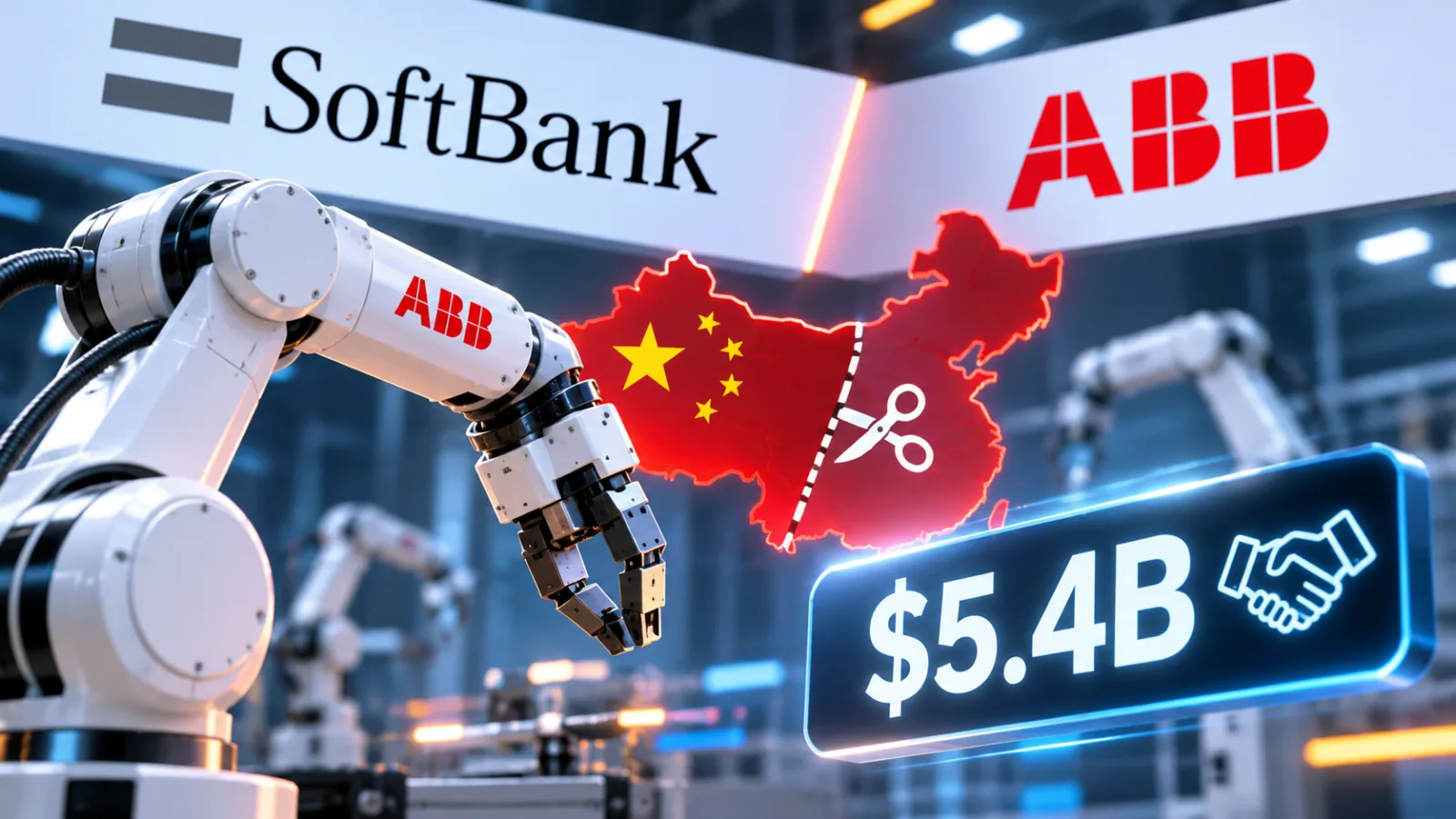
SoftBank’s planned acquisition of ABB’s robotics division has encountered a regulatory obstacle in China, prompting discussions about separating the Chinese operations from the rest of the business.
The potential restructuring could preserve the $5.375 billion transaction by allowing SoftBank to acquire ABB Robotics outside China while the Chinese operation remains under a different ownership arrangement.
The discussions were reported by Bloomberg and Reuters on November 7, 2026.
They followed confirmation from SoftBank that Chinese authorities had prohibited the acquisition of ABB’s robotics business in the country.
The distinction is important: China has officially blocked the acquisition of the Chinese robotics business, but the entire global transaction has not been formally cancelled. A carve-out is reportedly being considered as a possible solution, although neither company has announced a definitive agreement.
China’s regulatory decision disrupted the original acquisition structure
SoftBank agreed to acquire ABB’s robotics division on October 8, 2025, for approximately $5.375 billion.
The transaction was designed to transfer the entire division to the Japanese technology group, subject to regulatory approvals and customary closing conditions.
That arrangement changed after Chinese authorities intervened.
In an official update published on November 6, 2026, SoftBank said it had received notification on November 4 from China's Office of the Working Mechanism for Foreign Investment Security Review prohibiting the acquisition of ABB's robotics business in China.
SoftBank confirmed that discussions with ABB were continuing.
However, its statement did not announce a revised transaction structure or provide a detailed explanation of the Chinese authorities' reasoning.
The reported carve-out would address the restriction by separating the Chinese operations into an independent entity with a different ownership arrangement.
This could allow the remaining robotics business to be acquired by SoftBank without transferring ownership of the Chinese operation.
Reuters reported the proposal based on Bloomberg's coverage.
It has not been confirmed as an agreed solution by either company.

Archie
Archie helps employees find desks, coordinate office days and book rooms while giving workplace managers clearer visibility into attendance, space availability…
- Visual maps simplify desk discovery
- Resource based pricing supports shared seating
- Minimum monthly charges affect small offices
- Enterprise pricing requires a custom quotation
Why China represents a substantial part of ABB Robotics
China is a major market for ABB's robotics business, not simply a regional sales territory that can be excluded without operational consequences.
According to Reuters reporting, China accounts for approximately 30% of ABB's robotics business.
ABB also maintains a substantial presence across the country, with manufacturing, engineering, sales, and customer-support operations.
Reuters has reported that ABB's broader Chinese presence includes approximately 15,000 employees, operations in nearly 130 cities, and sales channels across hundreds of locations.
These figures describe ABB's wider business in China and should not be interpreted as the headcount or footprint of the robotics division alone.
ABB Robotics supplies industrial automation equipment and services used in manufacturing.
Its portfolio includes industrial robots, autonomous mobile robots, application solutions, software, engineering services, spare parts, and digital services.
These technologies support factory operations such as assembly, welding, painting, material handling, picking, packing, and palletizing.
The scale of the Chinese operation makes the proposed separation commercially complicated.
The companies would need to establish which facilities, employees, technologies, customer relationships, and commercial agreements belong to each resulting business.
A separation would also need to address how the Chinese entity could continue operating without creating unnecessary disruption for customers that depend on ABB's robotics products and services.
SoftBank’s physical AI strategy is part of the acquisition’s rationale
SoftBank's interest in ABB Robotics is closely connected to its ambition to expand its presence in artificial intelligence beyond conventional software and digital services.
The concept of physical AI involves applying artificial intelligence to machines and systems that interact with the physical world.
Robotics is an important part of this field because intelligent machines can perceive their surroundings, process information, and perform physical tasks.
Industrial robots already perform repetitive and highly structured operations in manufacturing environments.
Combining robotics with more advanced AI capabilities could expand the range of tasks machines can perform and improve their ability to adapt to changing conditions.
ABB Robotics would give SoftBank an established industrial automation business, an international customer base, and a portfolio of technologies developed for real manufacturing environments.
That strategic value helps explain why SoftBank may prefer to preserve the wider acquisition rather than abandon it because of the Chinese restriction.
However, excluding China could materially change the business SoftBank ultimately acquires.
The Chinese market represents a significant portion of ABB Robotics' operations, and the relationship between the separated entities could influence the commercial value of the remaining business.
A carve-out would require more than changing company ownership
Separating ABB Robotics' Chinese operations would involve several practical and technical decisions.
Industrial automation businesses depend on interconnected production, engineering, software, and support systems, meaning that a corporate separation must also address how those systems will continue to operate.
Intellectual property and software: The companies would need to determine which technologies, software platforms, patents, and engineering resources belong to the Chinese entity and which remain with the business acquired by SoftBank.
Licensing agreements may be necessary if either operation needs continued access to technology owned by the other.
Manufacturing and suppliers: ABB's robotics operations depend on production facilities and component supply chains.
A separation could require agreements governing manufacturing responsibilities, procurement, equipment, and the movement of components between markets.
Archie
Archie helps employees find desks, coordinate office days and book rooms while giving workplace managers clearer visibility into attendance, space availability…
- Visual maps simplify desk discovery
- Resource based pricing supports shared seating
- Minimum monthly charges affect small offices
- Enterprise pricing requires a custom quotation
Customer contracts and technical support: Industrial customers often depend on long-term maintenance arrangements, spare parts, warranties, and software support.
The companies would need to clarify which entity remains responsible for existing agreements and future service obligations.
Employees and engineering operations: The allocation of employees, management teams, research functions, and technical expertise would also need to be addressed.
Neither company has disclosed how personnel would be distributed under the reported proposal.
Data and operational access: Connected industrial equipment can generate operational information and rely on software platforms for monitoring and management.
A divided corporate structure would need clear arrangements governing data access, storage, processing, and cross-border transfers.
These are issues that any viable separation would need to resolve.
They are not confirmed provisions of an agreement between SoftBank and ABB.
ABB had previously considered a separate listing for its robotics division
The current discussions also revive an earlier question about how ABB intended to separate its robotics business from the wider group.
Before agreeing to sell the division to SoftBank, ABB had announced plans to spin off its robotics business as a separately listed company.
That approach would have allowed the division to operate as an independent publicly traded business.
The SoftBank acquisition replaced that proposed listing with a direct sale.
The Chinese regulatory restriction has now created another possible separation scenario, but it is different from ABB's original plan.
The reported carve-out would specifically address the Chinese operations within the robotics division, potentially leaving the rest of the business available for acquisition.
ABB has not announced that it will revive the original public listing plan.
The acquisition price could change if China is excluded
The original $5.375 billion transaction value applied to the acquisition of ABB's robotics division under the agreement announced in October 2025.
If the Chinese operations are excluded or transferred into a separately owned entity, the companies may need to reconsider the financial terms.
The value of the remaining business would depend on the assets included, its commercial footprint, and the agreements governing its relationship with the Chinese operation.
No revised purchase price has been announced.
Reuters reporting has also discussed alternative possibilities for ABB, including selling the robotics division to another buyer or returning to the earlier spin-off plan.
Reports have mentioned a potential valuation of approximately $2 billion to $3 billion in connection with alternative sale scenarios.
That figure is not a confirmed offer, an agreed valuation, or a revised price for SoftBank's transaction.
Any new arrangement would need to establish what SoftBank is acquiring, what remains outside the deal, and whether the companies require additional commercial agreements to maintain the robotics business's operations.
What happens if SoftBank and ABB cannot reach an agreement?
A China carve-out could offer a route to completing the wider acquisition, but it is not the only possible outcome.
If the companies cannot agree on a workable separation, ABB may have to consider other ways to divest the robotics division.
These could include finding another buyer or reconsidering the previously announced public listing plan.
For SoftBank, the decision involves more than whether it can acquire the remaining business.
Archie
Archie helps employees find desks, coordinate office days and book rooms while giving workplace managers clearer visibility into attendance, space availability…
- Visual maps simplify desk discovery
- Resource based pricing supports shared seating
- Minimum monthly charges affect small offices
- Enterprise pricing requires a custom quotation
It must also determine whether the revised transaction still delivers the industrial capabilities and strategic advantages that justified the original purchase.
For ABB, the challenge is completing the divestment without undermining the value or operational continuity of a major robotics business.
As of November 9, 2026, SoftBank has confirmed the Chinese regulatory prohibition and said discussions with ABB are continuing.
The carve-out remains a reported possibility, with no confirmed ownership structure, revised price, or new closing date.
The next stage depends on whether the companies can design a separation that satisfies the regulatory restriction while preserving the technology, manufacturing capabilities, and customer relationships needed to keep both operations functioning.
- China's prohibition is confirmed by SoftBank's official November 6 statement.
- The proposed China carve-out is based on media reporting. It has not been confirmed as a final agreement by SoftBank or ABB.
- The reported 30% figure refers to China's share of ABB's robotics business. Broader employee and operational figures for ABB in China do not represent the robotics division alone.
- The reported $2 billion to $3 billion valuation associated with alternative sale scenarios is not an agreed price or confirmed offer.
- The detailed regulatory rationale, ownership arrangements, employee allocation, intellectual-property agreements, revised transaction value, and closing date remain undisclosed.
- Information reflects reporting available as of November 9, 2026.