UK Councils and Public Bodies Face Growing Burden From AI-Written Complaints
By Evander Thorne · November 9, 2026
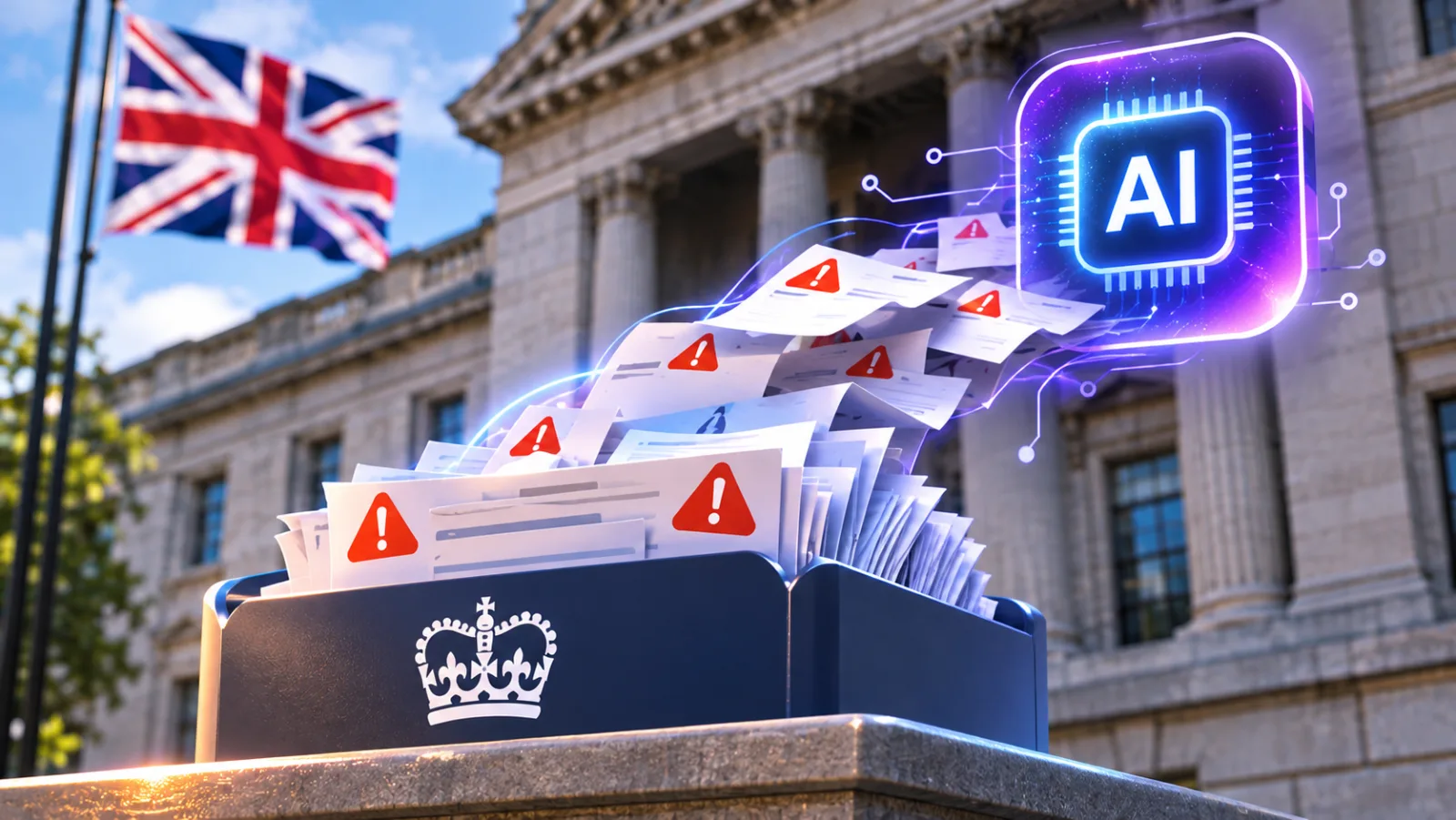
Table of contents
- When a two-page complaint becomes a much larger administrative task
- The pressure is reaching councils, schools and MPs' offices
- The figures show a broader administrative problem
- Why AI-written complaints can be harder to investigate
- Public authorities cannot simply ignore AI-generated requests
- Councils are considering AI to manage the correspondence
- The people who benefit from AI could also be hurt by the backlog
- What this development means beyond the UK
- Frequently Asked Questions
The growing use of ChatGPT and other generative AI tools is making it easier to challenge public decisions and submit formal complaints in the UK.
But councils, parliamentary offices and regulators say the resulting correspondence is taking considerably longer to process, creating a new administrative burden for already stretched public services.
The problem is not simply that more people are writing to public authorities.
It is that complaints that once fitted on a page or two can now arrive as lengthy documents containing legal arguments, references to legislation and supporting material that may be irrelevant, misleading or entirely inaccurate.
The phenomenon has been described as an emerging form of administrative overload: people can generate formal correspondence in minutes, while the institutions receiving it remain responsible for examining its contents, identifying the actual issue and responding appropriately.
Reporting published by The Guardian on November 8, 2026, describes the pressure across UK local authorities, MPs' offices, transport services and other public bodies.
The issue is also reflected in guidance from the Information Commissioner's Office (ICO), the UK's information-rights regulator, and in government responses acknowledging the growing complexity of AI-assisted complaints.
When a two-page complaint becomes a much larger administrative task
Generative AI has changed the effort required to write a formal complaint.
Someone who believes a council has mishandled a service, rejected an application unfairly or issued an incorrect decision can ask a chatbot to prepare a structured letter, add legal terminology and organize arguments into sections.
That can be useful.
People who struggle with writing, researching regulations or communicating confidently with public authorities can use AI to express concerns that might otherwise go undocumented.
However, the ease of producing a long document creates a separate problem for the recipient.
According to The Guardian, Deborah Evans, chief executive of Lawyers in Local Government, has described complaints that previously averaged around two pages becoming substantially longer.
Some submissions reportedly reach approximately 200 pages.
The additional material can include irrelevant arguments, inaccurate legal references and case law that does not apply to the matter being considered.
For the employee receiving the complaint, the central task has not disappeared.
Someone must still establish what happened, determine which department is responsible, examine the evidence and decide whether the authority made a mistake.
A chatbot can produce a lengthy argument quickly.
It cannot automatically establish that the argument is legally correct or that the facts supplied by the complainant are accurate.
That distinction explains why AI-assisted correspondence can increase workloads even when it reduces the time required by the person submitting it.
The pressure is reaching councils, schools and MPs' offices
The reported increase is not confined to one type of public service.
Local authorities deal with complaints involving adult social care, missed waste collections, parking decisions, planning applications and other everyday services.
These cases vary considerably in complexity, but they often enter the same administrative systems and require staff to assess them.
In Enfield, council leader Alessandro Georgiou told The Guardian that the authority had seen an increase in appeals against council decisions, including parking-related appeals.
The publication also reported that some parliamentary offices are receiving substantial volumes of AI-assisted correspondence.
Hollie Wickens, a senior caseworker in a Labour MP's office, said that approximately half of the emails received by her office now involve some form of AI.
She described the change as a significant increase in the complexity and time required to handle incoming messages.

Hostinger VPS
Hostinger VPS delivers KVM virtualization, NVMe storage and full root access at prices that undercut most competing cloud providers.
- Strong price to specification ratio overall
- NVMe storage included on every tier
- Renewal rates climb steeply after promo
- Self managed means security is your job
The consequences extend beyond the initial reading of an email.
Staff may need to check legal references, separate multiple requests contained in one submission, identify duplicated arguments and determine whether the sender is raising a new issue or repeating an existing case.
For parliamentary offices, this work competes with other responsibilities, including helping constituents navigate government services and raising individual cases with public agencies.
The GMB union, which represents staff working for MPs and peers, has also reported increased casework pressures.
Its representatives say that offices keeping their own figures have recorded casework levels that have doubled or more.
These figures should be understood as reports from participating offices, not as a verified nationwide measurement of AI-generated correspondence.
The figures show a broader administrative problem
Several separate developments help explain why the issue is attracting attention.
Transport for London (TfL), which operates the capital's public transport network, received 4,769 Freedom of Information (FOI) requests during the 2025–26 financial year.
That was a record for the organization and 5% above its previous peak in 2023–24.
TfL also reported an increase in appeals that appeared to have been generated using AI, some containing technical assertions and assumptions that were inaccurate.
Wiltshire Council provides another measurable example.
It received 783 formal complaints in 2025–26, a 27% increase from the previous year and more than twice its total four years earlier.
The authority also handled 2,384 service requests, up 40%.
Its annual complaints report identified the growing use of AI to draft submissions as one factor complicating the work, particularly when letters contained factual mistakes or incorrect references to the council's responsibilities.
These figures need careful interpretation.
They do not establish that AI caused every additional complaint or request.
More complaints can result from deteriorating services, changes in public awareness, greater willingness to challenge decisions or other factors.
The available reporting identifies AI as a contributor to the workload and complexity, not as the sole explanation for rising demand.
The legal complaints system is experiencing related pressure.
In a written parliamentary answer on August 3, 2026, the UK government said the Legal Ombudsman had reported a 37% increase in new complaints in 2025–26, a record rise.
The Ombudsman identified increased AI use as a driver of demand and as a factor making complaints more complex.
The government also acknowledged that AI can help consumers articulate complaints while increasing pressure on the organizations responsible for handling them.
Why AI-written complaints can be harder to investigate
The difficulty is not that a complaint sounds professional.
A well-organized letter can help an authority understand what went wrong and what the complainant wants.
The problem arises when the document's apparent sophistication exceeds the accuracy of its contents.
Generative AI systems produce text based on patterns in their training data and the information supplied in a prompt.
They can organize facts, explain procedures and suggest legal terminology.
But they can also produce fabricated authorities, confuse different legal jurisdictions, misstate statutory duties or present an uncertain interpretation as though it were established law.
That creates several practical challenges for public-sector employees.
First, the actual complaint can become difficult to identify. A resident reporting a missed waste collection may receive a document drafted as though it were a complex legal dispute.
The relevant facts and requested remedy can be buried beneath pages of background, arguments and citations.
Second, staff must verify claims rather than simply process them. If a letter cites legislation or court decisions, the recipient may need to check whether those references exist and apply to the matter.
A reference to a Canadian legal decision, for example, does not automatically establish a right under the law governing a local authority in England.
Third, lengthy submissions can complicate communication. A complaint containing several separate allegations may require clarification before an investigation can begin.
If the authority responds to the wrong issue, the exchange can generate further correspondence rather than resolve the original problem.
The ICO has specifically warned about AI-assisted FOI requests that are excessively long, repetitive, contain unrelated material or misdirect the authority about what information is being requested.
Its May 6, 2026 guidance was designed to help public bodies handle these submissions while continuing to meet their legal obligations.
This is an important distinction: the presence of AI-generated language does not make a complaint invalid.
Accuracy, relevance and the nature of the request matter more than whether a person used a chatbot to write it.
Public authorities cannot simply ignore AI-generated requests
The pressure on staff does not remove the responsibilities public bodies have toward the people contacting them.
The ICO's guidance addresses how authorities should handle FOI requests involving AI.
The regulator recognizes that some submissions require clarification and may contain incorrect legal references, but authorities still need to assess requests according to their applicable legal duties.
The Guardian also reports that the ICO expects requests that appear AI-drafted, including those containing inaccuracies, to receive human responses.
That creates a difficult operational balance.
An authority cannot assume that a long or formal-looking letter is frivolous.
Nor can it treat every AI-generated legal argument as reliable.
It must identify the request, apply the relevant rules and provide an appropriate response.
Hostinger VPS
Hostinger VPS delivers KVM virtualization, NVMe storage and full root access at prices that undercut most competing cloud providers.
- Strong price to specification ratio overall
- NVMe storage included on every tier
- Renewal rates climb steeply after promo
- Self managed means security is your job
For FOI teams, this can mean spending more time distinguishing the information actually being requested from unrelated commentary.
For complaint-handling departments, it can mean separating allegations, checking evidence and explaining which issues fall within the authority's responsibilities.
The risk is that employees spend more time processing the presentation of a complaint and less time investigating the underlying service problem.
Councils are considering AI to manage the correspondence
Some public authorities are beginning to consider whether the same technology contributing to the workload can help manage it.
Wiltshire Council has said it is exploring AI tools to summarize lengthy emails and prepare initial responses.
The intention is to reduce administrative work so employees can concentrate on investigating complaints and resolving cases.
The council has also indicated that human judgment will remain central to the process.
Stroud District Council in Gloucestershire has discussed using Microsoft's Copilot to assist with reports and the presentation of information.
Other organizations are considering more restrictive submission formats, including online templates and word limits.
Some ombudsman services have already introduced limits on the length of complaints or restrictions on attachments, according to The Guardian.
The Guardian
These approaches address different parts of the problem.
AI summarization could help employees identify the central issue in lengthy submissions.
Structured complaint forms could encourage people to provide the relevant facts, evidence and requested outcome without unnecessary material.
Human review would remain necessary to verify legal claims, assess evidence and make decisions.
Clear submission requirements could help authorities manage repetitive or incomplete requests without automatically rejecting legitimate complaints.
There are also risks.
An AI system summarizing a complaint could overlook an important allegation, misunderstand a legal reference or remove context that changes the meaning of the submission.
If an authority relies too heavily on automated screening, the process could become less transparent for people who already struggle to navigate public services.
Using AI to process correspondence therefore requires its own safeguards.
The technology should support administrative work rather than become an unaccountable decision-maker.
The people who benefit from AI could also be hurt by the backlog
The most important consequence may not be the additional work itself, but the possibility that legitimate complaints become harder to resolve.
AI can make formal communication more accessible.
Someone without legal training can ask a chatbot to explain a decision, organize supporting evidence or write a letter requesting an explanation from a public authority.
A person with limited confidence in written English may also find it easier to communicate concerns.
That benefit should not be dismissed simply because some submissions are unnecessarily long or inaccurate.
However, when the volume of correspondence increases faster than the capacity to process it, the people with valid complaints can face longer waits.
A resident reporting a serious service failure may find their case competing for attention with lengthy submissions that contain repeated arguments or irrelevant legal material.
The government has acknowledged a similar tension in the legal complaints system: AI can help consumers pursue redress, but the resulting increase in demand and complexity can place additional pressure on the organizations responsible for handling cases.
There is also a potential inequality problem.
Hostinger VPS
Hostinger VPS delivers KVM virtualization, NVMe storage and full root access at prices that undercut most competing cloud providers.
- Strong price to specification ratio overall
- NVMe storage included on every tier
- Renewal rates climb steeply after promo
- Self managed means security is your job
People who understand how to use AI effectively may be able to produce more elaborate submissions, but that does not necessarily mean their cases are more important or better supported.
A complaint's length should not determine the attention it receives.
For public institutions, the objective should be to preserve access to complaint procedures while ensuring that every case is assessed on its actual merits.
What this development means beyond the UK
Although the reported pressure concerns British public institutions, the underlying issue is relevant to government agencies, customer service departments, regulators and businesses in other countries.
Generative AI has lowered the cost of producing written communication.
It has not necessarily reduced the cost of responding to it.
The same imbalance can appear wherever an organization has an obligation to examine incoming correspondence.
A customer can generate dozens of pages of arguments in minutes, but a company may still need an employee to investigate the account, check its policies, review records and prepare a response.
For technology providers, this raises a practical question about how AI products should be designed and used.
Tools that help people write complaints could also encourage users to distinguish verified facts from assumptions, identify the specific outcome they want and avoid adding legal references they cannot substantiate.
For public institutions, the challenge is more immediate: administrative systems designed around conventional letters and forms may need to adapt to a world in which producing a formal submission requires very little effort.
The UK experience does not demonstrate that AI-assisted complaints should be restricted or that people should avoid using chatbots to exercise their rights.
It demonstrates that easier access to communication can create additional responsibilities for the organizations receiving it.
The next stage will depend on whether public bodies can improve their handling processes without making legitimate complaints more difficult to submit.
If they respond to AI-generated correspondence with poorly supervised AI of their own, they risk replacing a human administrative backlog with an automated process that is faster but less reliable.