China’s 24 MW Underwater Data Center Reignites Debate Over AI Infrastructure
By Noura Mint Ely · November 9, 2026
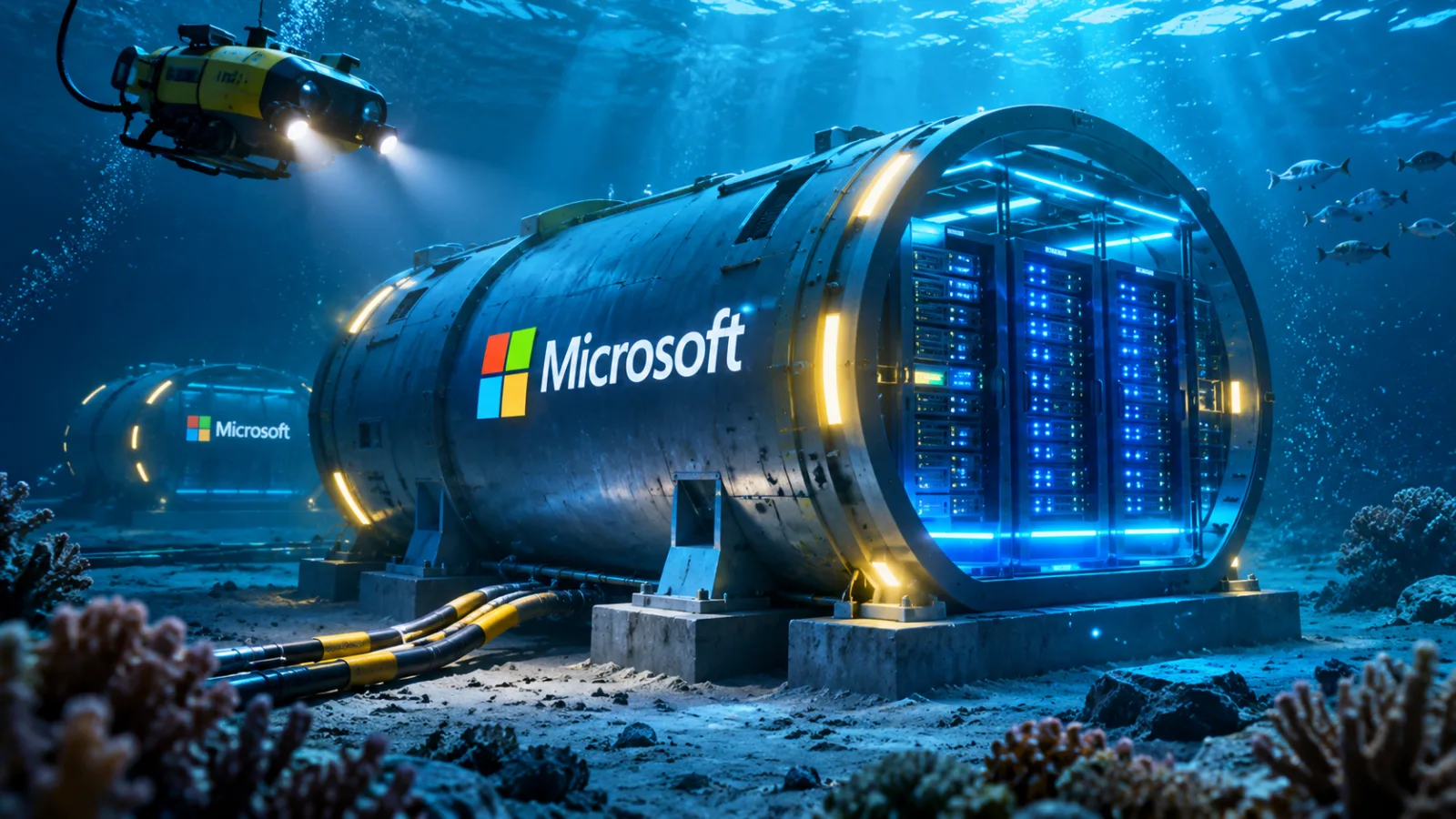
Table of contents
- Why underwater data centers are attracting renewed attention
- China's Shanghai facility demonstrates that commercial deployment is possible
- Microsoft's Project Natick proved the concept, but the company moved on
- The proposed US projects raise a different question: where should computing infrastructure go?
- Cooling is an advantage, but heat still has to go somewhere
- The environmental risks are different in oceans and freshwater lakes
- Maintenance could become the biggest commercial obstacle
- Underwater data centers are not yet a replacement for conventional facilities
- Frequently Asked Questions
The United States is reconsidering underwater data centers as a potential location for future computing infrastructure, with the Trump administration reportedly examining four sealed facilities off the coasts of Maine and Alaska.
The renewed interest comes as China operates a commercial underwater data center off Shanghai and developers look for alternatives to land-based facilities facing constraints involving electricity, cooling water and available sites.
But the technology brings its own engineering and environmental questions, particularly when data centers are placed in sensitive marine environments or freshwater lakes.
The debate has moved beyond whether servers can operate underwater.
They can.
The harder questions concern whether subsea facilities can be maintained economically, connected reliably to power and communications networks, and deployed without creating unacceptable environmental risks.
Why underwater data centers are attracting renewed attention
A conventional data center needs more than buildings and servers.
It requires a dependable electricity supply, cooling equipment, network connections, physical security and enough land to accommodate the facility and its supporting infrastructure.
Those requirements are becoming harder to satisfy in some locations as artificial intelligence increases demand for computing capacity.
Large AI workloads require dense clusters of servers and accelerators, generating substantial heat and placing pressure on electrical infrastructure.
Cooling systems can also consume significant quantities of water, depending on their design.
Underwater data centers offer a different physical arrangement.
Instead of housing servers in a conventional building, operators place computing equipment inside sealed modules beneath the water.
The surrounding water acts as a heat sink, allowing heat exchangers to transfer thermal energy away from the servers.
The approach can reduce dependence on conventional air-conditioning equipment and, in suitable locations, avoid using freshwater for direct cooling.
It can also move some infrastructure away from crowded urban and industrial sites.
However, underwater deployment does not eliminate the need for electricity, cooling engineering or network infrastructure.
It changes where and how those systems are built.
Power must still reach the facility, data must travel through subsea cables, and equipment must eventually be inspected, repaired or replaced.
China's Shanghai facility demonstrates that commercial deployment is possible
China provides the clearest commercial example of the technology's progress.
A 24-megawatt underwater data center developed with HiCloud Technology reached full commercial operation off Shanghai in May 2026, according to Data Center Dynamics.
Located in the Lingang Special Area, the facility was officially launched in June 2025 and completed in October of that year.
It subsequently underwent trials before entering full commercial operations.
The project involved HiCloud Technology and state-backed telecommunications and infrastructure partners, including China Telecom, according to published reporting.
The project is designed to combine subsea cooling with offshore wind power.

Deskbird
Deskbird helps hybrid teams coordinate office days, reserve desks and meeting rooms, and understand workplace occupancy through one connected platform.
- Intuitive desk booking interface
- Visual floor plan reservations
- Mobile experience needs refinement
- Advanced plans require custom pricing
Its reported capacity is 24 MW, making it a substantial infrastructure deployment rather than a small research capsule.
That distinction matters.
Microsoft's earlier Project Natick demonstrated that a sealed server module could operate on the seabed for an extended period.
Shanghai's project moves the concept into commercial service, although its existence does not establish that underwater facilities are already economical or suitable for every kind of computing workload.
The reported construction cost was approximately $226 million.
That figure comes from industry reporting and should be treated as an estimate, not as an independently audited final project cost.
Microsoft's Project Natick proved the concept, but the company moved on
The modern underwater data center debate has an important predecessor: Microsoft's Project Natick.
The company began investigating subsea computing to determine whether sealed server modules could operate reliably underwater, potentially close to coastal population centers and offshore renewable energy sources.
For its second phase, Microsoft deployed a full-scale module at the European Marine Energy Centre in the Orkney Islands, Scotland.
The vessel operated on the seabed for approximately two years.
Microsoft reported that servers in the Northern Isles module experienced a failure rate one-eighth that of the land-based comparison group.
The result attracted attention because reliability is a major operating concern for cloud infrastructure.
Fewer hardware failures can mean fewer interventions, less equipment replacement and potentially more predictable operations.
But Project Natick was a research program, not the beginning of a Microsoft commercial product line.
In June 2024, Data Center Dynamics reported that Microsoft had ended the project.
A senior executive told the publication that the company was not building subsea data centers and would apply lessons from the experiment to other operations.
Microsoft's current Project Natick page continues to describe the work as research into the feasibility of subsea facilities.
That distinction is important when assessing the latest interest.
Microsoft's experiment demonstrated technical feasibility under specific conditions.
It did not prove that subsea data centers offer lower total costs, easier maintenance or better environmental performance at commercial scale.
The proposed US projects raise a different question: where should computing infrastructure go?
According to The Guardian, the Trump administration is reportedly considering four sealed underwater data center pods off Maine and Alaska.
The report describes these as proposals under consideration, not approved construction projects or operating facilities.
The renewed US interest also reflects a domestic infrastructure problem.
Large data centers can face opposition from communities concerned about electricity demand, water consumption, land use, noise and the potential effect on household utility bills.
Locating computing equipment offshore could reduce some conflicts over land and proximity to residential neighborhoods.
The Great Lakes have also entered the discussion, although no underwater data center project has been proposed there.
Their cold freshwater and proximity to major cities could make them attractive from a cooling and network-latency perspective.
But the prospect has prompted environmental organizations to call for rules before developers submit formal proposals.
The Lake Erie Foundation is among the groups raising concerns.
Its representatives have contacted lawmakers in Ohio, Michigan and New York to discuss safeguards for the lakes.
Ohio's environmental agency told The Guardian it had not received an application to permit an underwater data center in its section of Lake Erie.
The political and commercial appeal of moving facilities offshore should not be confused with regulatory approval.
The reported Maine and Alaska proposals remain under consideration, while the Great Lakes discussion is currently focused on preparation and potential regulation.
Cooling is an advantage, but heat still has to go somewhere
The central engineering argument for subsea data centers is straightforward: servers produce heat, and surrounding water can absorb and carry that heat away.
In a conventional facility, cooling equipment circulates air or liquid through systems that transfer heat to the outside environment.
A subsea installation can use heat exchangers to move thermal energy from the sealed computing module into the surrounding water.
That can reduce reliance on energy-intensive cooling equipment.
It may also reduce direct freshwater consumption when the design uses the surrounding seawater as the heat sink rather than drawing water from municipal or freshwater supplies.
However, the heat does not disappear.
It is transferred into the marine environment.
The environmental consequences depend on factors including the amount of heat released, the temperature and circulation of the surrounding water, the depth of deployment, the local ecosystem and the facility's operating load.
Researchers and environmental groups therefore distinguish between reducing a data center's cooling requirements and proving that its cooling system has no environmental impact.
Deskbird
Deskbird helps hybrid teams coordinate office days, reserve desks and meeting rooms, and understand workplace occupancy through one connected platform.
- Intuitive desk booking interface
- Visual floor plan reservations
- Mobile experience needs refinement
- Advanced plans require custom pricing
A September 2026 briefing from the University of California, Santa Barbara's Bren School highlighted the potential environmental benefits and tradeoffs of underwater facilities as AI computing demand grows.
The university cited global data center electricity consumption of 448 terawatt-hours in the previous year and projected AI data center water demand of 1.3 billion units in the source's stated comparison.
These figures provide context for the infrastructure debate, but they do not establish that underwater deployment is automatically more sustainable.
The environmental risks are different in oceans and freshwater lakes
The environmental debate becomes more complicated when developers consider freshwater lakes rather than offshore marine locations.
Lake Erie, for example, already faces harmful algal blooms, agricultural runoff and rising water temperatures.
Environmental representatives interviewed by The Guardian warned that additional thermal discharge could increase oxygen demand, reduce dissolved oxygen availability and disrupt aquatic habitats.
The same reporting raised concerns about potential leaks involving cooling fluids, batteries and electrical equipment.
These are risks that developers and regulators would need to evaluate through engineering assessments, containment requirements and environmental monitoring.
They are not evidence that an existing underwater data center has caused such contamination.
There is also a distinction between an installation in the open ocean and one in a major freshwater resource.
A leak or poorly managed discharge in a lake supplying drinking water to millions of people could have consequences that extend well beyond the facility's immediate location.
The Great Lakes therefore present a particularly sensitive test case.
Their proximity to major population centers is attractive for connectivity, but their ecological and public-water importance raises the standard for environmental protection.
Maintenance could become the biggest commercial obstacle
Cooling efficiency is only one part of a data center's operating costs.
Facilities also require hardware replacement, software and network maintenance, security, power distribution and rapid responses to equipment failures.
On land, technicians can access servers directly.
In an underwater facility, reaching the equipment may require specialized vessels, lifting systems, pressure-resistant connections and planned recovery operations.
A sealed module can reduce the need for frequent physical intervention, but it cannot eliminate maintenance.
A failed server, damaged cable or malfunctioning power component may require an entire module to be recovered or isolated before repairs can take place.
This creates a different operational calculation:
Hardware replacement: Individual components are less accessible than in a conventional server room.
Physical access: Recovery can require marine engineering equipment and suitable weather conditions.
Connectivity: Subsea cables and shore connections become critical infrastructure that must be protected and maintained.
Equipment lifecycle: Operators need a practical way to upgrade servers as processors, accelerators and storage systems become outdated.
Emergency response: Failures must be managed without assuming technicians can immediately enter the facility.
Microsoft's Project Natick demonstrated that a sealed module could operate for an extended period without routine human intervention.
However, that research result does not establish how economically a large commercial installation can handle continuous hardware upgrades or unexpected failures.
Deskbird
Deskbird helps hybrid teams coordinate office days, reserve desks and meeting rooms, and understand workplace occupancy through one connected platform.
- Intuitive desk booking interface
- Visual floor plan reservations
- Mobile experience needs refinement
- Advanced plans require custom pricing
For AI infrastructure, this matters particularly because computing hardware evolves quickly.
A facility designed around a specific generation of accelerators may need substantial upgrades before the physical structure reaches the end of its useful life.
Underwater data centers are not yet a replacement for conventional facilities
The commercial evidence remains limited.
China's Shanghai deployment demonstrates that subsea computing can move beyond experimental testing, while Microsoft's research shows that sealed underwater modules can achieve promising reliability under controlled conditions.
But neither example establishes that the technology can replace conventional hyperscale data centers across different climates, network environments and computing workloads.
The economics will depend on more than cooling.
Construction, offshore power connections, subsea communications, equipment recovery, maintenance and environmental compliance all affect the total cost of ownership.
There is also no reason to assume every workload belongs underwater.
Applications requiring very low latency may benefit from facilities near population centers, while other workloads can operate in more remote locations.
The suitability of an underwater site depends on the network architecture and the services it is expected to support.
For now, subsea data centers are better understood as a developing infrastructure option rather than a general solution to the AI industry's electricity and cooling requirements.
The next phase of the debate will depend on whether operators can demonstrate reliable commercial performance over time, disclose meaningful environmental data and show that the savings from underwater cooling justify the complexity of operating computing equipment beneath the water.