Meta Plans to Raise Up to $95 Billion to Fund AI Expansion
By Noura Mint Ely · October 26, 2026
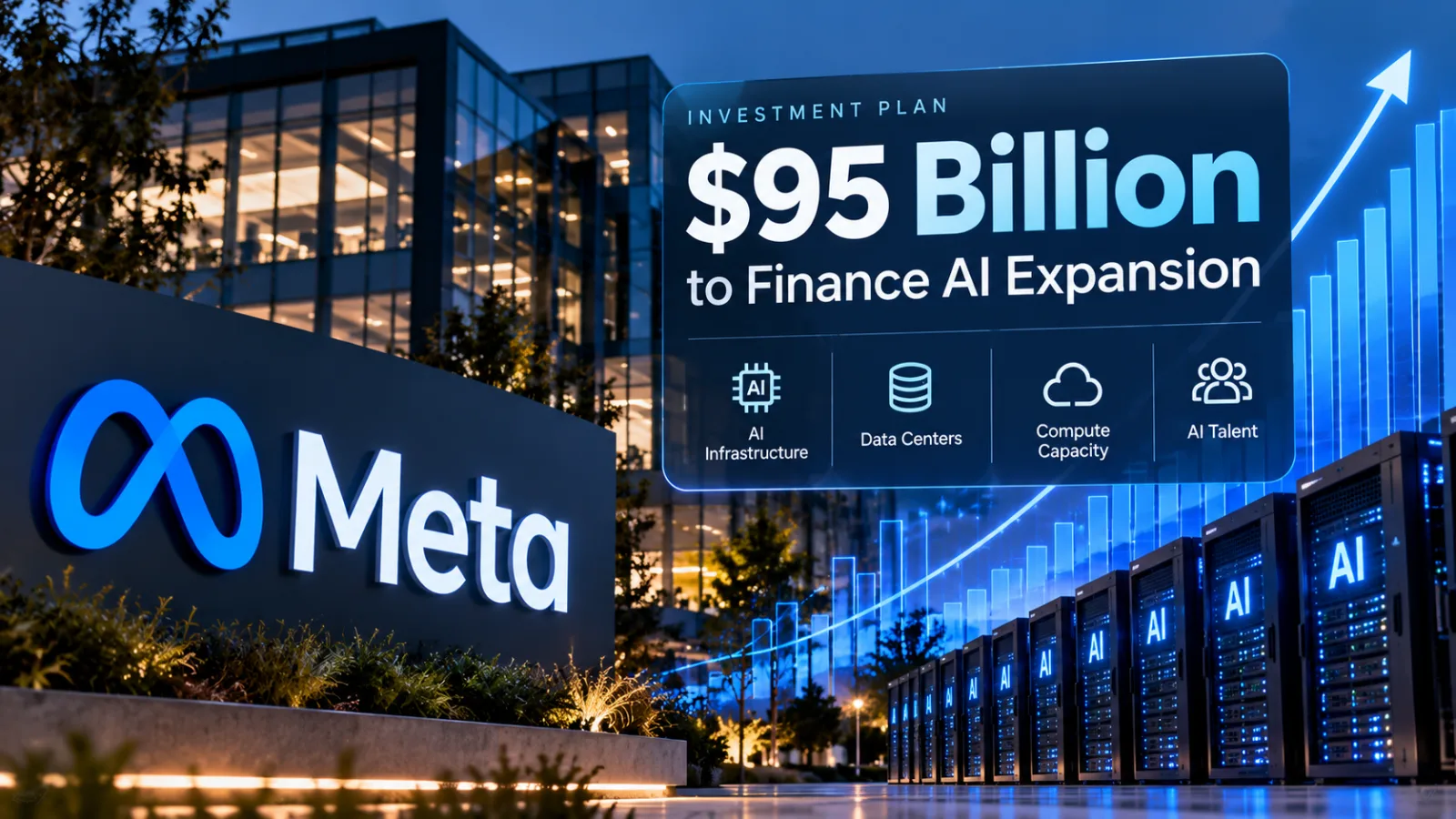
Table of contents
Meta Platforms plans to raise up to $95 billion in equity financing as the Facebook and Instagram parent accelerates its investment in artificial intelligence infrastructure, according to a report published by Reuters on October 26, 2026.
The fundraising plan could become one of the largest equity raises associated with the AI infrastructure race.
The company has launched public offerings totaling approximately $35 billion in common stock and convertible preferred stock.
Meta also plans a separate at-the-market share-sale program of up to $60 billion, which is expected to begin after its new non-voting Class C shares start trading, currently anticipated in the first quarter of 2027.
The additional capital is intended to support Meta's growing investment in data centers, computing capacity and other infrastructure needed to develop and operate AI systems.
The scale of the proposed fundraising illustrates how the industry is moving beyond model development toward a capital-intensive competition for computing power, energy and physical infrastructure.
The announcement comes as Meta increases its projected 2026 capital expenditures to between $135 billion and $145 billion.
Its plans also come amid growing competition with AI companies including OpenAI and Anthropic, as technology providers invest heavily in the infrastructure required to train and serve advanced AI models.
How Meta's $95 billion fundraising plan works
The proposed financing has two main components.
The first consists of public offerings worth approximately $35 billion in common stock and convertible preferred stock.
These offerings form the immediate part of the announced fundraising plan.
The second is a proposed at-the-market, or ATM, share-sale program of up to $60 billion.
An at-the-market offering allows a company to sell shares into the market over time rather than raising the entire amount through a single transaction.
Meta's planned ATM program depends on its new non-voting Class C shares beginning to trade.
The launch is expected in the first quarter of 2027, but the precise timing and terms of the larger share-sale program had not been finalized in the Reuters report.
The distinction is important: Meta has announced a plan to raise up to $95 billion, but that does not mean it has already raised the full amount. The final proceeds will depend on the execution of the offerings and the conditions under which shares are sold.
Because equity financing involves issuing shares, investors will also assess the implications for existing shareholders.
The effects depend on the number and type of shares issued, their pricing and the terms of the offerings.
Why Meta needs so much capital for AI
Building and operating advanced AI systems requires far more than developing software.
Companies must invest in specialized processors, servers, data centers, networking equipment, storage and the power infrastructure needed to keep those facilities running.
Meta's infrastructure spending supports both the development of AI models and the delivery of AI-powered features across its products.
Its investments are intended to strengthen its ability to compete in a market where computing capacity increasingly influences how quickly companies can develop and deploy new systems.
The financial commitments are substantial.
Meta's third-quarter 2026 financial results reported capital expenditures of $34.91 billion, including principal payments on finance leases.
The company also reported $82.45 billion in cash, cash equivalents and marketable securities at September 30, 2026, alongside $80.92 billion in long-term debt.
Meta's latest capital expenditure forecast puts spending for 2026 at between $135 billion and $145 billion, including principal payments on finance leases.
That forecast reflects the scale of its ongoing investment in AI and its core business.
The proposed equity raise would give Meta another financing option as it funds this expansion.
However, the fundraising target should not be confused with the company's annual capital expenditure forecast: one describes a potential source of financing, while the other estimates spending over a particular period.
Meta's financial performance adds context to the fundraising
Meta's AI investment is taking place alongside a growing advertising business.
The company reported third-quarter revenue of $64.60 billion, up 26% year over year, in its latest results.
Its Family of Apps averaged 3.64 billion daily active people in September 2026, an increase of 3% from a year earlier.
Advertising impressions increased 10%, while the average price per advertisement rose 14%.
These figures show that Meta continues to generate substantial revenue from its established business while investing in AI infrastructure.
Its advertising operations remain a key source of funding for its longer-term technology strategy.
Nevertheless, infrastructure spending is placing pressure on cash generation.
Meta reported negative free cash flow of $2.12 billion for the third quarter, compared with positive free cash flow of $10.63 billion a year earlier.
The company attributed its rising costs to several factors, including increased investment and other expenses.
Negative free cash flow for a quarter does not, on its own, establish that a company cannot finance its operations.
It does, however, illustrate why investors are examining the relationship between AI spending, cash generation and future returns.
For Meta, the central financial question is whether investments in infrastructure and AI products will generate sufficient long-term economic benefits to justify the capital committed.
Chipmakers have expressed interest in investing
The fundraising plan also involves potential participation from major semiconductor companies.
According to Reuters, Nvidia, Advanced Micro Devices and Broadcom have expressed interest in purchasing up to $5 billion in total of Meta's Class A common stock as part of the offering.
The reported interest is notable because these companies supply technology used in the broader AI infrastructure ecosystem.
Nvidia is a major supplier of AI accelerators, AMD competes in AI computing hardware, and Broadcom provides semiconductor and networking technologies used in large-scale computing environments.
Potential investments by suppliers could strengthen their financial relationships with major customers.
However, interest in purchasing shares is not the same as a completed investment, and the reported amount should not be treated as funding already received by Meta.
The arrangement also raises a broader question about capital flows within the AI industry.
As technology companies spend heavily on chips, cloud services and infrastructure, investments between industry participants can create financial relationships in which suppliers and customers are connected through both commercial contracts and equity ownership.
Such relationships are not inherently problematic, but investors may examine whether reported demand for AI infrastructure reflects sustainable end-user demand, the availability of financing, or a combination of both.
What the fundraising means for Meta shareholders
Issuing additional shares can provide a company with capital without adding the repayment obligations associated with new borrowing.
Equity financing can therefore help fund long-term investments when management wants to preserve financial flexibility.
The trade-off is that new share issuance can dilute existing shareholders' ownership percentage if their holdings do not increase proportionately.
The actual effect depends on the structure, pricing and size of the completed offerings, along with the number of shares ultimately issued.
Meta's plan to introduce non-voting Class C shares also makes the structure of the proposed fundraising relevant.
Different share classes can carry different voting rights, so investors will need to examine the final terms rather than assuming that all shares provide the same influence over corporate decisions.
The planned at-the-market offering adds another variable.
Because the company expects to sell shares over time, the ultimate amount raised and the effect on shareholders will depend on the program's execution and market conditions.
For investors, the key considerations include the capital raised, the terms of the offerings, the pace of AI infrastructure spending and the company's ability to convert that investment into sustainable revenue and profit.
The wider AI infrastructure race
Meta's proposed fundraising reflects a broader shift in the technology sector.
Competition increasingly depends not only on the quality of AI models but also on access to computing capacity, reliable power, data centers and the resources needed to serve large numbers of users.
Companies developing advanced AI systems must balance substantial upfront investment against uncertain future returns.
Infrastructure takes time to build, and the commercial benefits of that capacity may arrive gradually as new products are adopted and workloads expand.
Meta is approaching this challenge with an established advertising business and a large global user base.
That gives it a different financial position from AI companies that rely more heavily on outside capital or revenue from cloud and software services.
Even so, the scale of the planned equity raise demonstrates that existing cash generation alone is not the only consideration in financing Meta's next phase of expansion.
The company is preparing to use capital markets to support an investment strategy that could continue to shape its finances well beyond 2026.
The next milestones will be the completion and terms of the approximately $35 billion in public offerings, the eventual launch of the proposed $60 billion share-sale program, and evidence of how Meta's AI investments affect operating performance.
Until those details emerge, the $95 billion figure should be understood as the maximum amount contemplated by the announced plan, not a confirmed total of completed financing.