

Microsoft's New AI Models Target Coding Costs and Enterprise Security at Ignite 2026
 Published byEvander ThorneSoftware ReviewerEvander ThorneSoftware Reviewer Verified authorEvander Thorne is a Software Reviewer and IT Management Specialist at Desking, specializing in enterprise software, IT service management, project management, and busine…Author Profile
Ad disclaimer For links on this page, DESKING APP may earn a commission from the provider. This supports our work and has no influence on our editorial rating.
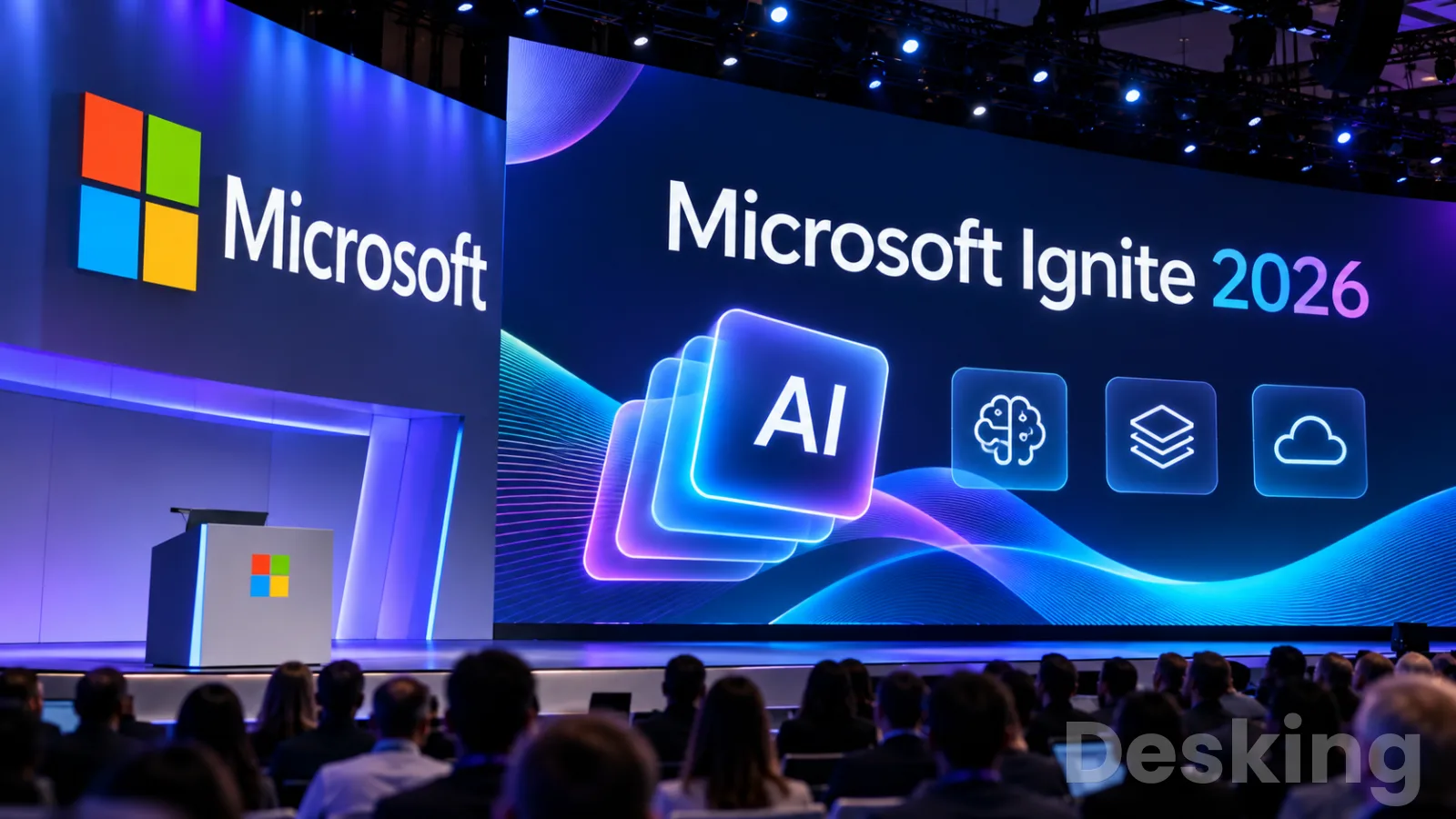
Table of contents
Microsoft announced a new family of artificial intelligence models at its Ignite 2026 conference in San Francisco on November 17, expanding its own technology for software development, cybersecurity, image generation, speech and automated business decisions.
The releases include MAI Code 2, a coding model designed for enterprise software work, and MAI Cyber 2 Flash, a security model intended to help organizations identify and address software vulnerabilities.
Microsoft is positioning the products around a specific commercial proposition: specialized AI models that can handle defined tasks at lower operating costs than larger general-purpose systems.
The announcements represent a further step in Microsoft's effort to build and commercialize its own AI models alongside the technology it provides through external partners.
The company also introduced new options for enterprise customers to access and customize its model weights, while expanding the selection of models available through Microsoft Foundry.
The launch took place during Ignite, which ran from November 17 to November 20 in San Francisco and online.
Microsoft described the release as a family of seven new models.
Its announcements covered coding, cybersecurity, image editing and generation, real-time voice, transcription and decision-making.
Coding models focus on enterprise software work

The most prominent releases for software developers were MAI Code 2 and MAI Code 2 Flash.
Microsoft designed the two models for different workloads, separating more demanding software engineering tasks from frequent, routine coding requests.
MAI Code 2 is intended for work such as implementing changes across multiple files, debugging complex applications, reasoning across entire code repositories and preparing code for production.
Microsoft said it had tuned the model for common enterprise development tasks rather than attempting to optimize it for every possible form of advanced reasoning.
In its November 17 announcement, Microsoft reported that MAI Code 2 achieved 98% of the coding performance of GPT 6.1 Sol at approximately 40% of its price, averaged across four benchmarks.
The company also reported 96% of Claude Opus 5.5's performance at 5% of the price.
The comparisons were based on DeepSWE 1.1, Terminal Bench 2.1, SWE Atlas and FrontierCode v1.1.
Microsoft said these benchmarks were selected to represent the everyday enterprise coding work it sees in GitHub Copilot.
The company also reported results from a separate evaluation of frontend development.
In a blind, side by side comparison, developers preferred MAI Code 2 over GPT 6 Sol in 64% of the evaluated cases.
Microsoft said the model had been tuned to produce dashboards and visualizations as well as conventional application code.
These figures are Microsoft's own reported results, not an independent guarantee that the model will outperform competing systems in every development environment.
The company explicitly said MAI Code 2 was not yet tuned for more difficult areas such as fundamental scientific research and very long-running agentic work.
That distinction matters for businesses evaluating the model.
Performance on routine repository work does not establish equivalent capability in scientific computing, complex mathematical reasoning or projects that require an AI agent to operate independently over extended periods.
MAI Code 2 Flash addresses a different part of the development process.
Microsoft designed the smaller model for high-volume requests, including code explanations, targeted edits, routine fixes and rapid iterations.

Proton VPN
Proton VPN combines Swiss privacy law, open source audited apps, and Secure Core routing with strong speeds and a genuinely usable free tier.
- Genuinely unlimited free VPN plan
- Fully open source client apps
- Monthly pricing sits above rivals
- Free plan limited to few countries
It is intended to provide developers with a lower-cost option when a task does not require the full capabilities of the flagship model.
Microsoft said Code 2 Flash delivered performance comparable to GPT 6 Luna at 65% of the price and Claude Haiku 5.5 at 20% of the price across three coding benchmarks.
Those comparisons also reflect Microsoft's selected tests and pricing calculations.
Both coding models became available through GitHub Copilot, including its model picker.
Microsoft also said they were integrated into Copilot Fusion.
The company identified a limited-access preview of Code 2 Flash in Microsoft Foundry, giving enterprise developers another route to evaluate the model.
Reuters reported that the coding release was part of Microsoft's effort to compete more directly with specialist AI companies such as Anthropic and OpenAI.
The news agency said MAI Code 2 was presented as a model that approached the performance of competing systems at a substantially lower cost.
Cybersecurity model targets vulnerability work

Microsoft also introduced MAI Cyber 2 Flash, a model developed for cybersecurity tasks.
The company said it was designed to support security teams working with code vulnerabilities and automated defensive systems.
The model is intended to work alongside security tools rather than operate as a general-purpose assistant.
Microsoft's stated applications include identifying vulnerabilities, validating findings and helping with remediation.
The company is integrating the model with its agentic security system, Microsoft Perception, and its Codename MDASH code security environment.
Microsoft said MAI Cyber 2 Flash achieved performance ahead of GPT 6 Astra on the CyberGym E2E benchmark at less than 2% of the cost per task.
That is a company-reported comparison tied to a specific cybersecurity benchmark.
It should not be interpreted as evidence that the model is universally more capable or less expensive across all security operations.
The release builds on earlier MAI Cyber models already used in Microsoft's security environment.
According to the company, MAI models account for almost 40% of scans in MDASH, and 90% of scans that began with an MAI model continued to use one.
Microsoft also said the new model's output token pricing was 86% lower than MAI Cyber 1.1 Flash.
The reduction is intended to make frequent security analysis more economical, particularly for systems that continuously inspect code and production environments.
Access was more restricted than for the coding models.
Microsoft's Ignite materials described MAI Cyber 2 Flash as a preview available through Codename MDASH, initially for a limited group of customers.
Reuters also reported that the company planned to offer the cybersecurity model to a limited customer group.
The release comes as AI tools are increasingly used to write and modify software, creating additional pressure on security teams to identify weaknesses in code.
Reuters reported that Microsoft AI chief Mustafa Suleyman had emphasized safeguards alongside model performance.
In an interview with the news agency, Suleyman said preventing AI systems from taking harmful actions and ensuring they behave as intended were his top priorities.
That concern is relevant to the deployment of autonomous security agents.
A system that can discover a vulnerability or propose a code change also needs controls over which actions it can take, what it can access and whether its findings are reliable.
Microsoft's positioning of Cyber 2 alongside its security products reflects that focus on integrating the model with operational tools.
Image and voice models extend the portfolio

The Ignite announcements also covered creative and communication tasks.
MAI Image 2.7 is Microsoft's image model for generation and editing, while MAI Image 2.7 Flash is intended for high-volume image generation.
Microsoft said MAI Image 2.7 ranked first in image editing on Artificial Analysis, an independent model evaluation platform.
The company also said it outperformed GPT Image 2.6 Sunburst in the cited comparison at one-fifth of the price.
For text-to-image generation, Microsoft reported that the model ranked fourth.
Those rankings refer to particular evaluation categories and should not be treated as a single measure of image quality across every use case.
Editing an existing image and generating a new image from a text prompt are different tasks, and results can vary according to the evaluation method.
MAI Image 2.7 Flash is aimed at organizations that generate images at larger volumes.
Microsoft listed an indicative price of approximately $10 per 1,000 images.
The company said both image models were available through Microsoft Foundry, while its Ignite Book of News described the image models as being in preview.
For real-time communication, Microsoft introduced MAI Realtime 1, its first live speech-to-speech model.
It is designed to support natural conversations with low latency, allowing an application to process incoming speech and respond with generated speech.
Microsoft said its internal and external evaluations showed MAI Realtime 1 outperforming GPT Realtime 2.1 across external and Dynamics 365 benchmarks.
The company listed pricing starting at $0.01 per audio minute.
It made the model available for experimentation through MAI Labs and invited interested customers to register for access.
Proton VPN
Proton VPN combines Swiss privacy law, open source audited apps, and Secure Core routing with strong speeds and a genuinely usable free tier.
- Genuinely unlimited free VPN plan
- Fully open source client apps
- Monthly pricing sits above rivals
- Free plan limited to few countries
The company also highlighted MAI Transcribe 2, its multilingual transcription technology.
The model is used in Dragon Copilot Transcribe, which is already deployed in Microsoft's healthcare product for transcribing doctor and patient conversations.
Microsoft said the system supports 10 million patient encounters each month, is used by a third of physicians in the United States and has halved multilingual error rates in the workflows described by the company.
Those figures refer to Dragon Copilot's reported deployment and performance, rather than a claim that every transcription in every language will have the same error rate.
The healthcare application gives the transcription model an established enterprise use case at launch.
Instead of presenting transcription solely as a standalone service, Microsoft is connecting it to a product used in clinical workflows.
Decision model is now generally available

Alongside the MAI releases, Microsoft announced the general availability of Microsoft Decision 1.1.
The model is designed for structured decisions that occur inside software applications and AI agent workflows.
These decisions can include routing a request to the right system, classifying information, prioritizing a support ticket, verifying whether a task has been completed and controlling which step an agent should take next.
Microsoft's argument is that not every operation in an AI workflow needs a large general-purpose model.
Sending every small decision to a more expensive system can increase costs and add latency.
A smaller model designed for defined decisions can handle routine operations, leaving more capable models available for tasks that require deeper reasoning.
Microsoft said Decision 1.1 was already being used by more than 4,000 customers.
The company reported that it was 50 times faster and 79 times cheaper than GPT 6.1 Sol.
It also said the model ranked ahead of systems from Google and OpenAI on the Artificial Analysis Decision Index.
The Ignite Book of News provides additional technical detail.
Decision 1.1 is built on Gemma 4 26B A4B and adds multimodal support, including the ability to analyze images included in instructions.
Microsoft said the model scored 68 on Artificial Analysis Decision Index version 2.1, six points higher than its predecessor, and was more than twice as fast as the first version.
The model became generally available through Microsoft Foundry, OpenRouter and Vercel.
Microsoft also said it was integrating Decision 1.1 into Copilot to route user requests to the appropriate experience and into Cowork's Auto mode to adjust the reasoning effort applied to tasks.
This makes the model relevant beyond customers building their own AI applications.
It can also operate within Microsoft's own products, where decisions about routing and task handling affect how users interact with Copilot.
Microsoft offers licensed model weights
Another part of the announcement concerns how enterprises can access and control Microsoft's models.
The company introduced MAI Licensed Weights, a program through which selected customers can obtain Microsoft AI model weights and customize them using their own proprietary data.
Microsoft said customers would be able to run the resulting models in their own Azure environments.
The company described the approach as a way for organizations to retain control over access, data and model adaptations while receiving support through its Frontier Company.
This is a different arrangement from simply accessing a model through a hosted application programming interface.
Organizations can adapt a model to their own data and deployment requirements, while the model remains subject to Microsoft's licensing and Azure environment conditions.
The distinction is important for businesses handling sensitive operational information or building products around proprietary datasets.
Access to model weights can provide more control over customization and deployment, although it does not automatically mean that the models are open source or available without restrictions.
Microsoft's announcement did not describe the program as unrestricted public access.
It referred to trusted customers and an enterprise arrangement delivered through Frontier Company.
The company did not publish a general release date or universal pricing for the licensed weights in the announcement.
Microsoft also cited AT&T as an example of its custom model work.
According to Microsoft, AT&T developed an MAI model for 5G network operations analytics that outperformed GPT 6.1 Sol at one-fiftieth of the cost.
The result was presented by Microsoft as an example of the potential economics of a model customized for a specific business workload.
A broader competition over enterprise AI costs
The releases arrive as Microsoft expands the number of models available to its enterprise customers while continuing to develop its own systems.
Microsoft Foundry already provides access to models from several providers, and the Ignite Book of News said the platform offered more than 11,000 models from companies and communities including OpenAI, Anthropic, Mistral and open-source developers.
The strategy gives customers the option to select models according to the task, rather than rely on a single system for every operation.
A company could use a coding model for software changes, a security model for vulnerability analysis, a decision model for workflow routing and a speech model for voice applications.
The approach also gives Microsoft a way to compete on the economics of AI deployment.
For organizations operating agents continuously, inference costs can accumulate across repeated model calls.
A lower-cost model that performs adequately on a narrow task may therefore be commercially useful even if it does not replace a larger model for complex work.
Axios reported that Suleyman told the publication Microsoft was making progress toward building its own frontier general-purpose model while introducing specialized systems.
Proton VPN
Proton VPN combines Swiss privacy law, open source audited apps, and Secure Core routing with strong speeds and a genuinely usable free tier.
- Genuinely unlimited free VPN plan
- Fully open source client apps
- Monthly pricing sits above rivals
- Free plan limited to few countries
The publication also noted that the company's comparisons relied on selected benchmarks and that some pricing advantages reflected promotional discounts.
Suleyman did not provide a release timeline for the broader model.
That distinction separates Microsoft's current announcement from a claim that it has replaced the leading general-purpose systems.
The products introduced at Ignite concentrate on defined workloads, with the company arguing that specialization can improve the balance between performance and cost.
The launch also does not remove the role of external models from Microsoft's platform.
The company announced that GPT 6.2 and Meta's latest models would be available through Foundry, maintaining a multi-provider approach while expanding its first-party portfolio.
For enterprise customers, the practical question will be whether the new models perform reliably in their own applications, under their own workloads and at the prices they actually pay.
Microsoft's benchmark figures provide an initial basis for comparison, but deployment decisions will also depend on integration, latency, security requirements, service availability and the quality of results on business-specific tasks.
Microsoft has made several of the models available through products that customers already use, including GitHub Copilot and Microsoft Foundry.
Others remain in preview or restricted access.
The different release stages mean organizations cannot assume that every model announced at Ignite is immediately available for unrestricted production use.
The November announcements therefore establish a wider set of Microsoft-developed options for coding, security, image generation, voice and automated decisions.
Their commercial significance will depend on how well those systems translate the company's benchmark results into dependable performance and lower costs in real enterprise deployments.
Sources3
- Axios on Microsoft's specialized AI models
- Microsoft on Ignite 2026 announcements
- Microsoft AI on seven new models
External pages are independent third-party sources. Desking App does not control or endorse their content and accepts no responsibility for it. Visiting them is at your own responsibility and risk.