

Amazon Acquires Decart's AI Optimization Technology to Strengthen Its Trainium Chips
 Published byEvander ThorneSoftware ReviewerEvander ThorneSoftware Reviewer Verified authorEvander Thorne is a Software Reviewer and IT Management Specialist at Desking, specializing in enterprise software, IT service management, project management, and busine…Author Profile
Ad disclaimer For links on this page, DESKING APP may earn a commission from the provider. This supports our work and has no influence on our editorial rating.
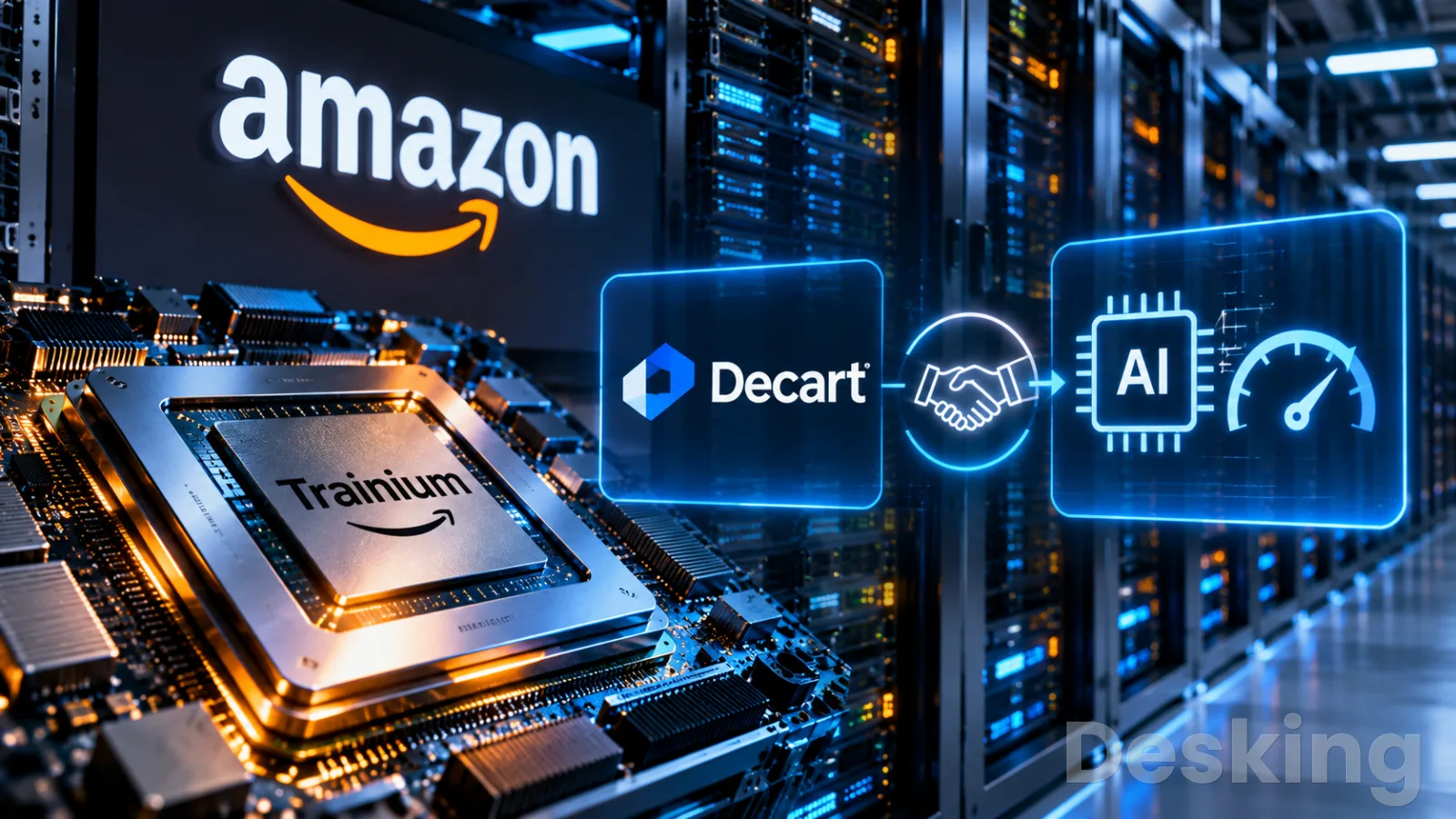
Table of contents
Amazon has signed an agreement to acquire the proprietary technology behind Decart’s Optimization Stack, bringing the Israeli startup’s three co-founders and its AI research and engineering team into the company.
Announced on Monday, November 23, 2026, the transaction is intended to improve the performance of Amazon’s custom processors and make it faster and less expensive for customers to train and run artificial intelligence models.
The agreement covers the technology behind Decart Optimization Stack, known as DOS, rather than an explicitly announced purchase of the entire Decart company.
Amazon named co-founders Dean Leitersdorf, Moshe Shalev and Orian Leitersdorf as part of the group expected to join its workforce.
The company did not disclose the purchase price.
Bloomberg reported that the transaction was valued at approximately $7.5 billion, citing a person familiar with the matter, a figure that Amazon has not confirmed.
Amazon said the technology will support its work on AI inference and custom silicon, including its Trainium processors.
The company has worked with Decart since 2025, using the startup’s full-stack optimization approach to improve performance on Trainium.
Completion remains subject to customary closing conditions, including regulatory clearance.
The distinction between acquiring Decart’s technology and acquiring the entire startup is important.
Amazon’s announcement identifies the proprietary DOS technology and the team joining the company as the assets involved.
It does not state that Amazon is purchasing every Decart product, business operation or corporate asset.
What the optimization stack does

Decart developed DOS to improve how artificial intelligence workloads use computing hardware.
The software works across the layers between AI models and processors, optimizing the way workloads are executed so that available computing resources can be used more efficiently.
This matters because running AI models requires substantial computing capacity.
Training involves processing large datasets to develop a model, while inference is the stage in which a trained model generates responses, predictions or other outputs.
Both activities depend on the performance of the underlying processors and the software that distributes work across them.
Decart’s technology is designed to improve this relationship between software and hardware.

Hostinger VPS
Hostinger VPS delivers KVM virtualization, NVMe storage and full root access at prices that undercut most competing cloud providers.
- Strong price to specification ratio overall
- NVMe storage included on every tier
- Renewal rates climb steeply after promo
- Self managed means security is your job
Reuters reported that DOS helps companies run AI systems faster and switch more easily between different types of AI chips, including processors from Nvidia, Amazon and Google.
The Register reported that the stack works with Nvidia GPUs, Google TPUs and Amazon Trainium chips.
It also described the software as operating between the AI model and the processor, optimizing kernels, compilers and runtimes for the hardware in use.
Those components perform different jobs.
Kernels execute specific computational operations, compilers translate software instructions into forms suitable for a processor, and runtimes manage the execution of workloads.
Optimizing these layers can help software make better use of the hardware available to it.
Decart has said its technology can reduce latency, improve throughput and lower the costs associated with training and inference.
The company has not published a complete independent benchmark in the acquisition announcement, so those performance benefits should be understood as the intended capabilities of the technology rather than guaranteed results for every workload.
The software’s ability to operate across different chip platforms is also relevant to customers that use hardware from multiple suppliers.
Instead of depending entirely on one processor architecture, companies can seek to adapt workloads to the hardware available to them.
Reuters identified Nvidia, Amazon and Google among the chip platforms supported by DOS.
Why Trainium is central to the deal

Amazon has invested in designing its own processors as part of its broader cloud infrastructure business.
Its custom silicon portfolio includes Graviton processors for general computing workloads and Trainium accelerators designed for AI training and related workloads.
Trainium is part of Amazon Web Services’ effort to offer customers an alternative to GPUs supplied by Nvidia.
However, hardware performance is only one part of the decision companies make when selecting processors.
Software compatibility, developer tools, workload migration and the ability to achieve consistent performance also influence whether customers adopt a new chip platform.
Decart’s optimization technology addresses that software layer.
By improving how AI workloads execute on Trainium, Amazon expects to make its processors more efficient for customers that train and operate models.
The relationship between the companies predates the acquisition announcement.
Amazon said it began working with Decart in 2025, and that the collaboration produced performance improvements on Trainium through a combination of hardware and software optimization.
GeekWire reported that Decart was among the early customers using Trainium3.
The publication also referenced an earlier Amazon statement that Decart had run real-time video workloads four times faster on Trainium and at half the cost of GPUs.
That result relates to the specific workload and comparison described by Amazon, not a general performance guarantee across all AI applications.
The acquisition gives Amazon access to the team that developed the optimization technology as well as the proprietary stack itself.
That combination may help the company continue adapting its processors and software together, rather than relying only on external developers to optimize workloads for its hardware.
Amazon has also been preparing to expand the market for its custom chips.
TechCrunch reported that the company was preparing to sell Trainium chips to customers beyond its own data centers.
Making those processors easier to use and more efficient could support that commercial objective.
The acquisition announcement did not provide a new launch date for external Trainium sales or disclose changes to the processor roadmap.
Amazon also did not publish a schedule for integrating DOS into its existing services.
The $7.5 billion figure remains unconfirmed

The reported price has attracted attention because of its size relative to Decart’s previous valuation.
Hostinger VPS
Hostinger VPS delivers KVM virtualization, NVMe storage and full root access at prices that undercut most competing cloud providers.
- Strong price to specification ratio overall
- NVMe storage included on every tier
- Renewal rates climb steeply after promo
- Self managed means security is your job
Reuters reported that Bloomberg placed the transaction at approximately $7.5 billion, citing a person familiar with the matter.
Amazon did not disclose financial terms, and Reuters said the company declined to comment on the reported valuation.
Decart was valued at nearly $4 billion following its latest funding round in May 2026, according to PitchBook data cited by Reuters.
The reported acquisition figure would therefore be substantially higher than that valuation, although the two figures may reflect different transaction structures and should not be treated as directly equivalent.
The distinction is particularly important because the announced transaction is an asset purchase covering DOS technology and the arrival of Decart's founders and technical staff.
The Register reported that an Amazon spokesperson explicitly described it as an asset purchase rather than a full acquisition of the startup.
The publication also reported that Decart's other products were not included in the agreement.
These include Lucy, a real-time video generation and editing model, and Oasis, a system designed to generate interactive virtual environments.
GeekWire similarly reported, citing Bloomberg, that Amazon was not buying those AI models.
Amazon's public announcement does not provide a detailed inventory of Decart assets included in the transaction, so the precise treatment of the remaining business and its products has not been fully explained by the companies.
The reported $7.5 billion valuation should therefore remain attributed to Bloomberg rather than presented as an official purchase price.
Until Amazon or Decart discloses the financial terms, the confirmed information is limited to the technology purchase and the planned arrival of the founders and technical team.
Decart's earlier funding and acquisition interest

Decart was founded in 2023 and developed products beyond its optimization software.
Its work on AI video generation and interactive world models helped establish the company as a startup operating across several areas of artificial intelligence.
In May 2026, Decart raised $300 million in a funding round led by Radical Ventures, with Nvidia joining as a new investor.
Reuters reported that the round valued the company at nearly $4 billion, based on PitchBook data.
The involvement of Nvidia is relevant to the transaction because Decart's optimization technology supports hardware from multiple suppliers, including Nvidia itself.
The acquisition gives Amazon access to software designed to improve performance across different processor platforms, even as Amazon seeks to strengthen its own position in AI computing.
Decart had also attracted acquisition interest from other AI companies.
Reuters reported that Anthropic explored buying the startup but decided against proceeding after due diligence in September 2026.
Bloomberg had previously reported discussions involving a potential transaction valued at approximately $6 billion.
GeekWire reported that Nvidia had also held earlier acquisition discussions with Decart, citing the Israeli publication CTech.
Those discussions did not result in an announced transaction.
Nvidia subsequently participated in Decart's May funding round.
The Amazon agreement therefore follows a period in which the startup attracted interest from companies seeking AI technology and engineering talent.
The confirmed transaction is narrower than a conventional purchase of the entire business, with the announced scope centered on DOS and the people developing it.
What happens to Decart's other products
The agreement leaves questions about Decart's remaining business.
Amazon's announcement identifies the optimization stack and the team joining Amazon, but does not explain the future ownership or commercial operation of the startup's other products.
Lucy is one of Decart's video models.
It is designed to generate and edit video in real time, with applications that include advertising and live streaming.
Oasis is a world model that generates interactive environments and has been presented as a tool for creating simulated worlds.
Hostinger VPS
Hostinger VPS delivers KVM virtualization, NVMe storage and full root access at prices that undercut most competing cloud providers.
- Strong price to specification ratio overall
- NVMe storage included on every tier
- Renewal rates climb steeply after promo
- Self managed means security is your job
Both products are separate from the optimization technology identified in Amazon's announcement.
The Register reported that an Amazon spokesperson confirmed the transaction did not include Decart's other technology and described the agreement as an asset purchase.
The companies have not announced whether Lucy and Oasis will continue to be developed under Decart, whether existing customers will retain access under the same arrangements or whether another organization will take responsibility for those products.
There is also no confirmed announcement about the future structure of Decart after the transfer of DOS and the planned hiring of its founders and engineering team.
Amazon has not published details about the number of employees joining, the locations where they will work or how the team will be organized inside its AI and chip operations.
The transaction remains subject to regulatory clearance and other customary closing conditions.
Until those conditions are satisfied, the agreement should not be described as a completed transfer of the technology.
For Amazon, the immediate objective is clear: secure an optimization system and experienced engineering team that can help extract more performance from its AI processors.
The longer term impact will depend on how the company integrates the technology into Trainium and its wider AI infrastructure business.
Sources3
- Amazon on Decart optimization technology
- TechCrunch on Amazon Decart chip technology
- GeekWire on Amazon Decart technology deal
External pages are independent third-party sources. Desking App does not control or endorse their content and accepts no responsibility for it. Visiting them is at your own responsibility and risk.