CrowdStrike Agrees to Buy Zscaler in $43.9 Billion All Stock Cybersecurity Deal
 Published byDr. Isabella GunnLead Cybersecurity Editor at DeskingDr. Isabella GunnLead Cybersecurity Editor at DeskingDr. Isabella Gunn, PhD, MBA - Is the Lead Cybersecurity Editor at Desking and a recognized authority in cybersecurity, digital privacy, and enterprise security. Holding …Author Profile
Ad disclaimer For links on this page, DESKING APP may earn a commission from the provider. This supports our work and has no influence on our editorial rating.
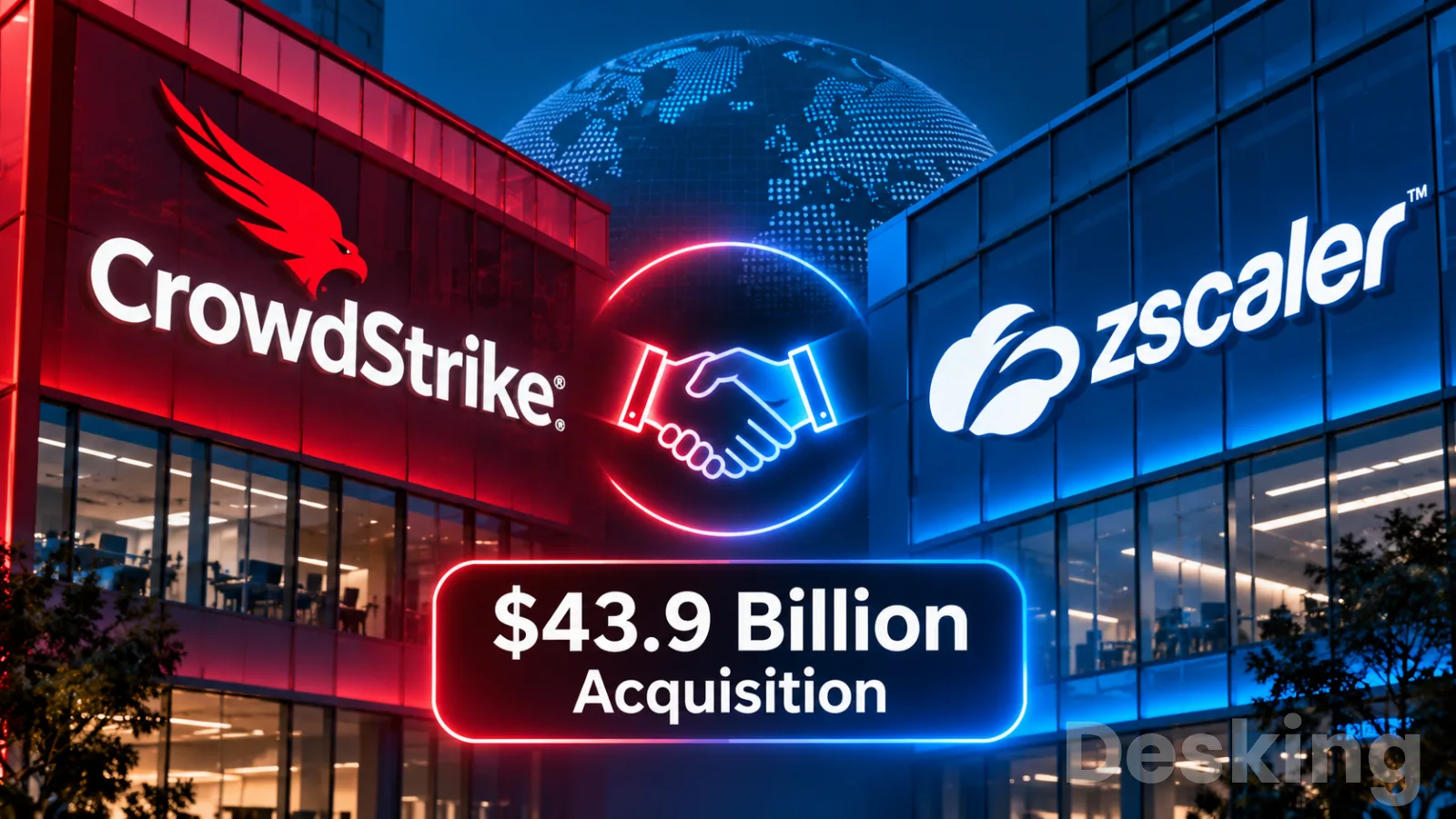
Table of contents
CrowdStrike agreed on Monday, November 23, 2026, to acquire cybersecurity company Zscaler in an all stock transaction valued at approximately $43.9 billion, bringing the two companies’ security technologies under the Falcon platform.
The agreement combines CrowdStrike’s endpoint, workload and identity protection with Zscaler’s cloud network security and Zero Trust services, subject to shareholder and regulatory approvals.
Under the terms announced by both companies, Zscaler shareholders will receive 1.135 shares of CrowdStrike common stock for each Zscaler share they own.
Based on CrowdStrike’s closing share price on November 20, the exchange represents approximately $260.41 per Zscaler share, a premium of about 34% to Zscaler’s closing price on that date.
The companies’ boards unanimously approved the agreement.
CrowdStrike said the combined business is expected to begin with more than $10 billion in annual recurring revenue.
The company estimates that the acquisition will expand its total addressable market by more than $185 billion by calendar year 2029 and create opportunities to sell its products to approximately 8,000 Zscaler customers that do not currently use CrowdStrike.
The transaction is expected to close in the second half of CrowdStrike’s fiscal 2028, subject to approval by Zscaler shareholders, regulatory clearances and other customary closing conditions.
Until completion, both companies will continue to operate independently.
CrowdStrike founder and CEO George Kurtz will lead the combined company, while Zscaler founder and CEO Jay Chaudhry will continue to run the Zscaler business and join CrowdStrike’s board.
How the transaction is structured

The $43.9 billion valuation is an enterprise value based on CrowdStrike’s November 20 closing share price.
The companies disclosed an implied value of approximately $260.41 for each Zscaler share, with the consideration paid entirely in CrowdStrike stock rather than cash.
The exchange ratio means that Zscaler investors will become shareholders in the combined company.
Once the transaction closes, existing CrowdStrike shareholders are expected to own approximately 84.1% of the business, while Zscaler shareholders will hold approximately 15.9%.
The implied offer price represents a 34% premium to Zscaler’s closing share price on November 20.
Reuters reported that the equity value of the transaction was approximately $42.46 billion, distinct from the $43.9 billion enterprise value announced by the companies.
The two figures describe different measures of the transaction and should not be treated as interchangeable.
Zscaler’s board approved the merger agreement, and the company disclosed voting agreements covering approximately 34% of its outstanding shares.
Those agreements include shares held by Chaudhry and affiliated entities, which have committed to support the transaction under the specified terms.
The agreement also includes a termination fee of $1.4 billion payable by Zscaler under certain circumstances, including if the company terminates the agreement to accept a superior proposal.
The fee and other termination provisions are set out in the merger documentation filed with the US Securities and Exchange Commission.

Hostinger VPS
Hostinger VPS delivers KVM virtualization, NVMe storage and full root access at prices that undercut most competing cloud providers.
- Strong price to specification ratio overall
- NVMe storage included on every tier
- Renewal rates climb steeply after promo
- Self managed means security is your job
The companies have not completed the acquisition.
Zscaler shareholders must approve the transaction, and the parties must obtain the required regulatory clearances before ownership can transfer.
Why CrowdStrike wants Zscaler
The acquisition extends CrowdStrike’s business from protecting devices and workloads to securing the network connections through which employees, applications and AI agents communicate.
CrowdStrike’s Falcon platform focuses on endpoints, cloud workloads, identities and data.
Zscaler provides cloud delivered security services that inspect and control access between users, applications and networks.
The companies describe the technologies as complementary.
CrowdStrike’s security tools collect information from endpoints and cloud workloads, while Zscaler’s Zero Trust Exchange sits between users, applications and agents to apply access policies to network connections.
Bringing those controls together would give CrowdStrike visibility across more parts of an organization’s IT environment.
The companies intend to combine endpoint and network telemetry in a shared security data layer.
CrowdStrike said its Falcon platform generates trillions of events each day from endpoints and cloud workloads, while Zscaler’s Zero Trust Exchange processes more than 750 billion transactions daily.
The companies plan to use the combined information in Falcon Next Gen SIEM and their security operations products.
The proposed integration is also intended to extend security controls to AI agents.
As organizations deploy software agents that can access applications, data and business systems, companies face the task of controlling what those agents can reach and what actions they can perform.
Zscaler’s network controls and CrowdStrike’s endpoint security are intended to cover different parts of that activity.
George Kurtz said the acquisition would bring network security into CrowdStrike’s platform.
“Security used to be about keeping the adversary out.
Today, safety is required to let AI in,” Kurtz said in the announcement.
Chaudhry said the agreement would extend Zscaler’s Zero Trust approach to a larger customer base.
He described the transaction as an evolution of the companies’ existing partnership.
The combination builds on an established commercial and technical relationship.
CrowdStrike said the companies already shared more than 2,000 customers and had 16 integrations between their products.
The acquisition would move that relationship from a partnership between separate vendors to a single corporate platform, although the integration would take place only after the deal closes.
Revenue and cost targets

CrowdStrike outlined several financial objectives associated with the acquisition.
The company expects the combined business to have more than $10 billion in annual recurring revenue at closing, including Zscaler’s reported $3.9 billion in annual recurring revenue from its most recently completed fiscal quarter.
The company also expects the acquisition to create revenue synergies as it sells products across both customer bases.
It projects approximately $1 billion in annualized run rate revenue synergies by the end of the first 30 months after closing.
The estimate is based on deeper customer relationships, cross selling and upselling, and incorporating Zscaler products into CrowdStrike’s Falcon Flex commercial model.
Cost reductions are another part of the financial plan.
CrowdStrike expects to achieve $500 million in annualized run rate cost synergies within 18 to 24 months after closing.
The company identified data center infrastructure, vendors and broader operations as areas where it expects savings.
These figures are management projections, not savings or revenue already achieved.
They depend on the transaction closing and the companies carrying out the integration plan.
CrowdStrike said it expects the acquisition to increase free cash flow per share immediately, before accounting for synergies, and to become accretive to revenue growth and certain non GAAP margin measures after synergies within the first fiscal year following completion.
The acquisition is also expected to expand CrowdStrike’s addressable market by more than $185 billion in calendar year 2029, according to the company.
That estimate reflects its planned entry into network security through Zscaler’s products.
Hostinger VPS
Hostinger VPS delivers KVM virtualization, NVMe storage and full root access at prices that undercut most competing cloud providers.
- Strong price to specification ratio overall
- NVMe storage included on every tier
- Renewal rates climb steeply after promo
- Self managed means security is your job
The figure represents a company estimate of market opportunity, not a forecast of revenue that the combined business will necessarily generate.
Leadership after closing
Kurtz will remain in charge of the combined company after the acquisition is completed.
Chaudhry will continue leading Zscaler’s business and will join CrowdStrike’s board of directors, according to the merger announcement.
The arrangement gives Zscaler’s founder an ongoing leadership role while placing the company within CrowdStrike’s wider corporate structure.
The announcement does not describe a broader management restructuring or identify other executive appointments resulting from the transaction.
The companies have also not published a detailed timetable for migrating customers, consolidating product operations or completing the technical integration.
They said both businesses will continue operating independently until the acquisition closes.
The planned Falcon Flex model is expected to provide a common commercial route for customers to purchase products from both companies after completion.
CrowdStrike said customers will be able to add the other company’s products through a single contract, rather than managing separate commercial arrangements.
For existing customers, the practical effect will depend on how the companies implement the integration.
The announcement does not state that current subscriptions, contracts or product interfaces will change before closing.

Regulatory review and competition
The acquisition will require regulatory approval in addition to a vote by Zscaler shareholders.
The merger agreement is subject to applicable antitrust and foreign investment reviews, as well as other customary closing conditions.
The size of the transaction and the position of both companies in cybersecurity are likely to attract regulatory attention.
Reuters reported that investors were considering the possibility of antitrust scrutiny because the deal combines two significant providers of enterprise security services.
Axel Rudolph, chief technical analyst at IG Group, told Reuters that regulatory scrutiny was possible but said it was too early to assume authorities would seek to block the transaction.
He identified the degree of overlap between the businesses and the availability of alternatives for customers as relevant questions for regulators.
The companies have not announced any regulatory objections or proposed remedies.
The transaction remains an agreement to acquire Zscaler, not a completed merger.
The merger documentation also establishes a deadline for completion.
If the acquisition has not closed by November 23, 2027, either party may have termination rights under specified circumstances.
The agreement provides for an extension to February 23, 2028, if certain antitrust or foreign investment approval conditions remain outstanding, subject to the contractual provisions.
Zscaler shareholders will be asked to vote on the agreement.
The company has agreed to call a shareholder meeting to seek approval, while the merger documents set out restrictions on soliciting alternative acquisition proposals, subject to specified exceptions.
Market reaction and company results
Investors responded differently to the announcement across the two companies.
Reuters reported that Zscaler shares rose more than 13% during trading on November 23 but remained below the implied offer value of $260.41 per share.
CrowdStrike shares fell nearly 12% during the session.
The difference between Zscaler’s market price and the implied consideration reflected investor uncertainty about the transaction and its completion.
Because the offer is paid in CrowdStrike shares, the value received by Zscaler shareholders is linked to CrowdStrike’s share price and can change before closing.
The acquisition announcement came on the same day that both companies reported quarterly financial results.
CrowdStrike reported fiscal third quarter 2027 revenue of $1.58 billion, up 28% year over year.
Its ending annual recurring revenue reached $6.26 billion, according to its results announcement.
Zscaler reported fiscal first quarter 2027 revenue of $949.3 million, an increase of 20% from the same period a year earlier, Reuters reported.
Its annual recurring revenue stood at $3.9 billion in the quarter referenced in the acquisition announcement.
The companies presented the acquisition alongside their financial results, but the transaction remains subject to the separate approval process.
Their quarterly performance does not remove the regulatory and shareholder conditions attached to the merger.
What customers should expect
Hostinger VPS
Hostinger VPS delivers KVM virtualization, NVMe storage and full root access at prices that undercut most competing cloud providers.
- Strong price to specification ratio overall
- NVMe storage included on every tier
- Renewal rates climb steeply after promo
- Self managed means security is your job

For organizations using either platform, the most significant proposed change is the possibility of buying endpoint and network security products through a more integrated offering.
CrowdStrike intends to combine Zscaler’s network security capabilities with Falcon’s existing endpoint, cloud workload, identity and data protection services.
The companies have not announced a mandatory migration for customers or a date for product consolidation.
Until closing, customers should expect the two businesses to operate independently under the terms announced.
The integration could also change how the companies package and sell their services.
CrowdStrike plans to make Zscaler products available through Falcon Flex, its existing commercial model, and expects to use its reseller, distributor, cloud marketplace and systems integrator relationships to expand distribution.
The companies have not published revised product prices, new subscription terms or a complete list of services that will be combined.
Those details remain separate from the acquisition agreement announced on November 23.
The next major steps are the Zscaler shareholder vote and the regulatory reviews.
If those conditions are satisfied, the companies expect to complete the acquisition in the second half of CrowdStrike’s fiscal 2028.