
Salesforce Expands Military AI Business With Rune Acquisition
By Noura Mint Ely · October 31, 2026
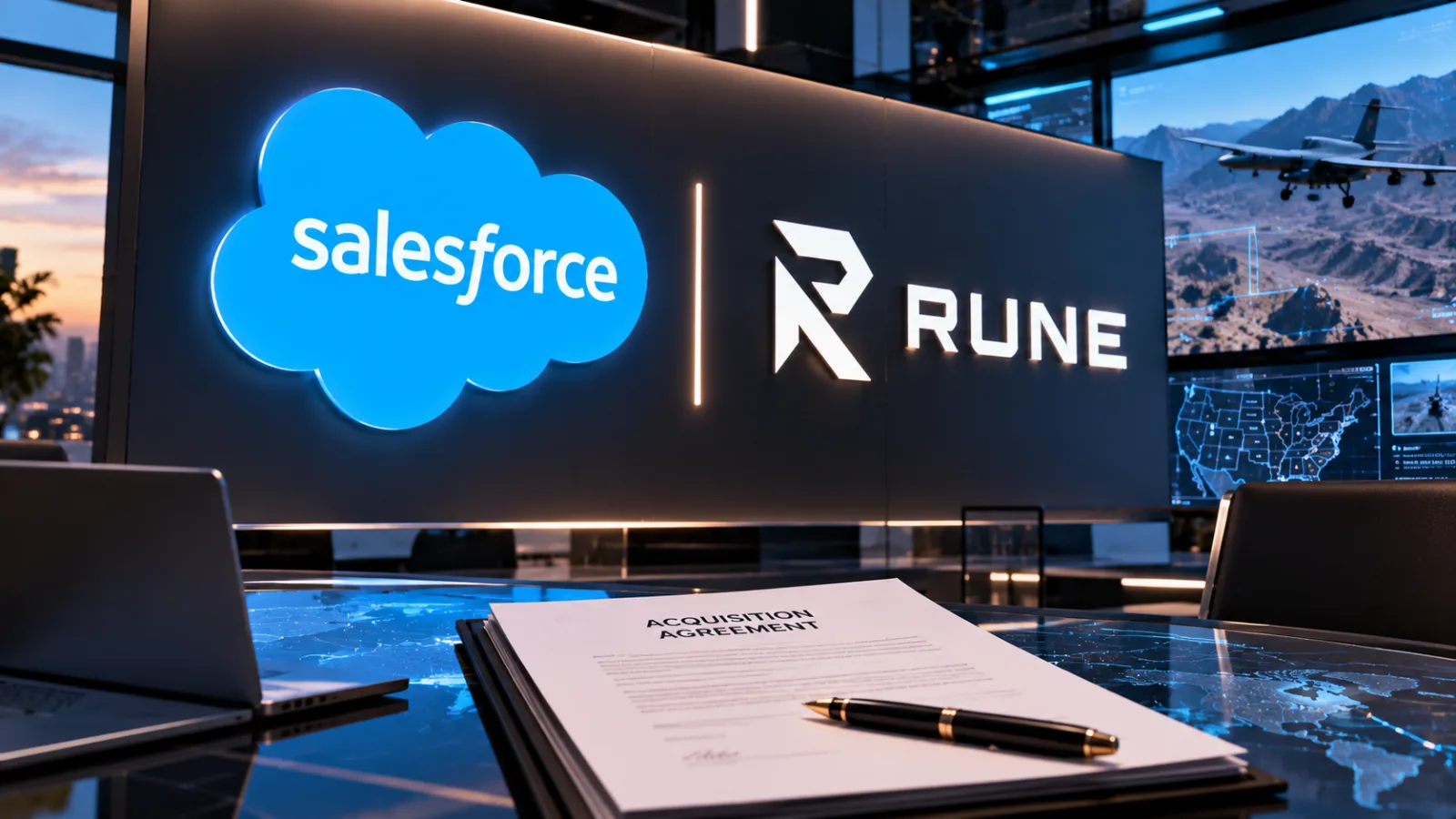
Table of contents
- Rune Gives Salesforce a Route From Headquarters to the Front Line
- What Rune Technologies Actually Does
- Why Offline Operation Matters for Military AI
- Missionforce Is Becoming More Important to Salesforce
- Why Salesforce Is Paying Attention to Defense Technology
- What the Reported $375 Million Price Tells Us
- How the Acquisition Fits Salesforce’s Broader M&A Strategy
- What Happens Next?
- The Bigger Picture: AI Is Moving Into the Logistics Behind Military Operations
Salesforce has signed an agreement to acquire Rune Technologies, a defense AI startup whose software helps military units forecast supply requirements and coordinate frontline logistics, in a move that would extend the enterprise software giant’s reach deeper into military operations.
The transaction’s price has been reported at $375 million in cash and stock, although Salesforce has not disclosed the financial terms.
Announced by Salesforce on October 29, the acquisition will bring Rune’s technology into Missionforce, the company’s business serving defense and national security organizations.
The strategic objective is to connect the systems used for planning at military headquarters with software designed to help personnel make logistical decisions in the field, including in environments where network connectivity is unreliable or unavailable.
The reported $375 million price comes from Resilience Media, which cited two people familiar with the transaction, according to TechCrunch.
It is not a figure confirmed in Salesforce’s announcement.
The deal highlights a broader shift in Salesforce’s strategy: expanding its AI business beyond conventional enterprise workflows and into specialized software for government and defense customers.
It also puts the company closer to the operational challenges of military logistics, where getting supplies, equipment, and resources to the right place at the right time can be as important as the systems used to plan an operation.
Rune Gives Salesforce a Route From Headquarters to the Front Line
Salesforce has long been associated with customer relationship management (CRM), sales software, and cloud-based enterprise applications.
Its defense business, however, is built around a wider ambition: providing digital systems that help government and military organizations coordinate information, resources, and operational processes.
Missionforce is central to that effort.
Salesforce describes the platform as a way to connect enterprise records and strategic planning with operational execution.
Rune would add capabilities designed for the tactical edge—the places where military personnel must make decisions under time pressure and may have limited access to communications networks.
That distinction is more than a product expansion.
Headquarters can use centralized systems to maintain records, plan operations, and coordinate resources.
Frontline units need tools that remain useful when the connection to those systems is disrupted.
Rune develops software for military logistics and sustainment, the work required to keep personnel, vehicles, equipment, and other resources supplied and operational.
Its technology is designed to help teams forecast demand, allocate resources, and plan transportation even when the network is unavailable.
By combining Rune’s operational software with Missionforce, Salesforce aims to link frontline decisions with the enterprise systems that support military planning and readiness.
In its October 29 announcement, Salesforce described the acquisition as its most significant national security-focused deal to date.
The transaction is expected to close in the fourth quarter of Salesforce’s fiscal 2027, subject to customary closing conditions.
What Rune Technologies Actually Does
Founded in 2024 by David Tuttle and Peter Goldsborough, Rune Technologies builds software for military logistics.
The company emerged from a recognition that frontline units often need to make supply and transportation decisions in conditions that traditional enterprise systems are not designed to handle on their own.
A military unit operating in the field must determine what supplies it needs, how quickly those supplies will be required, where resources are available, and how to move them to the appropriate location.
Those decisions become more difficult when inventory information is incomplete, demand changes rapidly, or communications with headquarters are disrupted.
Rune’s technology is intended to help address those problems by combining logistics information with operational data.
Its software supports several connected functions:
Salesforce
Salesforce connects customer data, sales pipelines, service operations, marketing, and automation, giving businesses a configurable CRM platform for managing c…
- Comprehensive customer relationship management capabilities
- Flexible sales process configuration options
- Advanced features require higher subscriptions
- Total costs can increase substantially
Supply forecasting: Estimating what units will need and when those requirements may arise.
Resource allocation: Helping planners determine how available supplies, equipment, and other resources should be distributed.
Transportation planning: Supporting decisions about moving supplies and resources to the locations where they are required.
Operational coordination: Connecting frontline logistics decisions with broader military planning and sustainment processes.
Disconnected operations: Supporting work when communications are disrupted, then synchronizing information when connectivity returns.
These capabilities are particularly relevant to military organizations because logistics decisions do not always happen in stable office environments.
A unit may need to continue operating even when it cannot maintain a reliable connection to a central network.
Salesforce says Rune’s technology is already deployed with the U.S. Army and U.S. Marine Corps.
That existing use gives the acquisition a practical operational foundation, although the companies have not publicly established a complete integration schedule for bringing Rune’s capabilities into Missionforce.
Why Offline Operation Matters for Military AI
One of Rune’s distinguishing characteristics is its focus on environments described as DDIL: denied, degraded, intermittent, or limited connectivity.
The term covers situations in which a network is unavailable, unreliable, periodically accessible, or constrained.
Such conditions can arise from infrastructure limitations, equipment failures, remote operating environments, or deliberate disruption of communications.
Many enterprise software products depend on persistent connections to centralized infrastructure.
That model works well for many office and administrative tasks, but it can become a liability when users must continue making decisions without a dependable network connection.
For military logistics, the consequences can be practical and immediate.
Personnel may need to check available inventory, assess supply requirements, update operational information, or coordinate transportation while disconnected from headquarters.
A system designed for DDIL environments must do more than display a warning when connectivity disappears.
It needs a way to support local operations, preserve relevant information, and reconcile updates when communication becomes available again.
Salesforce says Rune’s platform is designed to continue supporting frontline logistics in these conditions and synchronize information when connectivity returns.
The precise behavior of every feature, the full technical architecture, and the security controls associated with particular deployments have not been detailed in the acquisition announcement.
Those implementation details should not be assumed from the general description of disconnected operation.
Nevertheless, the underlying requirement is clear: military software must support both centralized coordination and the realities of operating far from a reliable network.
Missionforce Is Becoming More Important to Salesforce
The Rune agreement arrives as Salesforce expands its efforts to serve defense and government organizations.
According to Salesforce, Missionforce’s defense business grew 80% year over year during the year following its launch.
The company also said its customers span all six branches of the U.S. military.
Those figures are company-reported metrics, rather than independently audited measures presented in the acquisition announcement.
They nevertheless indicate how Salesforce is positioning Missionforce within its wider business strategy.
The company also points to a 10-year U.S. Army contract with a ceiling of $5.6 billion, announced in January 2026, as an important milestone for its government and defense operations.
The distinction between a contract ceiling and realized revenue is important.
A ceiling represents the maximum potential value under the relevant contract terms; it does not mean the full amount has already been spent, guaranteed as revenue, or paid to Salesforce.
Rune would add a different operational layer to that business.
Instead of concentrating primarily on enterprise records and strategic coordination, Salesforce would gain technology designed to support logistics decisions closer to frontline operations.
This creates a more complete proposition for military customers: connect planning and administrative systems with the processes that determine how supplies and resources move in the field.
Whether that integration delivers measurable improvements in readiness, efficiency, or operational outcomes will depend on implementation and actual use.
Salesforce has described the intended benefits, but the acquisition announcement does not provide independent performance measurements demonstrating the results of a combined platform.
Why Salesforce Is Paying Attention to Defense Technology
The acquisition also reflects Salesforce’s effort to diversify and expand the applications of its AI and enterprise software business.
Military and national security organizations manage complex networks of personnel, equipment, maintenance, procurement, inventory, and logistics.
These functions generate substantial amounts of operational information, but that information is useful only if the relevant people can access it, interpret it, and act on it at the right time.
AI-based forecasting and optimization can help analyze requirements, identify potential shortages, and evaluate resource-allocation options.
Enterprise software can then connect those decisions to records, workflows, and administrative processes.
In defense environments, however, the challenge extends beyond generating recommendations.
Systems must also function within demanding security requirements, accommodate fragmented data, and remain useful when communications are disrupted.
Rune gives Salesforce a product aimed directly at that operational problem.
It also offers an established technology and team rather than requiring Salesforce to build every frontline logistics capability from the ground up.
The acquisition could therefore accelerate the company’s attempt to connect its enterprise platform with military operations at the tactical edge.
The actual value of that strategy will depend on how successfully the companies integrate their technologies, meet customer requirements, and demonstrate that the combined platform provides benefits beyond those available from existing systems.
What the Reported $375 Million Price Tells Us
Resilience Media reported that Salesforce agreed to pay $375 million in a combination of cash and stock.
TechCrunch subsequently reported the figure while noting that Salesforce had not responded to its request for comment.
Salesforce
Salesforce connects customer data, sales pipelines, service operations, marketing, and automation, giving businesses a configurable CRM platform for managing c…
- Comprehensive customer relationship management capabilities
- Flexible sales process configuration options
- Advanced features require higher subscriptions
- Total costs can increase substantially
Salesforce’s official announcement did not disclose a purchase price.
The reported amount should therefore be treated as an attributed transaction figure, not a company-confirmed financial term.
Rune has raised approximately $30 million from investors, including Andreessen Horowitz, Point72 Ventures, and IQT, according to TechCrunch’s reporting.
PitchBook data cited in that report placed the startup’s previous valuation at $127 million following a Series A round.
If the reported $375 million purchase price is accurate, it would represent a substantially higher figure than that previous valuation.
However, the two amounts are not necessarily directly comparable: a private funding-round valuation and an acquisition price can reflect different circumstances, deal structures, and expectations about future commercial value.
The transaction also demonstrates why startup funding totals alone do not determine acquisition value.
A buyer may pay for technology, an established team, customer deployments, intellectual property, and the strategic advantages of incorporating a product into a larger platform.
Salesforce has not publicly provided a breakdown of the reported consideration or explained how the purchase price was calculated.
Any precise assessment of the deal’s valuation would therefore require additional financial details.
How the Acquisition Fits Salesforce’s Broader M&A Strategy
Rune is part of a wider pattern of acquisitions as Salesforce expands its portfolio of AI-powered and specialized enterprise applications.
TechCrunch reported that Salesforce has also pursued deals involving AI agent technology and other software companies.
The Rune transaction stands out because its core product is designed for military logistics rather than conventional commercial customer management.
The distinction matters for Salesforce’s long-term positioning.
Traditional enterprise software helps organizations manage customer relationships, sales pipelines, service requests, and business records.
Military logistics introduces a different set of requirements: operations may be time-sensitive, information may be incomplete, and systems must work under difficult connectivity conditions.
By acquiring Rune, Salesforce is pursuing a more direct role in the operational technology used by defense organizations.
That does not mean Salesforce is becoming a weapons manufacturer.
Rune’s announced focus is logistics and sustainment software, including supply forecasting, resource optimization, and transportation planning.
The acquisition instead reflects the expansion of commercial software and AI into military support functions that have historically depended on a mixture of specialized systems, manual processes, and large enterprise platforms.
For Salesforce, the strategic question is whether it can use its existing government relationships and enterprise infrastructure to deliver those capabilities at scale.
What Happens Next?
The agreement still needs to close, and the companies must complete the steps required under the transaction’s terms.
Salesforce expects the acquisition to close in the fourth quarter of its fiscal 2027, subject to customary closing conditions.
After closing, several developments will determine the deal’s practical significance.
Product integration: Salesforce will need to explain how Rune’s software will connect with Missionforce and which capabilities customers will be able to access through the combined offering.
Deployment and connectivity: Customers will need clarity about how the integrated platform will operate across headquarters, strategic planning environments, and disconnected frontline settings.
Security and compliance: Defense deployments require appropriate security controls and compliance with applicable government requirements.
The acquisition announcement does not establish the full details of future certification or deployment arrangements.
Customer adoption: Existing use of Rune’s technology by the Army and Marine Corps provides a starting point, but broader adoption will depend on operational requirements, procurement decisions, and successful integration.
Financial disclosure: The final purchase price and any material transaction details may become clearer through subsequent company disclosures.
Until then, the $375 million figure remains reported rather than officially confirmed.
The acquisition’s success will ultimately be measured less by the headline price than by whether the combined technology helps defense organizations coordinate resources more effectively and maintain readiness under difficult operating conditions.
The Bigger Picture: AI Is Moving Into the Logistics Behind Military Operations
The most consequential aspect of the Rune deal may be the type of problem Salesforce is seeking to solve.
Public discussion of military AI often focuses on autonomous systems, intelligence analysis, drones, and weapons.
Logistics is less visible, but it is essential to the ability of military organizations to operate.
Equipment must be maintained.
Supplies must be forecast and delivered.
Resources must be allocated across competing requirements.
Decisions must be made using information that can change quickly and may be incomplete.
AI software can potentially help with parts of this process by analyzing data, forecasting demand, and evaluating allocation or transportation options.
Enterprise platforms can connect those recommendations with the administrative and operational workflows needed to execute them.
But the technology does not eliminate the need for reliable data, accountable decision-making, appropriate human oversight, or resilient infrastructure.
A forecast is only as useful as the information and assumptions behind it, and a digital system cannot compensate for every physical constraint in a supply chain.
Rune’s focus on disconnected frontline environments addresses one important limitation of centralized enterprise systems.
Salesforce’s acquisition is an attempt to connect that specialized capability with the broader platform already serving defense customers.
The transaction therefore signals an expansion in how Salesforce wants to compete: not simply by providing software for organizations that support military operations, but by connecting enterprise planning to logistics decisions made closer to the field.
The agreement is confirmed.
Salesforce
Salesforce connects customer data, sales pipelines, service operations, marketing, and automation, giving businesses a configurable CRM platform for managing c…
- Comprehensive customer relationship management capabilities
- Flexible sales process configuration options
- Advanced features require higher subscriptions
- Total costs can increase substantially
The reported $375 million price is not.
And the longer-term value of the deal will depend on what Salesforce delivers after Rune becomes part of Missionforce.
1.
Salesforce — Salesforce Signs Definitive Agreement to Acquire Rune Technologies
Official announcement published October 29, 2026.
Confirms the acquisition agreement, Rune’s logistics capabilities, its intended role in Missionforce, the company’s stated defense-business growth, and the expected closing period.
Does not disclose the acquisition price.
2.
Reuters — Salesforce to Buy Defense Tech Firm Rune in Military Business Push
Published October 29, 2026.
Independently reports the acquisition, Rune’s military logistics focus, existing Army and Marine Corps use, and Salesforce’s expansion into defense technology.
Notes that financial terms were not disclosed.
3.
TechCrunch — Salesforce’s M&A Spree Continues With a Reported $375M Deal for Defense Tech Startup Rune
Published October 30, 2026.
Reports the $375 million figure attributed to Resilience Media, Rune’s funding history, its previous reported valuation, and the broader context of Salesforce’s acquisitions.
