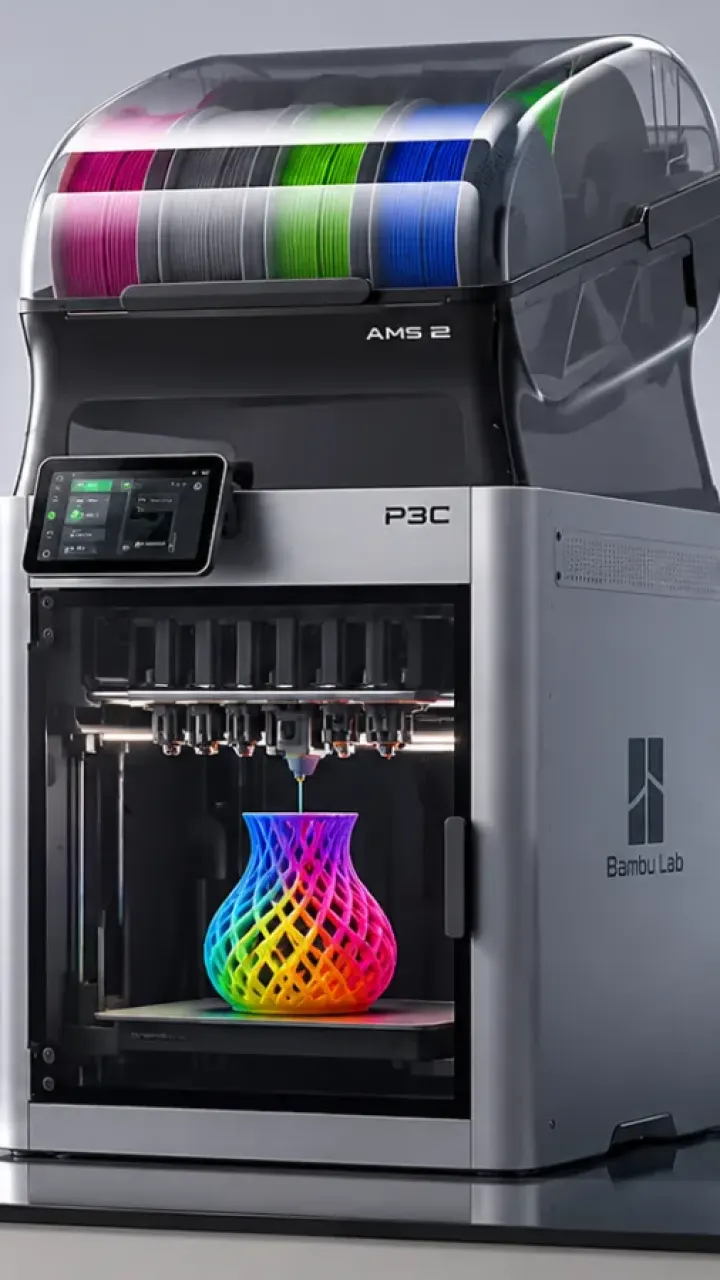


Bambu Lab P3C Brings Seven Tool Slots and Multi Material Printing to $1,149
 Published byNoura Mint ElySenior Technology ReporterNoura Mint ElySenior Technology Reporter Verified authorNoura Mint Ely is a Senior Technology Reporter at Desking, covering the latest developments in technology, artificial intelligence, enterprise software, cybersecurity, a…Author Profile
Ad disclaimer For links on this page, DESKING APP may earn a commission from the provider. This supports our work and has no influence on our editorial rating.
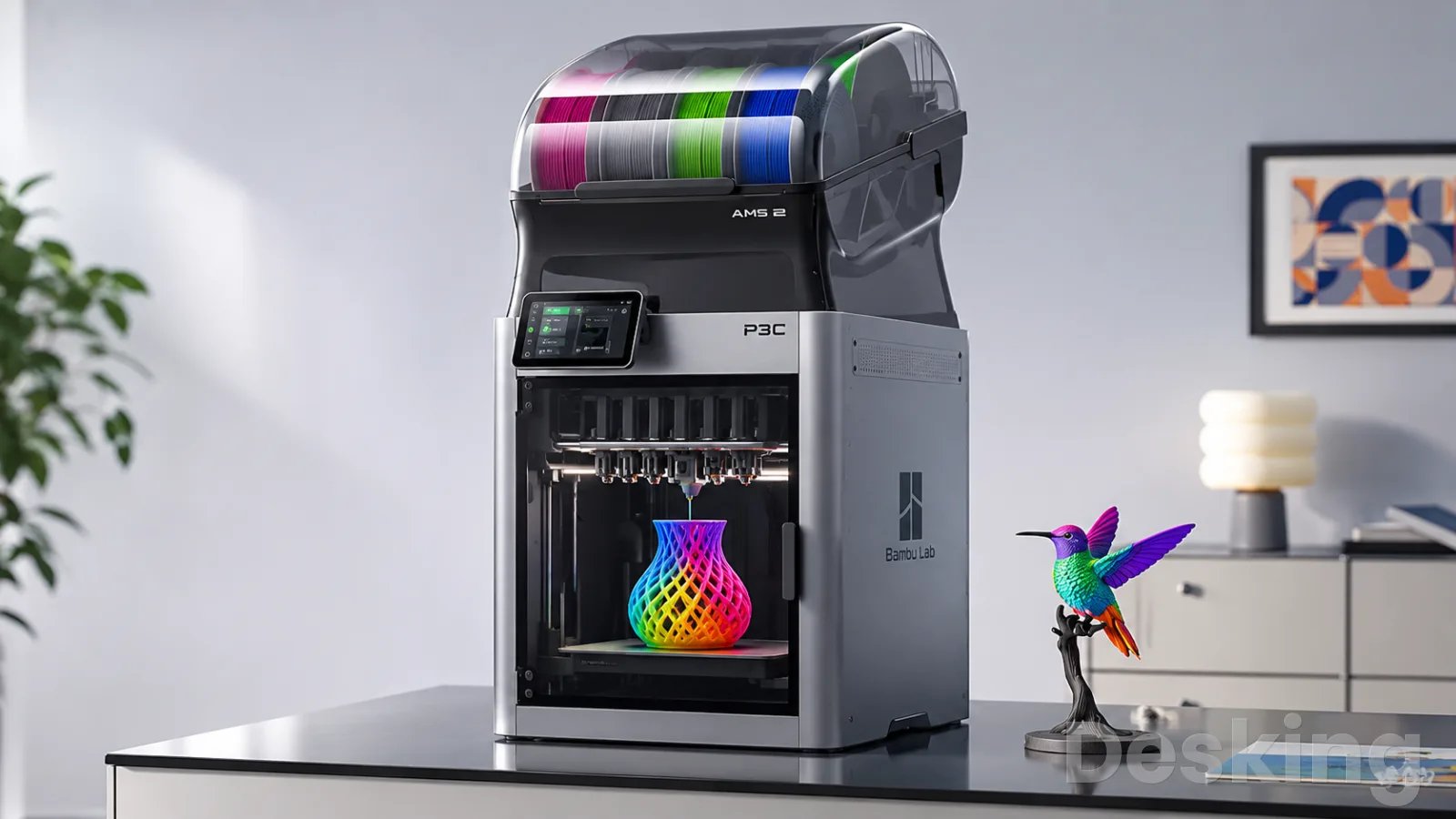
Table of contents
- Seven slots, five tools included
- How Swaptek handles material changes
- AMS 3P integrates filament storage
- FlexFeed supports different filament diameters
- Cutting and drawing tools extend its uses
- Technical specifications and printing capacity
- How the P3C compares with the H3C
- What independent testing found
- Pricing and availability
- A lower entry price with a more manual workflow
Bambu Lab launched the P3C on November 24, 2026, introducing a desktop 3D printer with seven independent tool slots, an integrated filament management system and automatic material changes that the company says take six seconds.
Starting at $1,149 before tax, the P3C brings technology from Bambu Lab's $2,499 H3C printer to a smaller and less expensive machine aimed at hobbyists, designers and small studios.
The standard package includes five PrintTools, while two additional slots remain available for optional tools and expanded printing configurations.
The P3C uses Bambu Lab's third generation Swaptek tool changing architecture.
Each PrintTool has its own filament path, heating system, power connection and data connection, allowing the printer to switch between materials without repeatedly retracting and reloading filament through a shared nozzle.
The launch expands the company's desktop printer range with a machine designed to produce objects using multiple colors, different materials and different nozzle sizes within a single print.
It also introduces a lower cost route into tool changing, a technology that traditionally requires more complex hardware than conventional single nozzle printers.
Bambu Lab announced the printer through its official newsroom and made it available for purchase worldwide on November 24.
The company positioned the P3C as a more accessible alternative to the H3C, although the lower price comes with some changes to the hardware and everyday operation.
Seven slots, five tools included
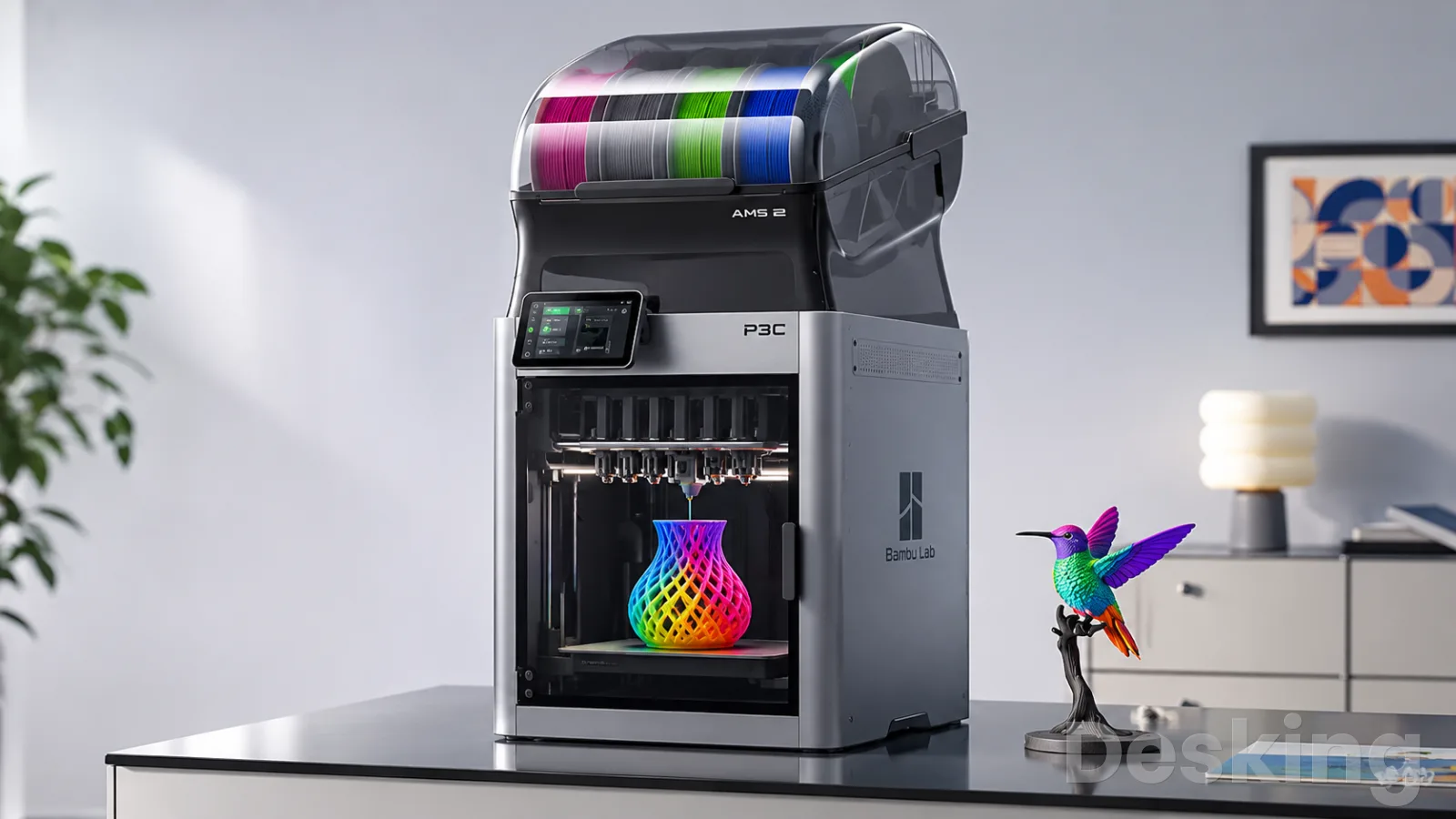
The defining feature of the P3C is its seven slot Swaptek system.
Unlike conventional printers that use one nozzle for several filament colors, the P3C can keep multiple dedicated PrintTools installed and switch between them during a print.
The standard P3C Combo includes five PrintTools, each equipped with a 0.4 mm hardened steel nozzle and designed for standard 1.75 mm filament.
The remaining two positions are open, allowing owners to add compatible tools according to their requirements.
This distinction is important when interpreting the printer's advertised seven tool capacity.
The standard $1,149 package does not arrive with seven complete printing tools.
Customers who want to use all seven positions must purchase additional compatible equipment.
The open positions can accommodate additional PrintTools, including configurations designed for 2.85 mm flexible filament.
Bambu Lab also offers different nozzle sizes as optional accessories, including 0.2 mm, 0.6 mm and 0.8 mm options.
The company says all included nozzles use hardened steel with a hardness rating of HRC 55+.
This construction is intended to support abrasive materials, including filaments reinforced with carbon fiber and glass fiber.
Having separate tools for different materials changes how a multi-color or multi-material print is produced.
A conventional single nozzle printer must remove one filament and introduce another whenever a color or material changes.
That process can require purging the previous material before the next one can be used.
With the P3C, each material remains assigned to its own PrintTool.
The printer selects the required tool during the job, reducing the need to repeatedly clean a shared filament path.
Bambu Lab says the system completes material changes in six seconds.
The company attributes this speed to its active preheating system, which begins preparing the next nozzle while the current tool is still printing.
The printer therefore does not need to wait until the next tool is installed before beginning its heating process.
A dedicated contact sensor measures nozzle temperature, while the retractable rack positions the selected tool for use.
The company says this architecture also reduces purging requirements.
However, the actual amount of material saved will depend on the design, the number of material changes and the selected printing configuration.

Xero
Xero is a cloud accounting platform aimed at small and growing businesses, combining invoicing, bank reconciliation, expense management, financial reporting, a…
- Unlimited users on US plans
- Strong bank reconciliation workflows
- Early plan has strict limits
- Advanced features require higher tiers
How Swaptek handles material changes
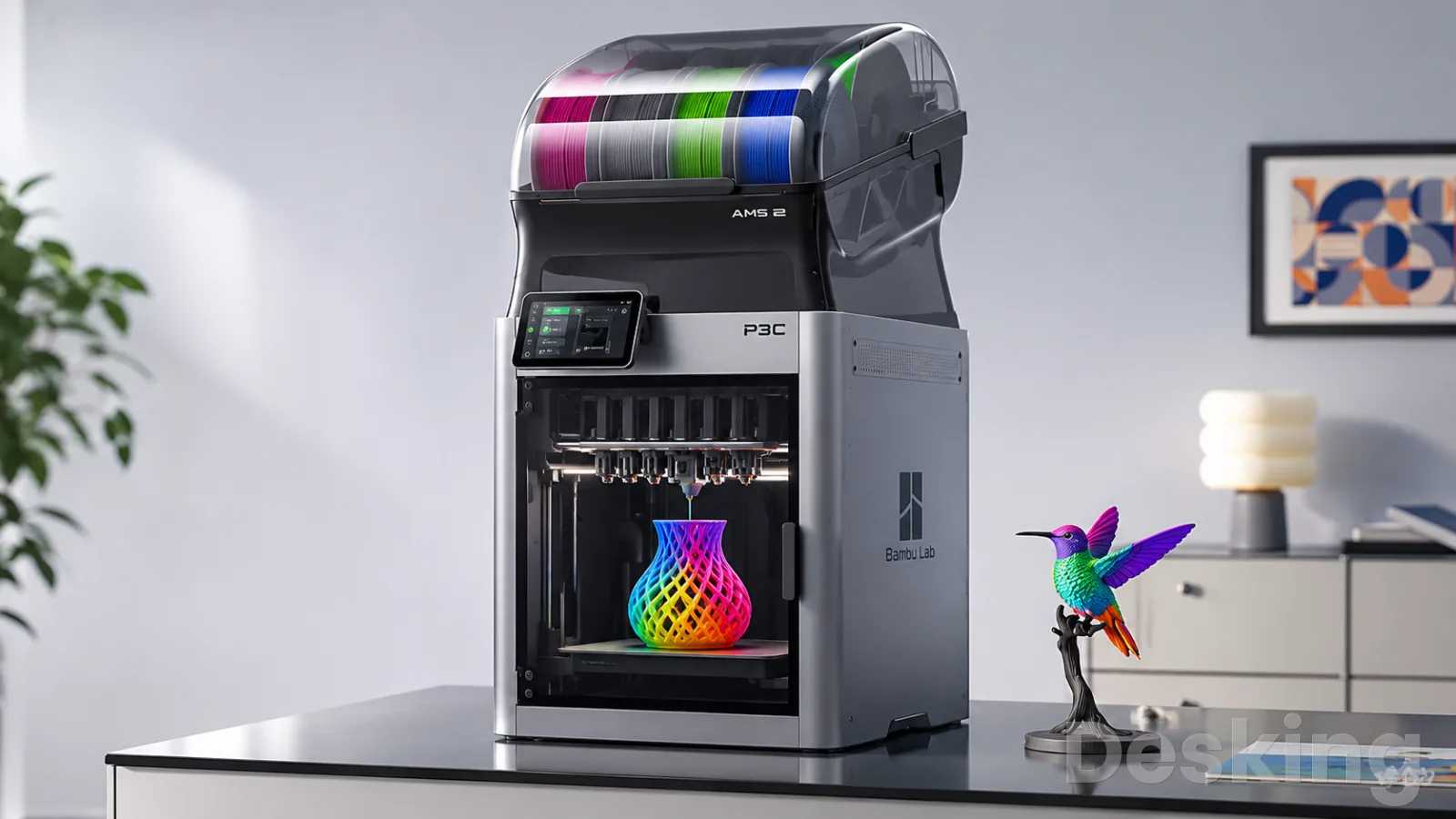
Swaptek is the central mechanical system behind the P3C.
Bambu Lab designed it to address a limitation of traditional multi-color printing: the time and material required to switch between filaments when several colors share a single nozzle.
Each PrintTool has an independent filament route and heating system.
The filament remains loaded in its dedicated tool, allowing the printer to select another nozzle without first extracting the previous material from a shared extrusion path.
The system also includes separate power and data connections for each tool.
This gives the printer control over the individual components and allows it to prepare the next nozzle before the material change takes place.
According to Bambu Lab, the process works through several coordinated operations:
- The printer identifies which PrintTool is required next.
- The next nozzle begins heating while the current tool continues printing.
- The retractable rack positions the selected tool.
- The printer connects the new tool and resumes material extrusion.
Bambu Lab says the complete material change takes approximately six seconds, with minimal purging.
The retractable rack is another important part of the design.
It moves along the Z axis to deliver tools to the printhead and then retracts away from the printing area.
The company says this arrangement reduces interference from filament tubes and helps prevent unwanted vibrations from affecting the finished object.
Swaptek also uses direct temperature measurement through a contact sensor.
Bambu Lab contrasts this with systems that rely on infrared temperature measurements, which the company says can be more susceptible to contamination.
These are manufacturer explanations of the architecture and its expected benefits.
Independent testing will determine how consistently the system performs across different materials, printing conditions and extended workloads.
AMS 3P integrates filament storage
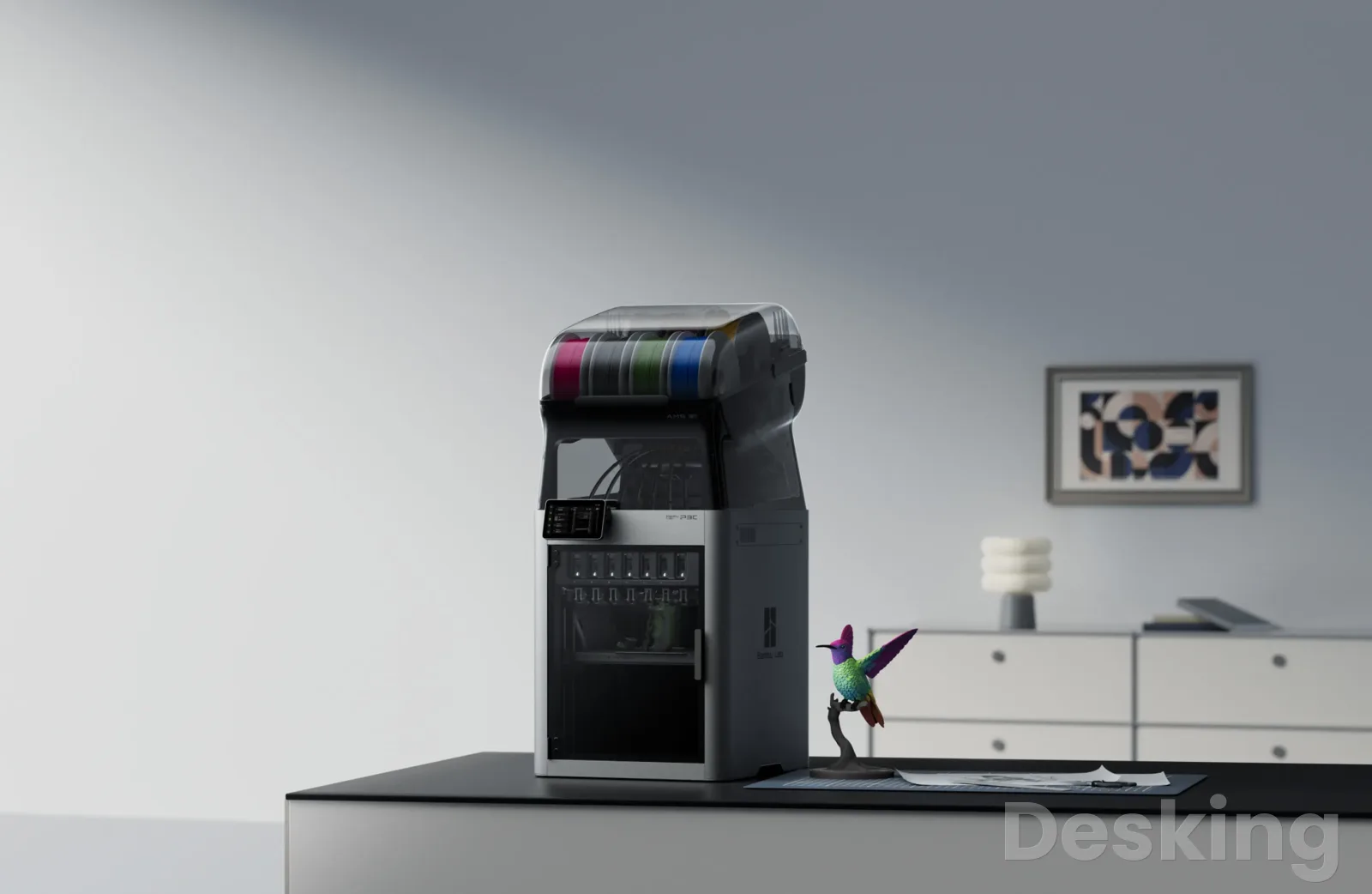
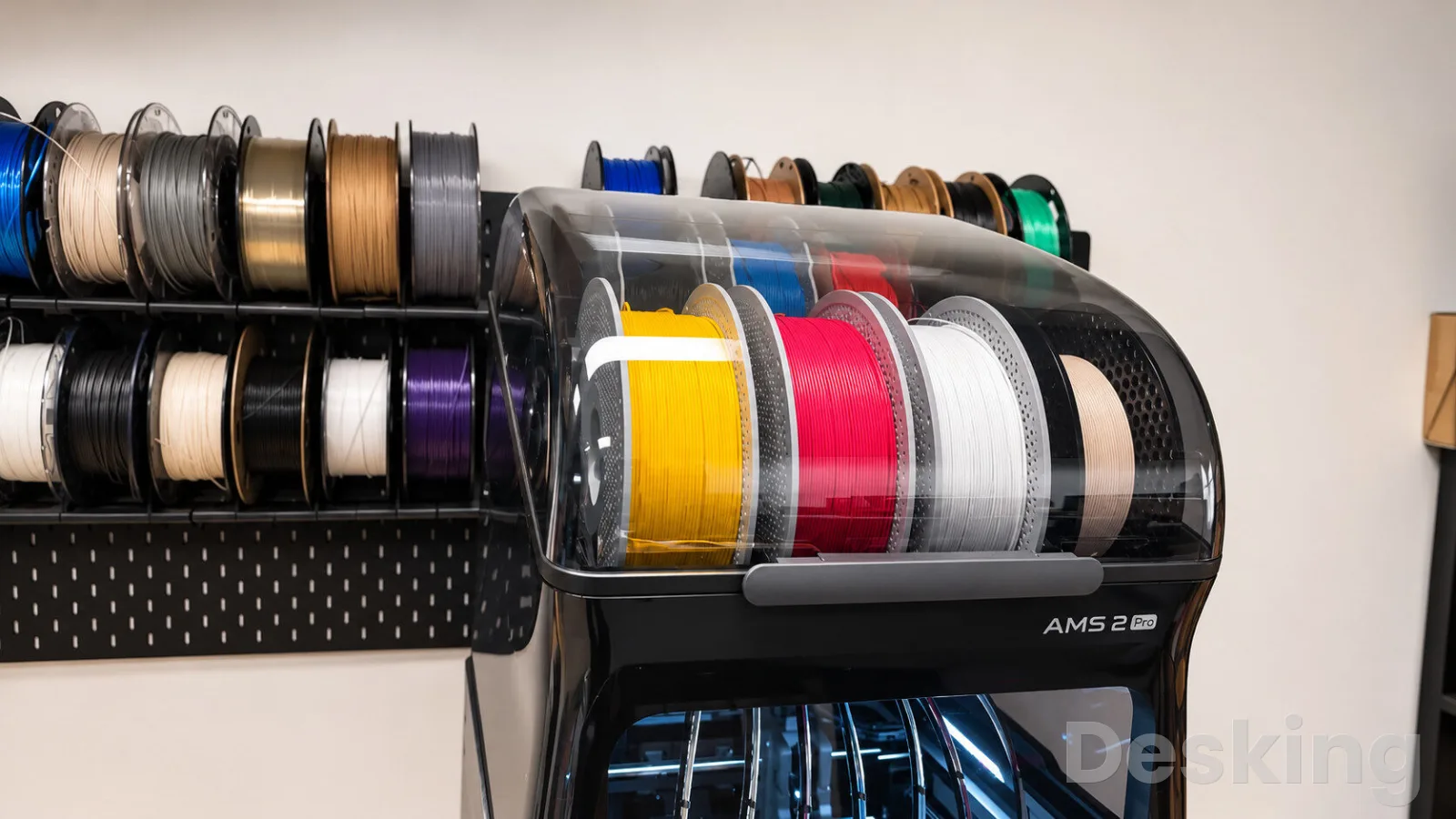
The P3C includes the AMS 3P filament management system as part of its standard Combo package.
Instead of requiring an external storage unit, the printer integrates filament compartments into its main structure.
Bambu Lab designed the compartments to keep filament enclosed and protected from environmental moisture.
The company says this arrangement is particularly useful in humid environments, where exposed filament can absorb moisture and affect print quality.
The integrated system is designed around seven spool positions, corresponding to the printer's maximum tool capacity.
The manufacturer says each spool has an independent feeding path.
However, the AMS 3P differs from the motorized automatic material systems used in some earlier Bambu Lab printers.
The Verge reported on November 24 that the P3C's AMS 3P does not include motors for automatic filament loading.
Users must manually feed filament through the system and into the corresponding PrintTools.
The publication described this as one of the main compromises made to achieve the printer's lower price.
According to Bambu Lab, loading five spools manually takes approximately five minutes.
The company told The Verge that it aims to reduce the hands on loading time to less than one minute through a future software update.
This is an important operational difference for customers familiar with earlier Bambu Lab systems.
The printer automates tool selection and material changes during printing, but preparing the filaments requires more manual involvement.
The AMS 3P also supports an optional drying module.
The accessory can dry two filament spools simultaneously at temperatures of up to 75 degrees Celsius.
Bambu Lab said the decision to limit active drying to two slots was related to power consumption, heat management and hardware costs.
The remaining filament positions still benefit from enclosed storage, but they do not receive active drying from the optional module.
For customers who require more filament capacity, the company offers another expansion route.
An optional buffer connected to PrintTool No. 1 allows the P3C to connect up to four external AMS units.
Bambu Lab says this configuration can support printing with up to 22 colors.
That capacity requires additional equipment and should not be confused with the seven tool positions available within the printer itself.
FlexFeed supports different filament diameters
Another feature of the P3C is its FlexFeed extruder, which supports both 1.75 mm and 2.85 mm filament.
The larger filament diameter is intended to improve the handling of very soft flexible materials, particularly TPU.
Bambu Lab says its configuration can print TPU with a hardness rating as low as 75A at up to five times the flow rate of its smaller diameter alternative.
Flexible filaments can be difficult to feed through conventional extrusion systems because their material properties make them more susceptible to deformation during feeding.
The FlexFeed system uses a cam mechanism and a dedicated permanent magnet synchronous motor.
Bambu Lab says electronic control adjusts the filament clamping force, helping maintain consistent feeding as the material moves through the extruder.
The support for two filament diameters also expands the types of objects that can be produced in a single job.
A designer could combine a rigid structural component with a softer section made from TPU without separating the materials into different prints.
For example, a wearable product could use a firmer material for its structural components and flexible TPU for areas that need to bend or provide cushioning.
Bambu Lab demonstrated this concept with a watch design combining a rigid body, a detailed dial and a flexible strap.
The company said the different sections could be printed using separate nozzle configurations in a single job.
The P3C also supports a mixture of nozzle sizes within the same project.
A smaller nozzle can handle fine details, while a larger one can deposit more material for sections where speed matters more than surface detail.
The printer supports nozzle diameters of 0.2 mm, 0.4 mm, 0.6 mm and 0.8 mm.
The ability to assign different sizes to different PrintTools allows users to combine these approaches without manually replacing a nozzle during the print.
Cutting and drawing tools extend its uses
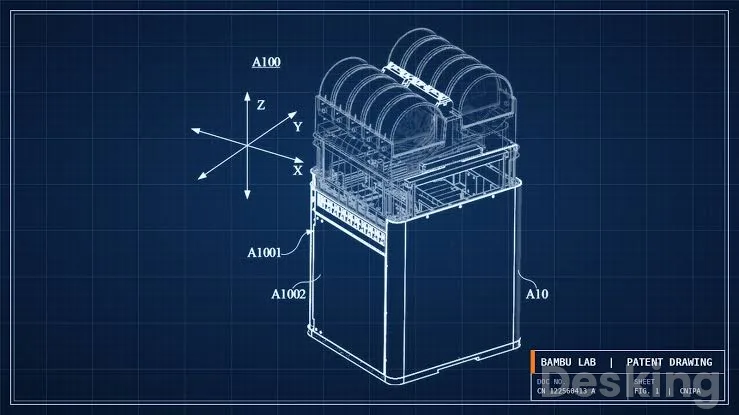
The seven slot system is not limited to conventional filament extrusion.
Bambu Lab designed the Swaptek architecture to accommodate compatible CraftTools, including tools for cutting, drawing and debossing.
These accessories can use the same general tool changing arrangement as the PrintTools.
Xero
Xero is a cloud accounting platform aimed at small and growing businesses, combining invoicing, bank reconciliation, expense management, financial reporting, a…
- Unlimited users on US plans
- Strong bank reconciliation workflows
- Early plan has strict limits
- Advanced features require higher tiers
This gives the P3C potential applications beyond producing three dimensional objects.
A compatible cutting tool can work on flat materials, while drawing and debossing tools provide additional ways to process designs.
The company says these operations can be coordinated through compatible project files and automatic tool changes.
The idea is to combine several fabrication processes within one machine rather than requiring separate equipment for every operation.
However, these capabilities depend on purchasing the relevant optional accessories.
The standard P3C Combo is supplied with five printing tools, not a complete collection of cutting, drawing and debossing equipment.
Bambu Lab also connects the printer to MakerWorld, its platform for sharing downloadable 3D models.
The company said it was preparing a collection of tool changer compatible projects with preconfigured files and printing profiles for the P3C and H3C.
The availability of prepared projects could reduce the amount of manual configuration required for users who do not design their own models.
It also provides a way to demonstrate the printer's multi-material capabilities without requiring customers to build complex projects from scratch.
Technical specifications and printing capacity
The P3C uses a build volume of 256 × 256 × 260 mm.
This gives it a relatively compact printing area compared with the larger H3C, while retaining the multi-tool architecture.
Bambu Lab published the following technical specifications:
| Specification | Bambu Lab P3C |
|---|---|
| Build volume | 256 × 256 × 260 mm |
| Tool changing system | Swaptek, seven slots |
| Standard included tools | Five PrintTools |
| Standard nozzle diameter | 0.4 mm |
| Supported nozzle diameters | 0.2 mm, 0.4 mm, 0.6 mm and 0.8 mm |
| Supported filament diameters | 1.75 mm and 2.85 mm |
| Maximum nozzle temperature | 300°C |
| Maximum bed temperature | 110°C |
| Extruder gears | Hardened steel |
| Air filtration | HEPA H11 |
| Product dimensions | 413 × 538 × 540 mm |
| Weight | 26.5 kg including AMS 3P |
The printer supports a range of common materials, including PLA, PETG, TPU, ABS, ASA, polycarbonate and several polyamide formulations.
Bambu Lab also lists support for carbon fiber and glass fiber reinforced filaments.
The maximum nozzle temperature of 300 degrees Celsius and bed temperature of 110 degrees Celsius define part of the machine's material operating range.
They do not mean that every filament listed by the company can be printed successfully under identical conditions.
The manufacturer also includes an H11 grade HEPA filtration system.
This is intended to help filter particles generated during printing.
Material selection, ventilation and the operating environment remain relevant considerations, particularly when printing engineering plastics.
The P3C does not have the same heated chamber configuration as the more expensive H3C.
Tom's Hardware identified the absence of a heated chamber and standard filament drying as limitations when comparing the two printers.
For users working primarily with common desktop printing materials, the smaller build volume and temperature limits may be acceptable.
Businesses producing larger parts or working regularly with materials that require controlled chamber temperatures may need a different machine.
How the P3C compares with the H3C
The P3C is positioned as a more affordable alternative to the H3C, which Bambu Lab introduced at $2,499.
Both printers use the third generation Swaptek architecture and share the advertised six second material switching speed.
The P3C reduces the price by simplifying parts of the system and using a smaller printing area.
The most visible differences concern capacity, included tools and material handling.
The P3C provides seven tool positions, with five PrintTools included in the standard package.
Its 256 × 256 × 260 mm build volume is smaller than the H3C's 330 × 320 × 325 mm printing area.
The P3C also omits some of the H3C's higher end features, including its heated chamber and automatic filament loading.
These differences help explain why the two machines are aimed at different users despite sharing the same core tool changing architecture.
For customers who need a larger build volume or more automated material handling, the H3C retains advantages.
The P3C is intended for users who prioritize multi-material printing and tool changing at a lower initial purchase price.
What independent testing found
The first independent coverage published on November 24 highlighted both the capabilities and the compromises of the P3C.
The Verge's Sean Hollister reported that the printer's multi-tool system made it possible to combine colors and materials without relying on the same single nozzle for every filament.
The publication tested a five color print using cyan, magenta, yellow, black and white PLA Palette materials, reporting that its hummingbird model came out nearly flawlessly on the first attempt.
The review also identified limitations in color mixing, including difficulty producing certain shades accurately.
The publication noted that the printer's manual filament loading process was less convenient than the motorized systems used in previous Bambu Lab products.
Hollister quoted Bambu Lab spokesperson Karlie Hou explaining that the company deliberately removed automatic loading from the AMS 3P to keep the price of the machine around half that of the H3C.
Tom's Hardware also published a review on November 24.
Its testing highlighted the printer's flexible filament capabilities, rapid color changes and ability to combine different nozzle sizes within one job.
The publication reported that the printer handled soft TPU particularly well.
It also identified manual filament loading, the machine's height and the absence of some convenience features as disadvantages.
These reviews provide an early picture of how the P3C performs outside the manufacturer's demonstrations.
Both publications identified the tool changing and multi-material capabilities as important features, while pointing to the manual preparation process as a meaningful tradeoff.
The distinction is relevant to prospective buyers.
A printer can automate operations during a print while still requiring considerable manual preparation before the job begins.
Pricing and availability
Bambu Lab made the P3C available worldwide on November 24, 2026.
The company announced several configurations, with the standard package starting at $1,149 before tax.
The published prices are:
| Configuration | US price |
|---|---|
| P3C Combo, printer, AMS 3P and five PrintTools | $1,149 |
| P3C Multi-Colorist Combo, introductory price before December 3 | $1,269 |
| P3C Multi-Colorist Combo, price from December 3 | $1,299 |
The Multi-Colorist Combo adds two additional 1.75 mm PrintTools to the standard package.
Xero
Xero is a cloud accounting platform aimed at small and growing businesses, combining invoicing, bank reconciliation, expense management, financial reporting, a…
- Unlimited users on US plans
- Strong bank reconciliation workflows
- Early plan has strict limits
- Advanced features require higher tiers
Bambu Lab said the introductory price applies before December 3, 2026, after which the price increases to $1,299.
The standard Combo is the entry point for customers who want the seven slot architecture but do not need to populate every position immediately.
Bambu Lab listed regional prices of £999 in the United Kingdom and €1,149 in Europe for the standard Combo, including tax.
The company said prices for other markets would be announced through their respective storefronts.
The optional drying module, additional PrintTools and external AMS equipment add to the total cost for customers who want a more extensive configuration.
The $1,149 starting price therefore represents the printer with five standard tools and the integrated AMS 3P, not a fully equipped seven tool configuration with every available accessory.
A lower entry price with a more manual workflow
The P3C gives Bambu Lab a lower priced option for customers interested in multi-material desktop printing.
Its seven slot architecture, dedicated PrintTools and support for different filament diameters distinguish it from conventional single nozzle machines.
The printer's strongest technical proposition is the ability to combine multiple materials and nozzle configurations within one project.
This can reduce the need to print separate components and assemble them afterward, particularly for designs that combine rigid and flexible materials.
Its limitations are equally relevant.
Five tools are included in the standard package, filament loading is manual, active drying is optional and the build volume is smaller than the H3C.
For hobbyists and small studios, the lower starting price may make tool changing more accessible.
For users who prioritize automated filament handling, larger prints or a heated chamber, the more expensive H3C and competing machines remain relevant alternatives.
The P3C's position in the market will depend not only on its ability to change tools quickly, but also on whether buyers consider the manual workflow and additional accessory costs acceptable.
The launch establishes a lower price point for Bambu Lab's third generation tool changing technology, while leaving customers to decide how much of that system they need.
Sources3
External pages are independent third-party sources. Desking App does not control or endorse their content and accepts no responsibility for it. Visiting them is at your own responsibility and risk.