


Microsoft Releases MAI Code 2 in Copilot With Lower AI Coding Costs
 Published byEvander ThorneSoftware ReviewerEvander ThorneSoftware Reviewer Verified authorEvander Thorne is a Software Reviewer and IT Management Specialist at Desking, specializing in enterprise software, IT service management, project management, and busine…Author Profile
Ad disclaimer For links on this page, DESKING APP may earn a commission from the provider. This supports our work and has no influence on our editorial rating.
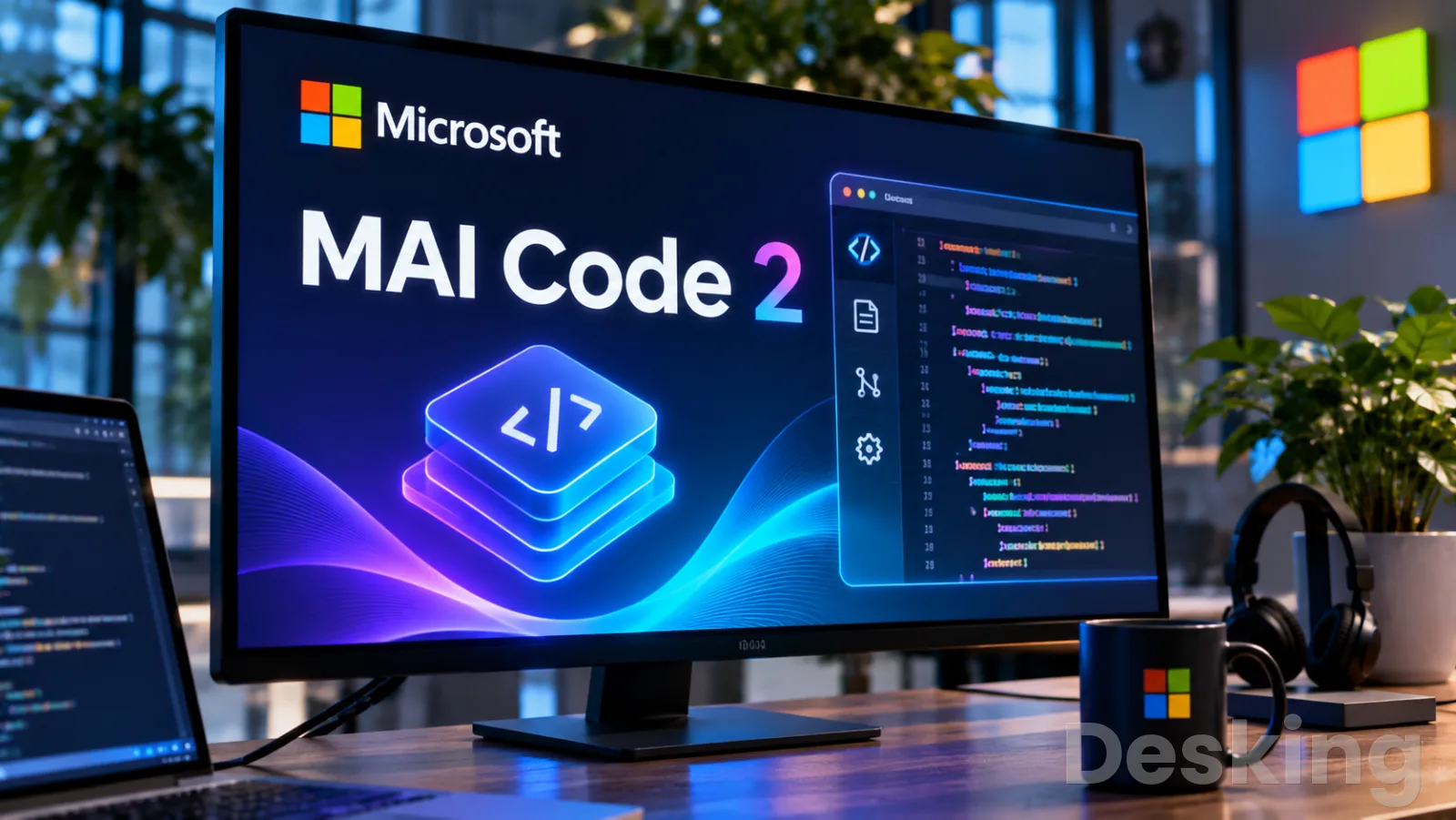
Table of contents
Microsoft released MAI Code 2 on November 17, 2026, introducing a new agentic coding model designed to handle complex software engineering tasks at a lower cost than competing systems.
The model, developed by Microsoft AI, became available through GitHub Copilot alongside a smaller version called MAI Code 2 Flash, giving developers two Microsoft built options for writing, debugging and modifying software.
Microsoft said its flagship model achieved 98% of the coding performance of GPT 6.1 Sol at approximately 40% of the price, while reaching 96% of Claude Opus 5.5's performance at 5% of its cost in selected benchmarks.
The release expands Microsoft's first party AI portfolio into a market where OpenAI and Anthropic have established strong positions among software developers.
It also gives Microsoft greater control over the models available inside GitHub Copilot, its developer assistant, rather than relying exclusively on technology supplied by external AI companies.
Microsoft introduced the models during its Ignite 2026 conference in San Francisco.
The announcement was part of a broader release of specialized AI systems covering cybersecurity, image generation, speech and automated decision making.
Two models for different development workloads

MAI Code 2 and MAI Code 2 Flash share the same product family but address different development requirements.
Microsoft designed MAI Code 2 for demanding software engineering work.
Its intended applications include implementing changes across multiple files, debugging complex applications, reasoning across entire code repositories and preparing software changes for production.
The company also highlighted its ability to generate user interfaces, dashboards and data visualizations.
These capabilities extend the model beyond conventional code completion, allowing developers to use it for tasks that involve both application logic and visual presentation.
MAI Code 2 Flash is the smaller alternative, optimized for speed and frequent requests.
Microsoft identified code explanations, targeted edits, routine fixes and rapid iterations as its main applications.
The distinction reflects two common patterns in AI assisted development.
Some requests require an AI system to understand a large codebase, plan several changes and execute a sequence of operations.
Others involve relatively simple tasks that developers perform repeatedly throughout the day.
Using a more expensive model for every request can increase the cost of operating an AI development environment.
Microsoft's two model approach gives developers the option to select a system according to the complexity and frequency of the work.
Microsoft said MAI Code 2 was not yet optimized for more demanding research applications, including fundamental scientific research and very long horizon agentic work.
The company's stated focus is everyday enterprise software engineering rather than unrestricted performance across every technical discipline.
This limitation is important when comparing the model with general purpose systems.
Performance in software engineering benchmarks does not establish equivalent capabilities in scientific research, mathematics or other specialized fields.
Microsoft's performance comparisons

Microsoft published its principal coding comparisons on November 17, using four benchmarks intended to represent everyday enterprise development tasks.
The evaluation included DeepSWE 1.1, Terminal Bench 2.1, SWE Atlas and FrontierCode v1.1.
Microsoft said MAI Code 2 achieved 98% of GPT 6.1 Sol's performance at approximately 40% of the price.
Against Anthropic's Claude Opus 5.5, Microsoft reported 96% of the performance at 5% of the cost.
The company also reported a separate result for frontend development.
Greenhouse
Greenhouse is a serious recruiting platform for companies that need hiring decisions to be consistent, measurable and accountable. Its strongest case is struct…
- Structured interviews support consistent evaluation
- Scorecards clarify candidate assessment criteria
- Pricing requires a customized vendor quote
- No publicly listed standard subscription price
In a blind evaluation comparing generated interfaces and applications, developers preferred MAI Code 2 over GPT 6 Sol in 64% of cases.
The visual coding evaluation covered user interfaces, games, data visualizations, 3D scenes and SVG graphics.
Microsoft said the assessment involved 258 annotators, who evaluated both visual appearance and functionality.
These results are relevant because software development increasingly involves generating complete interfaces and working applications rather than producing isolated code snippets.
A coding assistant may need to interpret a visual reference, implement the corresponding interface and make adjustments based on the resulting application.
Microsoft's published comparisons nevertheless require some qualification.
In the technical notes accompanying its results, the company explained that the models were evaluated at maximum reasoning effort.
The coding benchmarks were run through Microsoft's internal MSBench evaluation platform using the GitHub Copilot CLI without subagents.
FrontierCode 1.1 results and costs were obtained from Artificial Analysis.
Microsoft also disclosed that the MAI Code 2 cost comparison used a 50% promotional price.
This distinction matters when businesses calculate the expected cost of adopting the model.
A promotional price does not necessarily represent the standard long term cost of running the system.
Actual spending can also vary according to workload, model configuration, reasoning effort and the number of requests.
Microsoft acknowledged these variables in its published evaluation notes, stating that performance and cost comparisons depend on the task and pricing assumptions.
The company did not present the results as proof that MAI Code 2 would outperform every competing model in all software development environments.
MAI Code 2 Flash targets routine coding

The smaller model has its own performance and pricing comparisons.
Microsoft said MAI Code 2 Flash delivered performance comparable to GPT 6 Luna at 65% of the price and Claude Haiku 5.5 at 20% of the price.
The comparisons used three benchmarks: DeepSWE 1.1, Terminal Bench 2.1 and SWE Atlas.
Microsoft described these evaluations as representative of routine, high volume coding activities.
The company positioned Flash for developers who regularly request explanations, small modifications and corrections.
These activities may not require the deeper reasoning capabilities of a larger model, but they can account for a substantial number of interactions during a development session.
The lower cost structure is particularly relevant to organizations deploying coding agents across engineering teams.
An agent may perform several operations for a single user request, including inspecting files, searching a repository, modifying code and checking the resulting changes.
When these operations involve repeated model calls, the cost of inference becomes an operational consideration.
Microsoft's intention is to provide a smaller model for frequent work while retaining the larger MAI Code 2 for more complex engineering tasks.
The pricing comparisons for Flash also used a 50% promotional price, according to Microsoft's evaluation notes.
As with the flagship model, businesses should distinguish these promotional comparisons from the standard prices they may encounter later.
Microsoft did not disclose a universal savings figure for companies adopting both models.
The actual financial benefit will depend on how developers use them, which requests are assigned to each model and the pricing applicable to their subscriptions or deployments.
Availability through GitHub Copilot and Foundry
Microsoft made MAI Code 2 and MAI Code 2 Flash available through GitHub Copilot on November 17.
Both models were added to the GitHub Copilot model selection experience, allowing developers to choose between them when working with the service.
Microsoft also included the models in Copilot Fusion, its environment for agentic software development.
The availability through GitHub Copilot is commercially important because developers do not need to build an entirely separate application to begin testing Microsoft's coding models.
Organizations already using Copilot can evaluate the models within an established development workflow.
This reduces the operational steps involved in testing a new model, although teams still need to assess its output quality, reliability and compatibility with their development practices.
Microsoft also made MAI Code 2 Flash available through a limited access preview in Microsoft Foundry.
Foundry provides organizations with a platform for accessing and deploying AI models within their applications and services.
The company's November 17 announcement also identified additional distribution plans.
Microsoft said the models would be released on OpenRouter, Vercel, Hermes, OpenCode and Kilo.
Those platforms were described as forthcoming integrations rather than services with confirmed general availability on the announcement date.
The distinction between availability and planned distribution is relevant for developers choosing where to test the models.
GitHub Copilot was the immediate route for both coding models, while access through Foundry was more restricted for Flash.
Microsoft did not announce a single universal release date covering every planned platform.
Microsoft's model strategy extends beyond coding
MAI Code 2 is part of a broader effort by Microsoft to develop specialized models for its own products and enterprise customers.
During Ignite, Microsoft introduced seven new models across several categories.
The company emphasized that different applications require different combinations of intelligence, speed and operating cost.
The wider portfolio included MAI Cyber 2 Flash for cybersecurity, MAI Image 2.7 for image generation and editing, MAI Image 2.7 Flash for higher volume image workloads, MAI Realtime 1 for speech to speech applications and MAI Transcribe 2 for transcription.
Microsoft also announced Microsoft Decision 1.1, a model intended to support routing, classification, prioritization and other decisions within automated workflows.
The coding models fit into this strategy because software development is one of the areas where businesses can generate repeated AI requests and measure the operational cost of each task.
Microsoft AI chief Mustafa Suleyman discussed the company's approach in interviews surrounding the Ignite announcements.
Greenhouse
Greenhouse is a serious recruiting platform for companies that need hiring decisions to be consistent, measurable and accountable. Its strongest case is struct…
- Structured interviews support consistent evaluation
- Scorecards clarify candidate assessment criteria
- Pricing requires a customized vendor quote
- No publicly listed standard subscription price
Reuters reported that Suleyman described the strategy as building systems for specific domains to control costs while competing with external models on selected benchmarks.
In its interview with Axios, Suleyman also discussed Microsoft's progress toward developing a general purpose frontier model.
The publication reported that the company was continuing that work while releasing specialized systems.
This distinction is relevant to the positioning of MAI Code 2.
Microsoft is not presenting the coding model as a replacement for every general purpose AI system.
It is targeting a defined category of work where a specialized model may deliver a more favorable balance between performance and price.
Axios also reported that some of Microsoft's price comparisons relied on promotional discounts and that the models optimized for everyday coding would not necessarily deliver equivalent results in advanced mathematics or scientific research.
What the release means for software teams
For development teams, the immediate opportunity is to evaluate whether MAI Code 2 can reduce the cost of routine engineering work without lowering the quality of the resulting software.
The most relevant applications are tasks that already occur frequently in software projects:
Implementing changes across multiple files in an existing repository.
Investigating bugs and tracing problems across application components.
Explaining unfamiliar code to developers joining an existing project.
Generating and modifying frontend interfaces.
Creating dashboards and data visualizations.
Applying targeted fixes and making smaller code modifications.
Repeating development tasks through automated coding agents.
The larger model is positioned for tasks involving more extensive reasoning and changes across a repository.
Flash is intended for the more frequent requests that do not require the same level of processing.
Teams evaluating the models should compare them against their existing development assistants using actual repositories and representative tasks.
Benchmark results provide a starting point, but they cannot establish how a model will behave with every programming language, framework, internal coding convention or software architecture.
The quality of generated changes is also only one part of the evaluation.
Developers need to establish whether the model follows project instructions, handles dependencies correctly, produces maintainable code and responds appropriately when a requested modification introduces an error.
For organizations operating coding agents, the cost of repeated requests should be measured alongside the quality of completed work.
A lower cost per request does not automatically translate into lower total development costs if a model requires additional attempts, corrections or human intervention.
Security also remains relevant.
Automated coding systems can modify files and execute operations within development environments.
Companies need appropriate access controls, code review procedures and testing before accepting generated changes into production systems.
Microsoft's wider Ignite announcements addressed some of these concerns through its separate cybersecurity model and security products, but MAI Code 2's coding benchmarks should not be interpreted as a certification of software security.
Greenhouse
Greenhouse is a serious recruiting platform for companies that need hiring decisions to be consistent, measurable and accountable. Its strongest case is struct…
- Structured interviews support consistent evaluation
- Scorecards clarify candidate assessment criteria
- Pricing requires a customized vendor quote
- No publicly listed standard subscription price
Competition with OpenAI and Anthropic
The release gives Microsoft another way to compete with OpenAI and Anthropic in a market where coding assistants have become an important route for distributing AI models.
GitHub Copilot already provides access to models from different providers.
Adding Microsoft's own coding systems gives the company more control over the technology available within that product and creates an additional option for customers comparing performance and operating costs.
The commercial implications extend beyond model subscriptions.
Microsoft operates GitHub, Azure and Microsoft Foundry, giving it several distribution channels through which it can bring internally developed models to developers and enterprise customers.
That position can make adoption easier for organizations already using Microsoft's development and cloud infrastructure.
It also allows Microsoft to connect model development with the software tools and services where the models are used.
However, the announcement does not establish that customers will abandon external models.
Different systems may remain preferable for different programming tasks, and organizations can continue selecting models according to their technical requirements.
The availability of MAI Code 2 also does not eliminate the need for independent testing.
Microsoft's performance figures are useful for understanding its claims, but businesses should validate them against their own workloads before changing established development processes.
For now, the clearest development is that Microsoft has added two proprietary coding models to GitHub Copilot, with different capabilities and cost profiles.
MAI Code 2 is intended for more demanding software engineering, while Flash targets frequent, lower complexity requests.
The next stage of adoption will depend on the models' performance in production environments, the prices customers actually pay and the consistency of their results across real software projects.
Sources4
External pages are independent third-party sources. Desking App does not control or endorse their content and accepts no responsibility for it. Visiting them is at your own responsibility and risk.
