ChatGPT, Claude and Gemini: what $20 monthly buys in 2026
 Published byEva ElekchaGrowth Strategy SpecialistEva ElekchaGrowth Strategy Specialist Verified authorEva Elekcha is a Digital Marketing and Growth Strategy Specialist at Desking, covering the strategies, technologies, and platforms that help businesses strengthen their …Author Profile
Ad disclaimer For links on this page, DESKING APP may earn a commission from the provider. This supports our work and has no influence on our editorial rating.
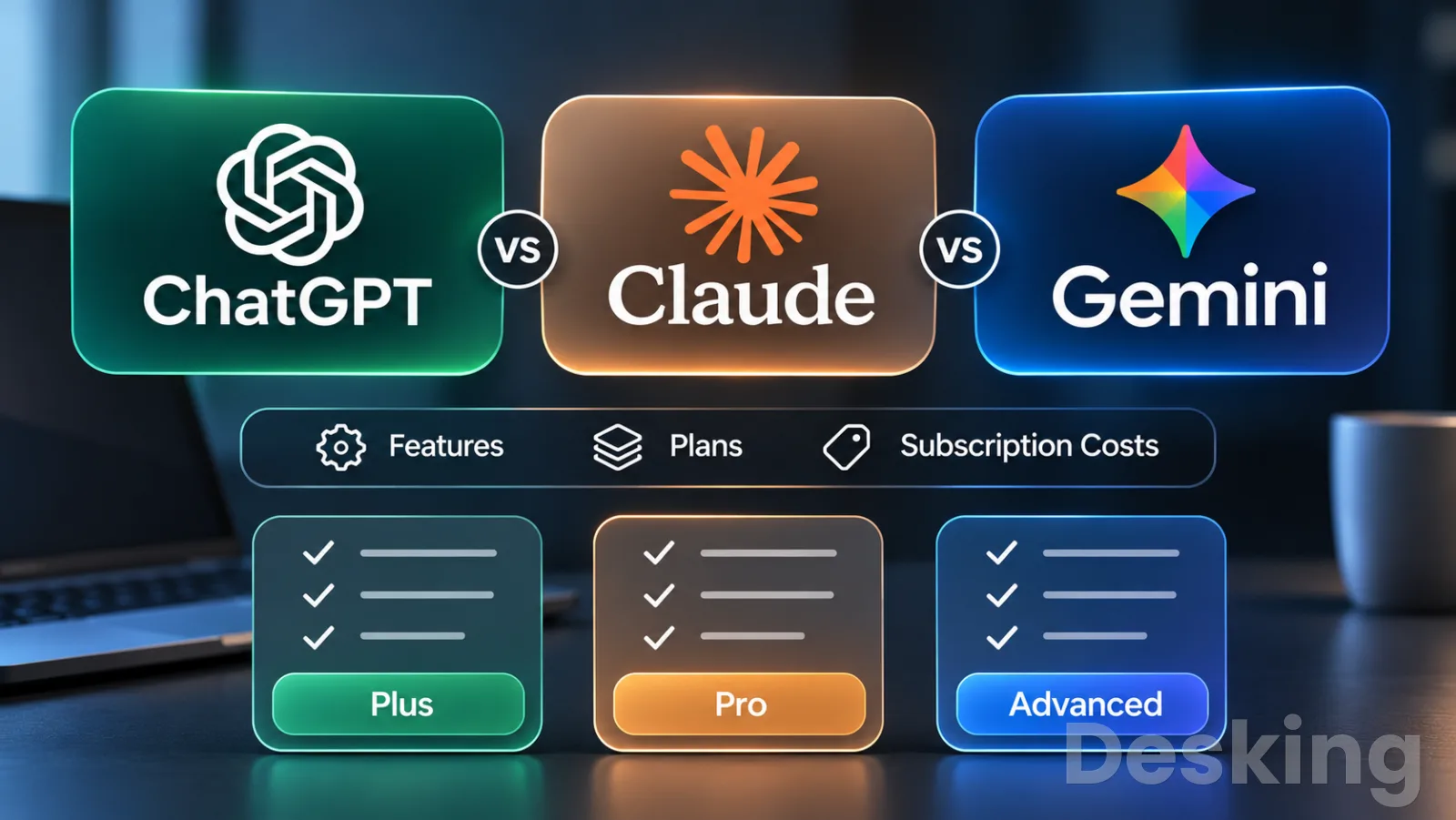
Table of contents
- 1. Compare the monthly subscription prices
- 2. Understand what ChatGPT Plus includes
- 3. See where Claude Pro differs
- 4. Examine Google's wider subscription bundle
- 5. Compare features beyond the chatbot
- 6. Read benchmarks with proper context
- 7. Understand usage and context limits
- 8. Choose according to your work
- Frequently Asked Questions
The three leading AI subscriptions occupy almost the same price bracket in the United States, yet they make different promises to paying users.
ChatGPT Plus costs $20 per month, Claude Pro costs $20 monthly or $200 when billed annually, and Google AI Pro costs $19.99 per month.
At first glance, choosing between them looks like a matter of personal preference.
The more useful comparison is what each subscription lets you accomplish, how quickly you can exhaust its allowance, and which other services come with the price.
The distinction has become more significant as the companies have introduced new model generations and expanded their products beyond conversational chat.
OpenAI now combines reasoning, image generation, research and coding tools in ChatGPT.
Anthropic has put greater emphasis on long document work, Claude Code and multi step tasks.
Google connects Gemini to its storage, productivity and creative services, including Gmail, Docs, NotebookLM and Google Flow.
The best purchase depends on the work you actually do, not a single leaderboard.
1. Compare the monthly subscription prices

The standard individual subscriptions cost almost exactly the same in the US.
ChatGPT Plus is $20 monthly, Claude Pro is $20 with monthly billing or an effective $17 per month on an annual subscription billed at $200, and Google AI Pro is $19.99 monthly.
The small price differences are less important than the billing commitment and included services.
These figures exclude applicable taxes and should not be assumed to apply in every country.
| Subscription | Monthly price | Annual cost at listed rate | Main selling point |
|---|---|---|---|
| ChatGPT Plus | $20 | $240 | General productivity and integrated tools |
| Claude Pro | $20 monthly or $17 annual equivalent | $200 on annual billing | Writing, coding and longer work |
| Google AI Pro | $19.99 | $239.88 | Gemini, Google integrations and storage |
Notebookcheck's November 2, 2026 pricing comparison confirms the three products remain close to the $20 monthly level.
Its review also highlights cheaper entry subscriptions, including ChatGPT Go and Google AI Plus.
Those lower tiers matter to occasional users who want more capacity than the free versions without paying for the full premium experience.
The headline price alone therefore does not describe the entire market.
The entry level options differ considerably.
ChatGPT Go costs $8 per month in the US, while Google AI Plus is listed at $9.99 and includes 2 TB of Google storage.
Claude does not offer an equivalent paid tier between Free and Pro on its individual pricing page.
Someone who mainly needs occasional answers may find the free versions sufficient, while a regular user should compare the standard subscriptions before paying for additional access.
2. Understand what ChatGPT Plus includes
ChatGPT Plus combines access to advanced reasoning models with a broad set of tools inside one application.
OpenAI lists expanded messages and uploads, image creation, Deep Research, memory, projects, scheduled tasks, custom GPTs, Codex and ChatGPT Work among the Plus benefits.
This makes the subscription particularly useful to people who move between research, writing, analysis, image creation and software development.
Its strength is the range of activities available without switching between separate products.
The practical value comes from how those capabilities connect.
A user can investigate a subject, upload supporting documents, analyze a spreadsheet, create an image and organize recurring work in the same account.

Proton VPN
Proton VPN combines Swiss privacy law, open source audited apps, and Secure Core routing with strong speeds and a genuinely usable free tier.
- Genuinely unlimited free VPN plan
- Fully open source client apps
- Monthly pricing sits above rivals
- Free plan limited to few countries
Codex provides a route into coding tasks, while ChatGPT Work supports more involved workflows across desktop, web and mobile.
These features make Plus a reasonable default for someone who wants one general purpose assistant rather than a specialized writing or coding product.
There are limits.
OpenAI describes Plus access as expanded, not unrestricted, and the available models and tools remain subject to usage limits.
Its pricing comparison lists a 256K total context window for GPT reasoning on Plus, compared with 400K on Pro.
Context size is only one measure of capacity, because model selection, reasoning effort, file size and task complexity also affect the experience.
A large context window does not guarantee unlimited messages or uninterrupted access.
ChatGPT also has a lower entry point than the other two standard subscriptions.
Go costs $8 per month and offers more messages with tools, uploads, image creation and voice than Free.
It does not provide the same advanced reasoning and expanded research package as Plus.
For users who mainly want a more generous everyday chatbot, Go can be a sensible first purchase.
People who depend on research, custom GPTs, advanced reasoning or heavier Codex use have stronger reasons to pay for Plus.
3. See where Claude Pro differs
Claude Pro is aimed at people who spend substantial time writing, programming, analyzing documents and working through complicated instructions.
Anthropic includes Claude Code, Projects, Research, additional models and task handoff features in the subscription.
Its product range also includes Claude Design, Claude Science and integrations with Microsoft 365.
The result is a subscription with a particularly clear appeal to developers, researchers and professionals who work with large amounts of text.
The annual billing option is a meaningful price advantage.
Paying $200 upfront makes Claude Pro equivalent to about $16.67 per month, compared with $240 over twelve months at the monthly rate.
That saves $40 across the year, but the customer accepts the annual commitment.
Anyone uncertain about long term usage should compare the flexibility of monthly billing against that saving.
Claude's usage system deserves particular attention.
Anthropic applies a five hour session limit and a weekly limit to paid plans.
Consumption depends on the model selected, the length of conversations, attached files and the features being used.
Usage across Claude's web interface, desktop application and Claude Code counts toward the same allowance.
A developer who uses Claude Code heavily may therefore reach a limit sooner than someone who mainly asks short questions.
Anthropic also offers higher individual tiers.
Max starts at $100 per month and provides five times the Pro usage allowance, while Ultra costs $200 and offers ten times Pro's weekly usage.
Verified Ultra accounts do not have the normal five hour limit.
Those prices are aimed at people who rely on Claude throughout the working day, rather than occasional users looking for a modest improvement over the free plan.
4. Examine Google's wider subscription bundle
Google AI Pro costs $19.99 per month in the United States and includes more than access to the Gemini application.
Google One lists 5 TB of storage shared across Google Photos, Drive and Gmail, higher Gemini usage, access to Gemini 4 Neon, Deep Research, Google Flow and Gemini features in Gmail, Docs and Vids.
The plan also includes Google NotebookLM benefits and other Google services.
For people already working inside Google's ecosystem, these additions can change the financial calculation.
Storage is one of the clearest differences in the comparison.
ChatGPT Plus and Claude Pro are primarily AI subscriptions, whereas Google AI Pro bundles its assistant with a substantial cloud storage allowance.
A person already paying for Google One storage may be able to replace an existing subscription rather than add another bill.
Google says storage can be shared with up to five others through the Google One family sharing arrangement, subject to the relevant account and household rules.
Gemini also has a direct connection to Google's productivity applications.
Its presence in Gmail and Docs can reduce the need to copy information between separate windows.
NotebookLM is useful for working with a defined collection of sources, while Google Flow supports AI assisted creative production.
The value of these features depends on whether the subscriber already uses Google services.
A business centered on Microsoft 365 may get less practical benefit from the same bundle.
Google AI Plus is a lower cost alternative at $9.99 per month, with 2 TB of storage and increased Gemini access compared with the free experience.
Google AI Ultra occupies the higher end of the market, starting at $99.99 monthly for the lower usage tier, with a $199.99 tier offering substantially higher limits.
Those premium options are difficult to justify for casual chatbot use, but can make sense for people who regularly use advanced models and Google's creative tools.
5. Compare features beyond the chatbot
The three applications overlap in writing, research, file analysis and coding, but the surrounding tools create different working environments.
ChatGPT emphasizes a broad collection of integrated capabilities.
Claude has developed a strong set of features around coding, documents and longer tasks.
Gemini benefits from its connection to Google's productivity and storage products.
The table summarizes the practical distinctions rather than claiming that one model produces the best answer for every task.
Proton VPN
Proton VPN combines Swiss privacy law, open source audited apps, and Secure Core routing with strong speeds and a genuinely usable free tier.
- Genuinely unlimited free VPN plan
- Fully open source client apps
- Monthly pricing sits above rivals
- Free plan limited to few countries
| Capability | ChatGPT Plus | Claude Pro | Google AI Pro |
|---|---|---|---|
| Advanced reasoning | Yes | Yes | Yes |
| Web research | Deep Research | Research | Deep Research |
| Image generation | Yes | Available through supported features | Yes |
| Coding tools | Codex | Claude Code | Google Antigravity access |
| Long document work | File uploads and context | Large context on supported models | Gemini and NotebookLM |
| Productivity integrations | Projects and connected tools | Microsoft 365 integrations | Gmail, Docs and Vids |
| Cloud storage bundle | No comparable storage allowance | No comparable storage allowance | 5 TB |
| Premium usage tiers | Pro from $100 | Max from $100 | Ultra from $99.99 |
This comparison needs one qualification: the availability of a feature does not mean every subscriber receives the same allowance.
Model access, reasoning settings, usage caps and regional availability can differ.
Some features also remain in beta or are available only through particular interfaces.
Before buying for a specific workflow, check whether the required feature is included in the plan and whether it is available in your country.
The difference is especially visible in coding.
ChatGPT Plus includes Codex, Claude Pro includes Claude Code, and Google AI Pro provides access to Google's Antigravity environment.
These are not interchangeable products.
They have different interfaces, workflows and usage rules.
A developer should test the same repository task in each environment, then assess code quality, debugging accuracy, tool integration and how much subscription capacity the task consumes.
6. Read benchmarks with proper context
Independent model evaluations offer useful evidence, but a benchmark score cannot decide which subscription is best for an individual.
Artificial Analysis's Intelligence Index v5 evaluates knowledge work, coding, science and general capabilities.
Its October 27 methodology update introduced new tests and private or held out datasets, which account for 60 percent of the index.
This makes the results more resistant to simple memorization, although the index still represents a defined selection of tasks rather than every real world use case.
The October version placed Claude Opus 5.5 at 58, GPT 6 Astra at 57 and GPT 6.1 Sol at 55.
Gemini 4 Argon scored 50 in that release.
These numbers should not be treated as a final ranking for the current November models.
Google subsequently released Gemini 4 Neon, while Anthropic introduced Claude Fable 5.2.
Model generations and benchmark versions change quickly, so an older leaderboard can become misleading within weeks.
DataCamp's November 24 comparison of Gemini 4 Neon and Claude Fable 5.2 provides a more recent example.
Across six shared benchmark results, each model led three.
Neon performed better on AutomationBench, Agents' Last Exam and Chartography, while Fable led on the Artificial Analysis Index, FrontierCode 2.0 and Terminal Bench Science.
DataCamp also cautioned that vendor evaluation setups can produce different scores for the same model, making small differences difficult to interpret.
The useful conclusion is that neither product has a universal technical lead.
A developer should give more weight to repository level coding tests than to image generation results.
A researcher should test document retrieval, source handling and factual accuracy.
A marketing team may care more about image creation, brand consistency and campaign workflows.
Benchmarks help narrow the field, but the subscriber's own repeatable tasks should decide the purchase.
7. Understand usage and context limits
A subscription's effective value depends on how much work it permits before access slows or stops.
Claude makes its session and weekly allowances explicit, and Anthropic explains that longer conversations and larger files consume more capacity.
ChatGPT and Gemini also apply plan and feature limits, although their allowances are presented differently across models and tools.
There is no reliable universal message count that can be applied to every subscriber.
Context windows also need careful interpretation.
Anthropic lists a one million token context window for several of its latest paid models, including Fable 5.2, Opus 5.5 and Sonnet 5.5.
Other Claude models use smaller windows.
OpenAI lists 256K total reasoning context for ChatGPT Plus, while Google's model and feature limits depend on the selected Gemini experience.
These figures describe how much information a model can handle in a conversation, not how much work a subscriber can perform each month.
For someone who analyzes lengthy reports, contracts or technical documentation, context can be important.
A larger window may reduce the need to divide source material into smaller batches.
It does not guarantee perfect recall, accurate citations or correct conclusions.
The user still needs to verify extracted figures and check whether the model has understood the relevant sections.
A shorter context with careful document selection can sometimes produce a more reliable result than uploading everything at once.
The practical limits to check before subscribing include:
- Message allowance: How much normal conversation is available before a reset or restriction?
- Model access: Does the plan include the advanced model needed for the work?
- Tool allowance: Are image creation, research, coding and agent features subject to separate caps?
- Context capacity: How much source material can the selected model process in one task?
- Reset schedule: Does capacity return after a session, daily period or weekly cycle?
A heavy user should pay attention to these details before choosing the cheapest plan.
Claude Pro's five hour and weekly limits are particularly relevant to people using Claude Code throughout the day.
ChatGPT Plus users should also distinguish general chat access from the separate allowances for advanced tools.
A subscription that looks inexpensive can become frustrating if its limits interrupt the exact workflow that justified the purchase.
8. Choose according to your work
For general productivity, ChatGPT Plus is the most balanced starting point.
Its combination of reasoning, Deep Research, image generation, projects, custom GPTs, Codex and ChatGPT Work covers a wide range of tasks.
It is a strong option for people who want one application for research, writing, data analysis and creative work.
Proton VPN
Proton VPN combines Swiss privacy law, open source audited apps, and Secure Core routing with strong speeds and a genuinely usable free tier.
- Genuinely unlimited free VPN plan
- Fully open source client apps
- Monthly pricing sits above rivals
- Free plan limited to few countries
The $20 monthly price is easy to compare with the alternatives, and Go offers a cheaper route for lighter use.
Claude Pro is the more focused choice for people whose working day revolves around code, long documents and substantial writing tasks.
Claude Code is included, and the annual subscription reduces the effective price to about $17 per month.
The main caution is its shared usage allowance across Claude interfaces.
A user who frequently works with large files or demanding coding sessions should consider whether Pro is enough before committing to the annual plan.
Google AI Pro is attractive to people who already use Gmail, Google Drive, Docs and Photos.
The 5 TB storage bundle, Gemini integrations, NotebookLM and Google Flow add value beyond the chatbot itself.
It is also competitively priced at $19.99 per month.
If a subscriber already pays for Google storage, the combined package may offer better overall value than a standalone AI subscription.
The decision becomes clearer when the use case is specific:
- Research and mixed office work: Start with ChatGPT Plus for its broad collection of tools and workflows.
- Software development: Compare Claude Pro and ChatGPT Plus using the same repository tasks, debugging requests and coding environment.
- Google Workspace users: Choose Google AI Pro if Gemini integrations and the storage allowance will replace services already being paid for.
- Occasional AI use: Try the free versions before taking on a recurring subscription.
- High volume professional work: Consider the $100 tiers only after measuring how often standard plan limits interrupt actual work.
There is no financial reason to subscribe to all three automatically.
A month of testing can reveal which product consistently saves time on the tasks that matter.
Keep a short record of failed answers, time spent correcting outputs, usage restrictions and useful features.
That evidence is more valuable than choosing a subscription because one model leads a public benchmark by a few points.
Frequently Asked Questions
Can I use all three subscriptions together?
Does Claude Pro include API credits?
Is Google AI Pro available everywhere?
Can I cancel an annual Claude subscription?
Are these subscriptions suitable for businesses?
Sources6
- Notebookcheck on AI subscription prices
- Artificial Analysis on its Intelligence Index
- Anthropic on Claude subscription plans
- Google One on AI subscription plans
- Hyperautomation Labs on coding agent tests
- Tom's Guide on ChatGPT and Claude differences
External pages are independent third-party sources. Desking App does not control or endorse their content and accepts no responsibility for it. Visiting them is at your own responsibility and risk.