The real cost of running AI models, from GPU rental to electricity
 Published byIsabella GunnLead Cybersecurity Editor at DeskingIsabella GunnLead Cybersecurity Editor at Desking Verified authorDr. Isabella Gunn, PhD, MBA - Is the Lead Cybersecurity Editor at Desking and a recognized authority in cybersecurity, digital privacy, and enterprise security. Holding …Author Profile
Ad disclaimer For links on this page, DESKING APP may earn a commission from the provider. This supports our work and has no influence on our editorial rating.
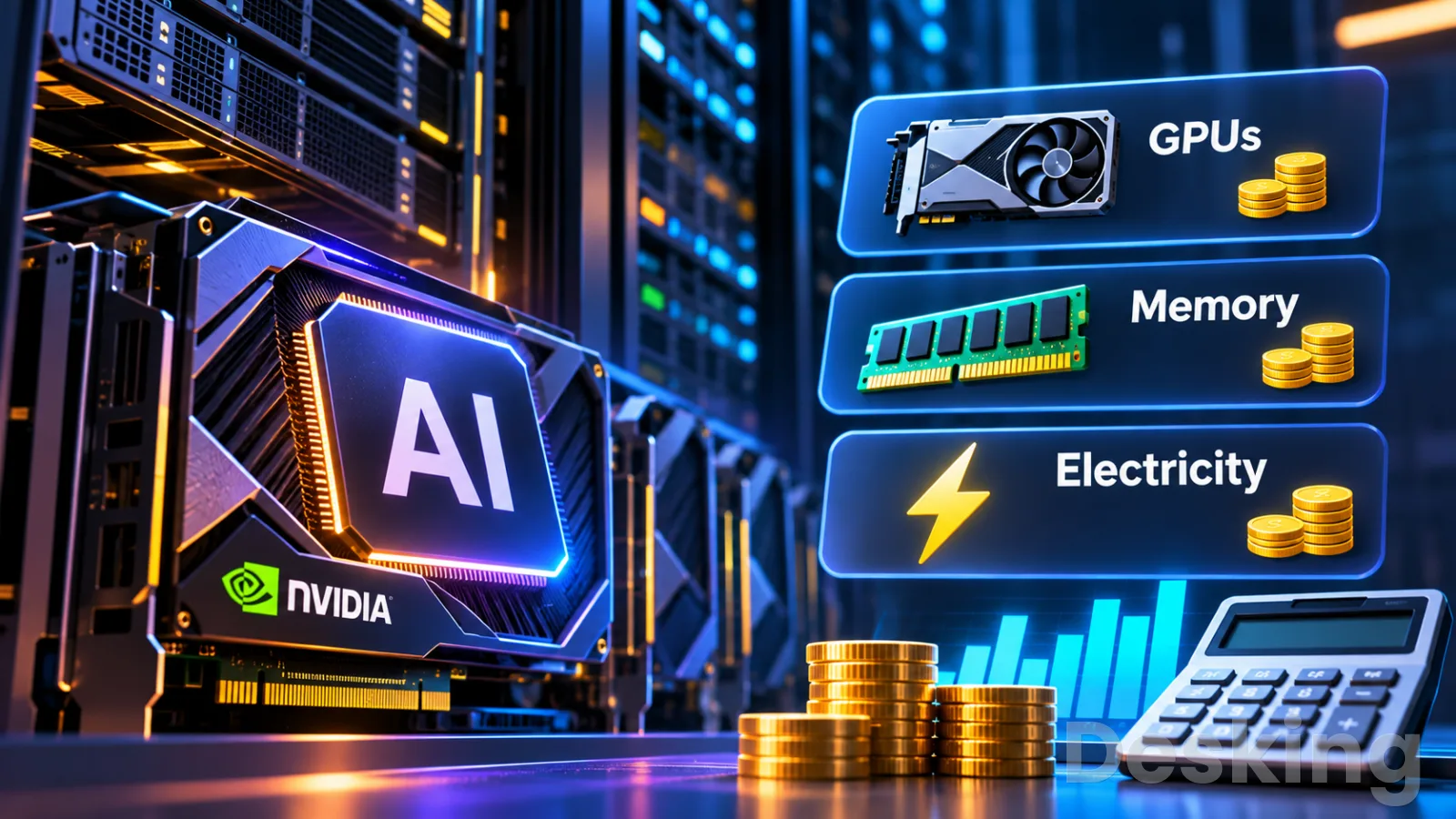
Table of contents
An NVIDIA H100 GPU rented on demand cost a median of $3.90 per hour in the November 16, 2026, snapshot published by Compute Census.
That price is a useful starting point for estimating AI infrastructure expenditure, but it does not represent the full cost of producing model output.
Memory capacity, server components, networking, electricity, cooling, storage and idle time all affect the economics of running an AI model.
The largest expense depends on the workload.
Training a frontier model ties up large accelerator clusters for extended periods, making hardware acquisition or rental a major cost.
Inference has a different profile: the system must keep model weights and growing request data accessible while serving users at acceptable speeds.
A GPU with enough processing power can still deliver poor economics if memory capacity, bandwidth or utilization prevents it from serving enough requests.
The practical way to evaluate AI infrastructure is to measure the cost of useful output, such as a million generated tokens or a completed inference request.
GPU prices matter, but the amount of productive work obtained from each paid GPU hour matters more.
1. The hardware bill starts with GPUs
A GPU is the main computational resource in many AI systems, and its price depends on whether an organization buys hardware, rents cloud capacity or uses a managed inference service.
Purchasing shifts expenditure toward capital investment, depreciation, maintenance and infrastructure.
Renting converts much of that commitment into a recurring hourly charge, although storage, networking and other services may remain separate.
Compute Census reported a median on demand price of $3.90 per H100 80GB GPU hour on November 16, 2026, based on 133 published provider quotes across 36 providers.
Its recorded prices ranged from $1.30 to $12.29 per hour.
The spread shows why a single advertised GPU price should not be treated as a universal market rate.
Provider, region, availability, reservation period and service configuration all affect the quote.
For a practical comparison, the same index listed these median hourly rates:
| GPU | Memory | Median rental price per hour |
|---|---|---|
| NVIDIA A100 80GB | 80GB | $1.75 |
| NVIDIA H100 80GB | 80GB | $3.90 |
| NVIDIA H200 | 141GB | $4.80 |
| NVIDIA B200 | 192GB | $7.40 |
These are published on demand rental medians, not purchase prices or guaranteed offers.
They also do not establish that the more expensive accelerator will be cheaper per generated token.
A faster GPU may complete more work in the same period, while a larger memory capacity may allow a model to run with fewer devices.
The correct comparison is the cost of delivering the same workload under equivalent latency and quality requirements.

Hostinger VPS
Hostinger VPS delivers KVM virtualization, NVMe storage and full root access at prices that undercut most competing cloud providers.
- Strong price to specification ratio overall
- NVMe storage included on every tier
- Renewal rates climb steeply after promo
- Self managed means security is your job
For organizations evaluating ownership, depreciation changes the calculation.
The acquisition price must be spread across the period in which the hardware remains useful, while accounting for utilization, maintenance, networking and the possibility that newer accelerators will change the economics.
An expensive GPU sitting idle is still consuming capital.
2. Memory determines model capacity

GPU memory is one of the main constraints on model deployment.
Model weights occupy memory when a model loads, while inference creates additional demand as requests arrive and context grows.
The available capacity determines which model configurations fit on a device and how many simultaneous requests can be served without moving data elsewhere.
The NVIDIA H100 SXM provides 80GB of high bandwidth memory and up to 3.35TB per second of memory bandwidth, according to NVIDIA's technical specifications.
Its maximum configurable thermal design power reaches 700 watts.
These specifications illustrate why accelerator selection involves more than comparing processing performance: memory capacity and the speed of moving data can determine the workload a GPU can sustain.
Inference also uses a key value cache, commonly called the KV cache.
It stores information from previous tokens so the model can generate subsequent tokens without recalculating the entire preceding context.
Longer conversations and larger batches increase this memory requirement.
A deployment may therefore run out of available GPU memory even when its arithmetic processing capacity is not fully occupied.
A 2026 survey in Artificial Intelligence Review identifies model weight movement, KV cache movement and activation movement as three major sources of inference data traffic.
Its analysis explains why memory bandwidth can become the limiting factor during generation.
At low batch sizes, repeatedly loading model weights can dominate.
With larger batches or longer contexts, KV cache traffic can become the stronger constraint.
Memory efficiency also affects the number of GPUs required.
Quantization reduces the space occupied by model weights by representing parameters with fewer bits, although the resulting quality and performance depend on the model and implementation.
KV cache compression, grouped query attention and more efficient memory allocation can reduce the capacity required for serving.
3. Electricity includes the facility

Electricity is frequently underestimated because GPU specifications describe the accelerator rather than the entire data center.
Servers also need CPUs, memory, storage and networking equipment.
Cooling systems, power conversion and other facility operations add further consumption.
The electricity bill therefore cannot be calculated accurately by multiplying a GPU's advertised power rating by operating hours alone.
Epoch AI estimated that GPUs account for approximately 41% of total facility power in a typical frontier AI data center at peak operation.
Its analysis attributes 63% to server power, 71% to total IT equipment and the remainder to facility overhead.
The estimate uses reference architectures and a peak power model, so actual proportions vary with hardware, cooling design and operating conditions.
The U.S. Energy Information Administration reported an average industrial electricity price of 8.62 cents per kilowatt hour in 2025.
Commercial customers paid an average of 13.41 cents.
Those figures are national averages, not the rates available to every data center, and local tariffs, demand charges and power contracts can change the economics substantially.
The International Energy Agency reported that data center electricity demand increased by 17% in 2025.
Its April 2026 analysis projected that global data center consumption would rise from 485 terawatt hours in 2025 to 950 terawatt hours in 2030.
Electricity use by AI focused data centers is projected to triple over that period.
A simplified calculation illustrates the difference between accelerator power and a complete facility estimate.
Eight H100 SXM GPUs at their maximum configurable 700 watt rating would draw 5.6 kilowatts collectively.
Operating for 720 hours would consume approximately 4,032 kilowatt hours at the GPUs alone.
At the EIA's 2025 industrial average, that represents about $348 in electricity, excluding the rest of the server and facility.
Epoch AI's separate facility analysis estimates an overhead multiplier of approximately 2.44 between GPU power and total facility power in its GB200 based reference model.
Hostinger VPS
Hostinger VPS delivers KVM virtualization, NVMe storage and full root access at prices that undercut most competing cloud providers.
- Strong price to specification ratio overall
- NVMe storage included on every tier
- Renewal rates climb steeply after promo
- Self managed means security is your job
Applying that multiplier as an illustrative scenario would raise the eight GPU system's estimated facility consumption to approximately 9,838 kilowatt hours per month, or about $848 at the same electricity rate.
This is not a measured H100 facility bill: the multiplier comes from a different reference architecture and the example excludes local tariff differences.
4. Training and inference spend differently

Training and inference consume the same broad categories of infrastructure, but their cost profiles differ.
Training performs repeated computations across large datasets and can require clusters of accelerators operating together.
Inference runs a trained model to answer requests, with expenditure accumulating across the number, length and complexity of those requests.
A 2025 revision of the research paper The Rising Costs of Training Frontier AI Models estimated the costs of developing leading models using hardware, energy, cloud rental and research staff.
For GPT 4 and Gemini, accelerator hardware and staff represented the largest development expenses.
Server components accounted for 15% to 22%, interconnect hardware for 9% to 13%, and energy for 2% to 6% of estimated total development costs.
That finding should not be interpreted as evidence that electricity is unimportant.
Energy can represent a smaller share of a training project's financial cost while still imposing major power capacity requirements.
It also does not mean the same percentages apply to inference, where request volume, utilization and memory traffic can change the cost structure.
Inference economics are particularly sensitive to the number of requests served concurrently.
Running a model for one request at a time can leave substantial GPU capacity unused.
Batching allows a serving system to process multiple requests together, spreading some of the weight loading and computation costs across more output.
However, larger batches also consume more memory through their KV caches.
A published engineering evaluation provides a concrete example of the effect.
Researchers from UC Berkeley, Stanford and other institutions developed vLLM and its PagedAttention memory management approach.
Their paper reported two to four times higher serving throughput than the systems used for comparison, at the same latency level.
The result came from their evaluated workloads, not a universal guarantee for every model or deployment.
5. Measure the cost per output
An hourly GPU price is useful for procurement, but it is a weak measure of application economics.
A business needs to know how much it spends to produce valid output at the required quality and response speed.
That means measuring total infrastructure expenditure against actual completed requests or generated tokens, rather than counting the number of GPUs alone.
Consider an illustrative rental scenario using eight H100 GPUs at the Compute Census median of $3.90 per GPU hour.
The cluster costs $31.20 per hour for accelerator rental.
If it runs continuously for a 30 day month of 720 hours, the GPU rental alone reaches $22,464.
This example excludes additional services and assumes the same hourly rate throughout the period.
The result changes significantly with utilization.
If the cluster spends half its time waiting for requests, the organization still pays for the reserved GPU hours while producing less output.
If better scheduling and batching allow the same hardware to serve more requests, the cost per token can fall without purchasing another accelerator.
A useful cost review should track the following measurements:
- GPU utilization: Record how much time accelerators spend performing useful work rather than waiting for requests or data.
- Memory pressure: Measure model weight capacity, KV cache consumption, memory bandwidth and the number of requests that fit concurrently.
- Output throughput: Track generated tokens per second and completed requests under representative production traffic.
- Electricity and cooling: Include facility consumption, local tariffs, power conversion and cooling overhead when calculating owned infrastructure costs.
- Service quality: Measure latency, failed requests and output quality so that cheaper configurations are not rewarded for delivering an inferior service.
These measurements also help separate hardware limitations from software inefficiency.
A GPU can be underutilized because requests arrive too slowly, batches are too small, memory allocation is inefficient or the application spends time waiting on storage and network operations.
Increasing accelerator capacity without diagnosing the bottleneck can increase expenditure without improving useful throughput.
6. Lower costs through system design
The most effective cost reduction often comes from improving the amount of useful work each accelerator completes.
Quantization can reduce model weight size and memory traffic.
More efficient attention mechanisms can reduce KV cache requirements.
Continuous batching can keep the hardware occupied as requests arrive and finish at different times.
Other changes require workload specific testing.
Hostinger VPS
Hostinger VPS delivers KVM virtualization, NVMe storage and full root access at prices that undercut most competing cloud providers.
- Strong price to specification ratio overall
- NVMe storage included on every tier
- Renewal rates climb steeply after promo
- Self managed means security is your job
Smaller models may serve simpler tasks at lower cost, while larger models remain necessary for requests that demand greater capability.
Routing requests according to complexity can avoid sending every task to the most expensive model.
Caching repeated results can also reduce unnecessary inference, provided the application can safely reuse previous outputs.
Infrastructure purchasing decisions should follow measurements from production like workloads.
An H200 or B200 may justify its higher hourly price if its additional memory or throughput reduces the number of GPUs needed.
Conversely, an older A100 may remain economically suitable for workloads that fit its memory capacity and do not require the latest performance.
Published hourly rates alone cannot settle that decision.
The broader cost picture is changing as hardware efficiency improves and AI usage expands.
Stanford's 2026 AI Index reported that the cost of GPU computation had fallen by more than 99% since 2006.
The IEA's electricity projections show that aggregate data center demand is still expected to rise sharply.
Lower computation costs can therefore coexist with higher total infrastructure expenditure as more models and users consume computing resources.
Frequently Asked Questions
How much does one H100 cost per hour?
Does GPU memory increase inference costs?
Is electricity the biggest cost of AI models?
Is renting GPUs cheaper than buying them?
Why can a faster GPU cost less per token?
What is the best way to reduce AI inference costs?
Sources5
- NVIDIA on H100 hardware specifications
- Stanford AI Index on GPU computation costs
- Epoch AI on GPU data center power
- US Energy Information Administration on electricity prices
- arXiv on frontier model training costs
External pages are independent third-party sources. Desking App does not control or endorse their content and accepts no responsibility for it. Visiting them is at your own responsibility and risk.