Microsoft vs Google AI: Cloud growth, models and enterprise reach in 2026
 Published byEva ElekchaGrowth Strategy SpecialistEva ElekchaGrowth Strategy Specialist Verified authorEva Elekcha is a Digital Marketing and Growth Strategy Specialist at Desking, covering the strategies, technologies, and platforms that help businesses strengthen their …Author Profile
Ad disclaimer For links on this page, DESKING APP may earn a commission from the provider. This supports our work and has no influence on our editorial rating.
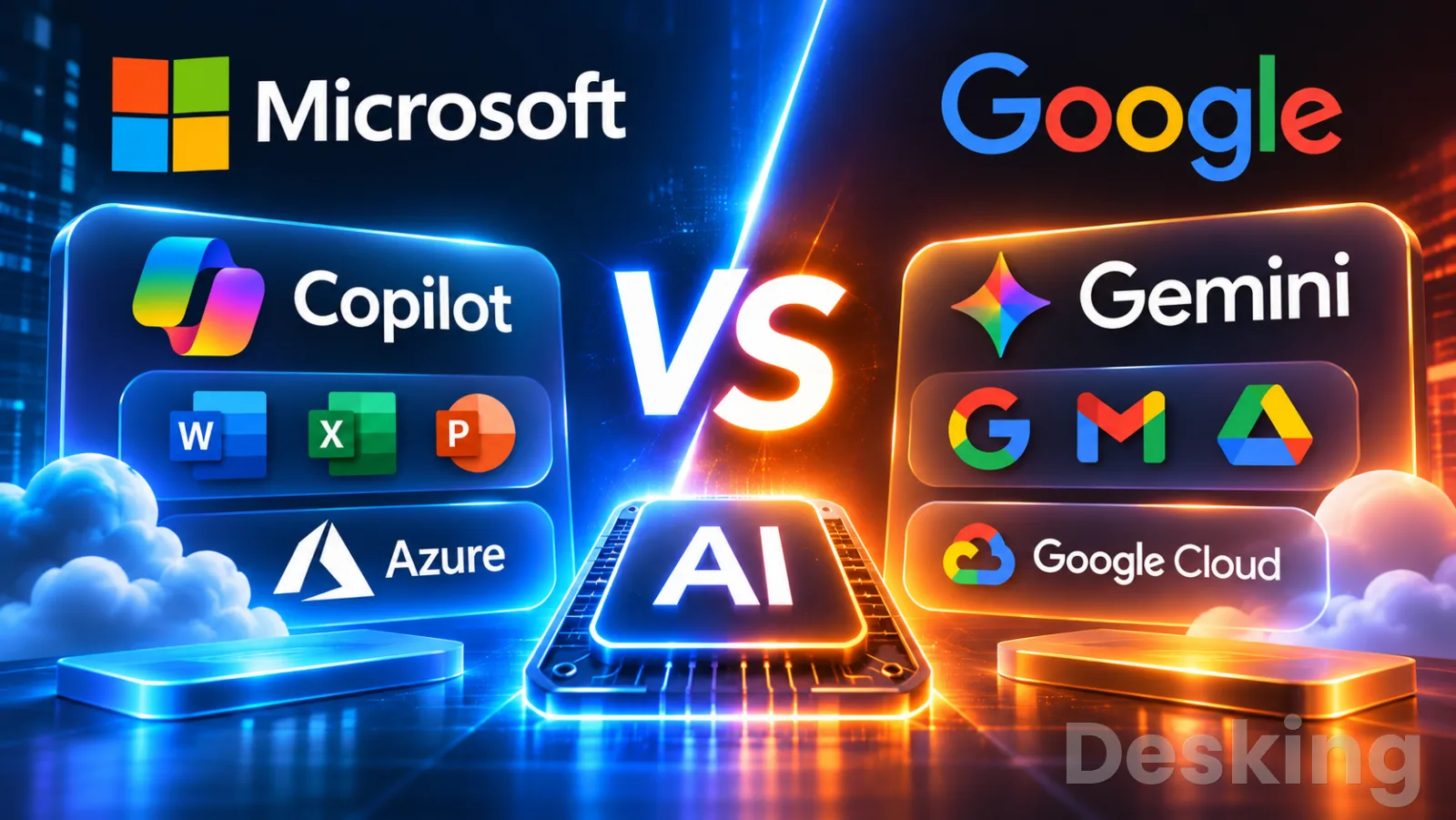
Table of contents
- 1. The ecosystem competition has changed
- 2. Microsoft owns enterprise distribution
- 3. Google controls more technology layers
- 4. Cloud growth tells different stories
- 5. Model choice changes the contest
- 6. Enterprise adoption exposes the gaps
- 7. The stronger ecosystem depends on buyers
- Frequently Asked Questions
Microsoft and Google are pursuing different routes to control the commercial AI market, and the latest financial results show why both strategies deserve attention.
In the third quarter of 2026, Microsoft Azure generated $33.2 billion in revenue, while Google Cloud reached $30.7 billion.
Google Cloud grew 103% year over year, compared with Azure's 48%, according to their reported results and Synergy Research Group's market analysis.
Microsoft still has the larger cloud business by these figures, but Google's growth rate points to a serious shift in competitive momentum.
The distinction becomes clearer when the comparison moves beyond cloud revenue.
Microsoft has a powerful route into corporate workflows through Microsoft 365, Windows, GitHub, Teams and its enterprise software portfolio.
Google controls a more vertically integrated AI operation, combining Gemini models, custom Tensor Processing Units, data center infrastructure, Search, Android, YouTube and Workspace.
Both companies can distribute AI at enormous scale, but they have different advantages in the places where customers develop, deploy and use it.
The stronger ecosystem depends on what a customer needs.
Microsoft currently has the more established enterprise distribution network and a particularly strong position in workplace software.
Google has the stronger argument for technical integration across its own AI stack, with first party models, custom accelerators and consumer services under one corporate roof.
The next stage of competition will test whether Microsoft's distribution can compensate for Google's infrastructure and model integration, and whether Google can turn its technical advantages into deeper enterprise relationships.
1. The ecosystem competition has changed

An AI ecosystem is the combination of models, computing infrastructure, developer platforms, applications, distribution channels and commercial relationships that allow a company to build and deliver AI products.
Its strength depends on how effectively those parts work together, how much customers can accomplish within them, and how difficult it is to replace one component.
A company with a leading model can still lose commercial ground if it lacks distribution, while a company with extensive software distribution can remain dependent on external model suppliers.
This distinction matters because the industry is moving from individual AI assistants toward systems that operate inside business processes.
The Stanford Institute for Human-Centered AI's 2026 AI Index reported that 88% of surveyed organizations used AI in at least one business function in 2025.
However, agent deployment remained in the single digits across almost every business function.
Adoption of AI tools is widespread, but the transition to autonomous systems that perform sustained business tasks is still developing.
The companies are competing across several connected layers, and their positions are not identical.
The following comparison separates the areas where each has a structural advantage from those where the other has a credible challenge.
| Ecosystem layer | Microsoft | |
|---|---|---|
| Foundation models | OpenAI partnership, Microsoft AI models including Phi, and third party model access | Gemini and Gemma, developed within Google |
| AI infrastructure | Azure data centers, NVIDIA accelerators and Maia custom silicon | Google data centers, TPUs and NVIDIA accelerators |
| Enterprise platform | Microsoft Foundry, Azure and enterprise data services | Gemini Enterprise Agent Platform and Google Cloud |
| Workplace distribution | Microsoft 365, Teams, Outlook, Windows and Dynamics | Workspace, Gmail, Meet, Docs and Sheets |
| Developer distribution | GitHub, GitHub Copilot, Visual Studio and Azure | Google AI Studio, Gemini APIs, Cloud and developer tools |
| Consumer distribution | Windows, Bing, Edge and Copilot | Search, Android, Chrome, YouTube and Gemini |
| Core strategic advantage | Existing enterprise relationships and workflow integration | Vertical integration across models, chips, infrastructure and consumer services |
The table reveals an important difference in the way each company reaches customers.
Microsoft's strongest commercial advantage is the ability to introduce AI into software that organizations already license, administer and use every day.
Google's advantage is the ability to develop AI technology and distribute it through services that already reach billions of people.
Neither advantage automatically guarantees better products or higher returns, but each creates a different starting position.
There is also a distinction between owning a component and controlling the customer relationship.
Microsoft can distribute models developed by OpenAI or Anthropic through its platforms without owning those companies' entire research operations.
Google develops Gemini internally, but also makes competing models available through its cloud platform.
The ecosystem is therefore not a collection of completely closed systems.
Partnerships and external model access have become part of the competitive strategy.
2. Microsoft owns enterprise distribution

Microsoft's enterprise position is built on decades of software adoption, licensing relationships and organizational infrastructure.
Microsoft 365, Teams, Outlook, SharePoint, Windows, Dynamics and GitHub already occupy important positions inside corporate technology environments.
That footprint gives the company a practical way to introduce AI without asking customers to replace their existing software or establish an entirely new working environment.
The company's fiscal 2026 annual report provides a useful indication of the scale behind this strategy.
Microsoft reported $331.8 billion in annual revenue, with Microsoft Cloud revenue of $214.4 billion.
Azure grew 41% year over year and exceeded $100 billion in annual revenue for the first time.
Microsoft also reported more than 30 million paid Microsoft 365 Copilot seats and 50 million GitHub Copilot users.
These are company reported figures, and they measure different forms of adoption rather than comparable active usage.

Hostinger VPS
Hostinger VPS delivers KVM virtualization, NVMe storage and full root access at prices that undercut most competing cloud providers.
- Strong price to specification ratio overall
- NVMe storage included on every tier
- Renewal rates climb steeply after promo
- Self managed means security is your job
Microsoft 365 creates daily access
The commercial value of Microsoft 365 is the frequency with which employees already use its applications.
Copilot can appear in Word, Excel, PowerPoint, Outlook and Teams, where users have access to documents, meetings, email and organizational information.
Microsoft Graph provides a mechanism for connecting those experiences to business content, subject to organizational permissions and configuration.
That connection gives Microsoft an opportunity to sell AI as an extension of existing work rather than as a separate destination.
A customer account examined by the UK's Competition and Markets Authority provides a grounded example of this distribution model.
In its October 2026 proposed decision on Microsoft's business software, the CMA described customer evidence in which an organization used Microsoft 365 Copilot to summarize emails and prepare drafts.
This is a modest but meaningful example: the AI feature was applied to existing communication work, rather than introduced as a standalone experiment.
The evidence does not establish productivity gains across the wider customer base, but it shows how Microsoft can place AI inside established workflows.
The company's agent strategy extends that approach.
Microsoft has been developing agents that can perform tasks using organizational information and interact with applications such as Teams and Outlook.
Its Copilot Cowork offering is intended to carry out work across Microsoft 365, including creating documents, managing files, searching information and scheduling meetings.
These capabilities depend on permissions, available integrations and the quality of the underlying organizational data.
They also make the Microsoft ecosystem more relevant to businesses that want AI to act on work rather than simply generate text.
GitHub strengthens developer loyalty
GitHub gives Microsoft another distribution channel that reaches a technically influential audience.
Developers use the platform to store source code, review changes, manage collaboration and run software development workflows.
GitHub Copilot places AI assistance inside that environment, while Visual Studio and Azure provide additional routes from code creation to application deployment.
The company can therefore participate in several stages of a software project's lifecycle.
The scale is significant, although the reported figures require careful interpretation.
Microsoft's fiscal 2026 reporting put GitHub Copilot at 50 million users, while GitHub itself had 225 million users.
Those numbers do not mean that every GitHub user pays for Copilot, or that all users rely on it equally.
They do demonstrate the reach available to Microsoft when it introduces AI features into an established developer platform.
Microsoft's approach also benefits from its ability to support different models.
Developers and businesses can access models through Microsoft Foundry, formerly Azure AI Foundry, rather than committing every application to a single model provider.
The platform's model catalogue and development services allow Microsoft to compete for infrastructure and application spending even when a customer prefers an external model.
That flexibility is commercially important because model quality, pricing and availability can change quickly.
The partnership question remains
Microsoft's relationship with OpenAI helped establish its early position in generative AI, but the relationship has become more complicated as both companies pursue overlapping commercial interests.
Reuters Breakingviews reported in October 2026 that their revised agreement had loosened restrictions on OpenAI's ability to work with other partners.
Microsoft is also developing its own models, while revenue sharing with OpenAI is subject to a total cap under the revised arrangement.
This matters because Microsoft's ecosystem cannot be assessed solely by counting the models available through Azure or Copilot.
Its access to external research partners is a strength, but dependence on another company's frontier model development creates strategic uncertainty.
Microsoft needs its own model capabilities and a broad supplier network if it wants to preserve control over product quality, costs and availability.
Its enterprise distribution is a powerful asset, but it does not remove the need to compete in model research.
3. Google controls more technology layers

Google's AI strategy starts from a different position.
The company has spent years developing machine learning systems, designing specialized processors and operating large scale data infrastructure for Search, YouTube and other services.
Gemini is therefore connected to an existing technical and commercial environment that already depends heavily on AI.
Google can use its own research, infrastructure and products to improve the same ecosystem, rather than relying primarily on an external model partner.
Constellation Research's May 2026 analysis of AI vertical integration identified Google's combination of custom silicon, models, platforms, data services and consumer applications as its strongest strategic advantage.
The report also identified a limitation: Google Cloud has less enterprise application presence than Microsoft in areas such as back office software and corporate productivity.
This is the central tension in Google's strategy.
Its technical integration is unusually broad, but the company still has to convert that capability into durable relationships with business customers.
Gemini connects Google's products
Google's model family gives the company a first party foundation for AI across its services.
Gemini supports consumer assistant experiences and provides models for developers and enterprise customers.
Google also develops Gemma, an open model family that gives developers another route to build applications using Google's technology.
The company can decide how its models are deployed across its own products, while also offering external access through APIs and cloud services.
The third quarter of 2026 results published by Alphabet reported that the Gemini app had reached one billion users.
Alphabet also said its first party model APIs were processing nearly 32 billion tokens per minute, more than four times the volume recorded a year earlier.
These figures come from the company's own reporting and should be read as measures of reach and processing activity, not independent assessments of model quality or customer satisfaction.
Google's distribution is especially strong in consumer technology.
Search, Android, Chrome, YouTube and Gmail provide access to users across different devices and activities.
Gemini can appear as a direct assistant, while AI features can also become part of search, communication, content discovery and mobile experiences.
This gives Google multiple opportunities to make AI a routine part of existing services, even when users do not deliberately open a separate chatbot.
The scale of this distribution also creates a business risk that Microsoft does not face in the same way.
Google's advertising business depends heavily on Search, and AI generated answers can change how users interact with search results.
If an AI response satisfies a query without a traditional results page interaction, Google must manage the commercial implications for advertising and publisher traffic.
Its AI products can improve the usefulness of Search, but they can also alter the economics of one of its most valuable businesses.
TPUs give Google infrastructure control
Google's Tensor Processing Units are a major part of its technical position.
These custom accelerators are designed for machine learning workloads and are integrated into Google's data center infrastructure.
By developing its own processors, Google can optimize hardware and software together, manage capacity for internal products and offer TPU computing to cloud customers.
This creates an alternative to depending entirely on commercially available GPUs.
The advantage is not simply that Google owns a chip design.
Custom silicon can influence how models are trained, how inference is served and how efficiently data centers use available computing resources.
Google can coordinate processor architecture, networking, software frameworks and model development across its infrastructure.
That level of integration can matter when a company operates AI services at the scale of Search, YouTube and Gemini.
Microsoft is developing its own Maia AI accelerator and Cobalt CPU, but its custom silicon position is less mature than Google's TPU program.
Constellation Research identified this as an area where Microsoft still has ground to make up.
Microsoft can continue to use NVIDIA accelerators and other suppliers while it develops its own hardware, but Google's longer history with TPUs gives it more experience operating a proprietary AI computing platform.
That advantage should not be overstated.
Google still uses external accelerators, and custom processors do not automatically outperform GPUs across every model or workload.
Hostinger VPS
Hostinger VPS delivers KVM virtualization, NVMe storage and full root access at prices that undercut most competing cloud providers.
- Strong price to specification ratio overall
- NVMe storage included on every tier
- Renewal rates climb steeply after promo
- Self managed means security is your job
Their value depends on software support, availability, performance, energy consumption and the ability of developers to use them without excessive engineering work.
For businesses choosing a cloud platform, the practical question is whether the available hardware performs well for their applications at an acceptable cost.
Google Cloud is gaining momentum
Google Cloud's recent growth is the clearest financial evidence that Google's AI infrastructure strategy is attracting customers.
Alphabet reported third quarter 2026 Google Cloud revenue of $30.7 billion, an increase of 103% year over year.
The company attributed growth to enterprise AI infrastructure, AI solutions, core cloud services and TPU system sales.
The result indicates strong demand, although the reported growth cannot be attributed entirely to Gemini or AI services.
Synergy Research Group estimated that Google Cloud held 16% of the global cloud infrastructure market in the third quarter of 2026.
Microsoft held 19%, while Amazon Web Services retained the largest share at 26%.
Google's share had increased by three percentage points compared with the same quarter a year earlier.
The data suggests Google is gaining ground, but it has not yet overtaken Microsoft in cloud infrastructure market share.
The growth rate is important because it shows that Google's infrastructure is becoming more commercially relevant beyond its own consumer products.
Companies can use Google Cloud for data processing, AI model deployment and enterprise workloads without moving their entire technology estate to Google.
That gives Google a route into organizations that may already use Microsoft software or another cloud provider.
The challenge is to turn individual AI projects into long term infrastructure and software relationships.
4. Cloud growth tells different stories
Cloud revenue is one of the most visible measures in this comparison, but the figures need to be interpreted correctly.
Microsoft reports Azure revenue separately, while Alphabet reports Google Cloud as a broader business segment that includes infrastructure, platform services and other cloud products.
The numbers therefore provide a useful commercial comparison, but they do not represent identical accounting categories or a pure measurement of AI revenue.
Synergy Research Group's third quarter 2026 figures offer a more consistent view of the overall cloud infrastructure market.
The research group estimated global spending at $167.7 billion for the quarter, up 55% year over year.
Its market share figures place Microsoft ahead of Google, although Google is growing faster.
The data also shows why a comparison based only on growth rates would be misleading: Microsoft is growing from a larger revenue base.
| Third quarter 2026 measure | Microsoft Azure | Google Cloud |
|---|---|---|
| Reported quarterly revenue | $33.2 billion | $30.7 billion |
| Year over year revenue growth | 48% | 103% |
| Global infrastructure market share | 19% | 16% |
| Annualized quarterly revenue | $133 billion | $123 billion |
| Strategic emphasis | Enterprise cloud and AI services | AI infrastructure and data services |
The figures show a clear pattern.
Microsoft remains larger by quarterly revenue and estimated infrastructure market share, while Google is expanding more quickly.
Annualized quarterly revenue is a simple multiplication of the reported quarter and should not be treated as a forecast or as the companies' official full year revenue.
It is useful as a scale comparison, not as a guarantee that the same growth rate or revenue level will continue.
There is another important point in the market data.
Synergy estimated that AI specific cloud services accounted for around one third of the total cloud infrastructure market in the third quarter.
The growth of AI is changing the economics of cloud providers, but the market is not limited to the largest two companies.
Amazon remains the market leader, and specialist providers such as CoreWeave, Crusoe and Nebius are expanding their role in AI infrastructure.
Microsoft and Google compete in a wider ecosystem where customers can distribute workloads across several providers.
5. Model choice changes the contest
The quality of a company's own models is important, but enterprise customers increasingly need access to multiple models.
A business may prefer one model for coding, another for document analysis and a third for multimodal processing.
Model performance also changes with new releases, while pricing and service availability can influence deployment decisions.
An ecosystem that gives customers a choice can remain commercially attractive even when its own first party model is not the best option for every task.
Microsoft Foundry and Google's Gemini Enterprise Agent Platform provide routes to build and deploy AI applications, manage models and create agents.
Google evolved Vertex AI into the Gemini Enterprise Agent Platform in April 2026, while Microsoft renamed Azure AI Foundry as Microsoft Foundry.
These naming changes matter for procurement and engineering teams because older documentation, tutorials and internal architecture plans may still use previous product names.
Microsoft's model flexibility matters
Microsoft's model strategy combines its own research, its partnership history with OpenAI and access to external providers.
The company can sell infrastructure and development services to customers who want to use different models, rather than requiring every application to run on a single Microsoft model.
This can reduce the risk of a customer leaving the platform because a competing model performs better for a particular task.
The approach also reflects a broader change in the relationship between cloud providers and model developers.
RBB Economics' November 2026 report on generative AI competition found that leading cloud marketplaces generally distribute models from competing developers.
Its research describes Claude availability through the major cloud platforms, including Microsoft's Azure AI Foundry, Google's Vertex AI and Amazon Bedrock.
The report was commissioned by the Computer & Communications Industry Association, so its conclusions should be considered in that context rather than treated as a regulator's independent finding.
Google's first party models integrate
Google has a different advantage because Gemini is developed within the same company that builds its chips, data centers and consumer applications.
This can help Google coordinate model development with the infrastructure that serves those models.
The company can also use its own products to deploy new AI features at scale, collect operational feedback and refine the underlying services.
This is a strong technical position, particularly for workloads that benefit from close integration between models and infrastructure.
However, first party integration does not mean Google is committed to a closed model environment.
Its cloud platform also offers access to third party models, including Anthropic's Claude and Meta's Llama.
The same RBB Economics report describes a broad distribution system in which models can reach customers through direct APIs, cloud marketplaces, data platforms, aggregators and self hosting.
Google's commercial opportunity depends partly on making its infrastructure useful even when customers select a model developed elsewhere.
6. Enterprise adoption exposes the gaps
The difference between having an AI product and having an AI ecosystem becomes visible when customers attempt to deploy agents across departments.
An enterprise deployment requires identity management, data permissions, monitoring, security, compliance, application integrations and operational support.
The model itself is only one component.
A technically impressive assistant can still be difficult to deploy if it cannot access the right information or perform actions within the organization's existing systems.
Microsoft has a practical advantage in this area because many businesses already use Entra ID, Microsoft 365, SharePoint, Teams and Azure.
Its products can connect AI experiences to established identity and administration systems.
Google has strong enterprise capabilities through Google Cloud, Workspace, data services and its agent platform, but customers with deep Microsoft investments may face additional integration work before they can move substantial workflows to Google's environment.
For a business assessing either platform, the most useful evaluation criteria are operational rather than promotional.
A structured assessment should include the following:
- Identity and permissions: Confirm that agents respect existing access controls and cannot retrieve information that a user is not authorized to see.
- Data integration: Test whether the platform can work with the company's actual databases, documents, communication systems and business applications.
- Model flexibility: Check whether applications can change models without extensive redevelopment or loss of important functionality.
- Monitoring and governance: Establish how administrators inspect agent activity, trace errors, manage usage and demonstrate compliance.
- Deployment costs: Compare model usage, infrastructure, software licenses, storage, networking and the engineering time needed to operate the system.
- Portability: Determine how much application logic, data and agent configuration can move to another provider if commercial or technical requirements change.
These checks are important because ecosystem advantages can become switching costs.
A company that builds agents around Microsoft 365 data, identity and workflows may find it expensive to move those systems elsewhere.
The same applies to organizations that build applications around Google's data services, Gemini models and TPU infrastructure.
The cost of changing platforms is not limited to cloud migration.
It can include rebuilding integrations, retraining employees, changing security policies and validating the behavior of deployed agents.
RBB Economics also identified deeper agent integrations, persistent user memory and proprietary tool ecosystems as factors that could increase switching costs.
Hostinger VPS
Hostinger VPS delivers KVM virtualization, NVMe storage and full root access at prices that undercut most competing cloud providers.
- Strong price to specification ratio overall
- NVMe storage included on every tier
- Renewal rates climb steeply after promo
- Self managed means security is your job
Its analysis suggests that current competition remains active across several model and application channels, but the market could become less flexible as customers build more complex agent systems.
This is a significant consideration for organizations planning multi year AI investments.
A platform should be judged on its current capabilities and on the practical difficulty of leaving it.
7. The stronger ecosystem depends on buyers

Microsoft is the stronger choice for organizations that already depend on Microsoft 365, Windows, GitHub, Teams and Azure.
Its distribution advantage reduces the effort required to introduce AI into familiar applications, while its model flexibility gives businesses room to use external providers.
The company also has a large enterprise sales and support operation, which matters for regulated industries and organizations with complex procurement requirements.
Google is the stronger candidate for businesses that prioritize AI infrastructure, data intensive workloads, Gemini integration and access to custom TPU computing.
Its full stack approach gives it an important advantage for customers that want to coordinate models, hardware and cloud services.
Google is also a natural option for companies already invested in BigQuery, Google Cloud and Workspace, particularly where AI workloads connect closely to data analytics and consumer facing services.
The practical decision changes according to the type of work involved.
The following recommendations reflect ecosystem fit rather than a claim that one provider delivers the best result in every technical benchmark.
- Microsoft 365 centered organizations: Start with Microsoft because its identity, collaboration and document systems can reduce integration work for workplace AI.
- Google Cloud data teams: Evaluate Google's platform first when BigQuery, TPU access and Gemini are central to the architecture.
- Software development organizations: Compare GitHub Copilot and Google's developer services using the team's actual repositories, security rules and coding tasks.
- Multi model application builders: Test both platforms for model availability, API portability, agent orchestration and monitoring before committing to a long term design.
- Consumer AI product teams: Assess Google's distribution through Android, Search and Gemini alongside Microsoft's Windows, Edge and Copilot reach, according to the intended audience.
A serious procurement decision should include a proof of concept using representative company data and workflows.
Run the same tasks on both platforms, measure completion quality, latency, failure rates and total cost, and involve security and operations teams before selecting a provider.
The evaluation should also include the cost of integrating existing systems and maintaining the deployment after launch.
A platform that performs well in a demonstration may require significant additional engineering before it is suitable for production.
The competitive position is not permanent.
Google Cloud's 103% quarterly growth shows that the gap is narrowing, while Microsoft's Azure business remains larger and its enterprise distribution is difficult to reproduce.
Google has a more integrated technical stack, but Microsoft has a deeper route into many business workflows.
The company that combines model quality, reliable infrastructure, usable agents and sustainable customer economics will have the stronger long term ecosystem.
Frequently Asked Questions
Is Microsoft or Google better for enterprise AI?
Can Google Gemini work with Microsoft 365?
Does Microsoft own OpenAI?
Why are Google's TPUs important to AI?
Can a company use both Microsoft and Google AI?
Sources6
- Microsoft on its 2026 annual results
- SEC on Alphabet third quarter results
- CRN on cloud market share in Q3 2026
- Constellation Research on AI vertical integration
- RBB Economics on generative AI competition
- UK CMA on Microsoft's business software
External pages are independent third-party sources. Desking App does not control or endorse their content and accepts no responsibility for it. Visiting them is at your own responsibility and risk.