Microsoft Offers Voluntary Buyouts to 60,000 Employees as AI Spending Grows
By Eva Elekcha · October 26, 2026
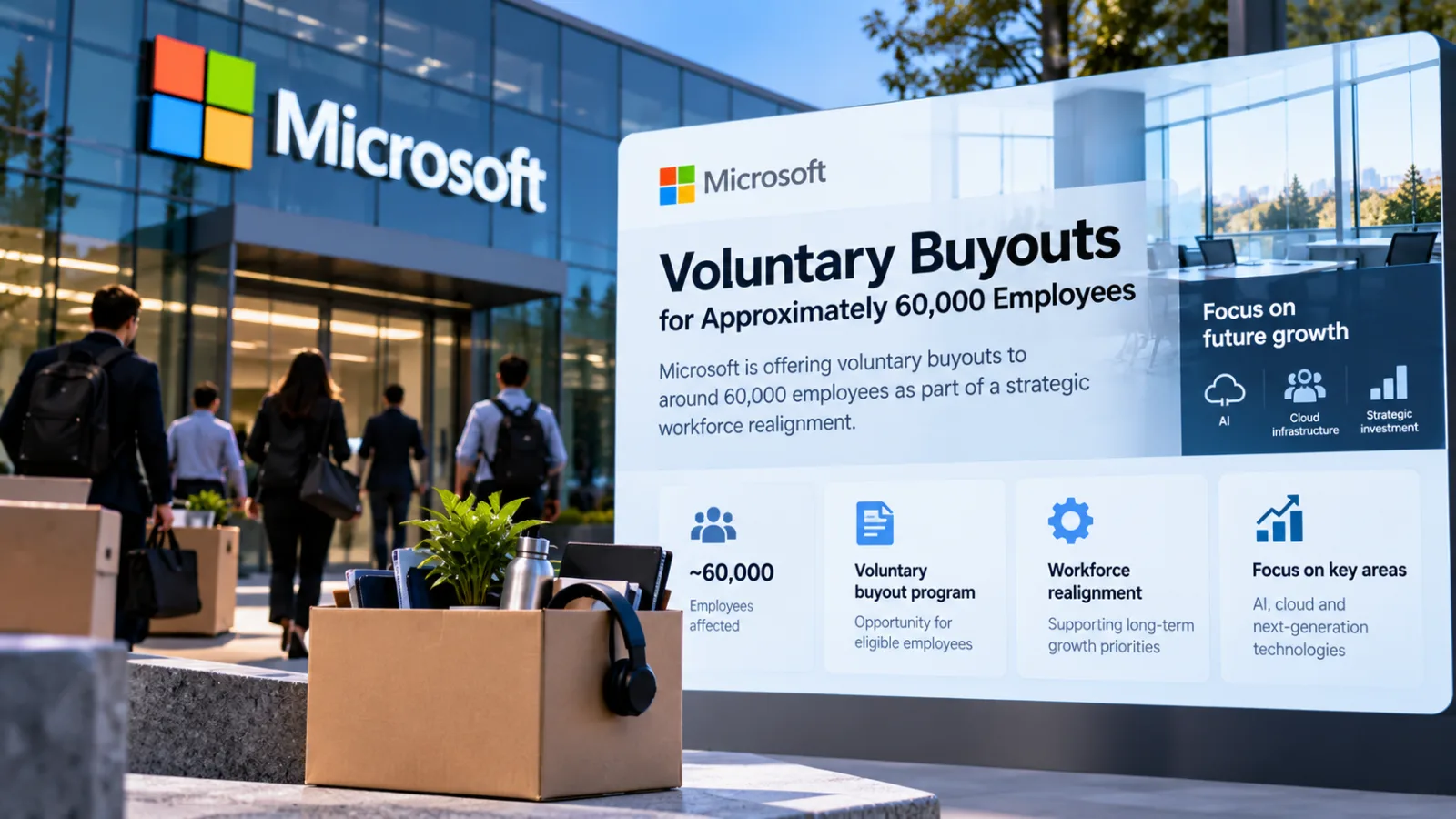
Table of contents
- Which Microsoft employees are eligible for the buyouts?
- What employees receive under the voluntary exit program
- Why Microsoft is offering buyouts as AI investment expands
- How the new offer compares with Microsoft's earlier workforce changes
- When must employees decide?
- What the announcement means for the technology workforce
- Frequently Asked Questions
Microsoft is offering voluntary buyouts to approximately 60,000 employees as the technology company reshapes its workforce while committing substantial resources to artificial intelligence.
Announced on October 26, 2026, the Voluntary Exit Offer is available to eligible employees in participating organizations in the United States, Canada, the United Kingdom and India.
The initiative covers employees at Microsoft's internal level 70 and below, including some senior personnel, but eligibility varies by organization.
Microsoft says the time-limited program gives eligible workers the option to leave the company with financial support and career-planning resources.
The announcement does not mean that 60,000 employees will lose their jobs.
That figure represents the approximate number of workers eligible for the offer, not a forecast of how many will accept it.
Microsoft has not publicly disclosed a target for departures under the program.
The move comes as the company increases investment in AI infrastructure, including the data centers and computing resources required to develop and operate AI services.
It also follows earlier workforce reductions and a voluntary retirement program introduced earlier in 2026.
Which Microsoft employees are eligible for the buyouts?
According to Microsoft's official announcement, the Voluntary Exit Offer is available to eligible employees in participating teams in four countries: the United States, Canada, the United Kingdom and India.
The offer applies to employees at internal level 70 and below.
Microsoft's internal levels help determine seniority and compensation, meaning the program can extend beyond junior and mid-level employees to include some senior managers and executives.
Eligibility is not universal across the company.
Microsoft says participation depends on the priorities, customer commitments and workforce needs of individual business organizations.
Reuters reported that participating areas include AI experiences, Copilot, finance, human resources, Xbox, and Windows + Devices.
The report said marketing, commercial business and security were excluded.
The exact eligibility of an individual employee depends on their team and the terms communicated by Microsoft.
The company said eligible employees would receive an email with a link to their individual offer details.
Those communications are important because compensation and departure arrangements may vary according to the employee's circumstances and applicable company policies.
What employees receive under the voluntary exit program
Microsoft describes the offer as a supported departure rather than a conventional involuntary layoff.
Eligible employees can choose whether to accept, with financial assistance and career-planning resources included in the program.
Business Insider reported that the packages generally follow Microsoft's standard severance policies, with benefits varying according to seniority, location and length of service.
Its reporting described different severance calculations for employees at different internal levels.
The terms reported by Business Insider should not be treated as a universal payment schedule for every eligible employee.
Employees need to consult their individual offers to understand the applicable severance amount, benefits, stock treatment, deadlines and departure conditions.
The voluntary structure gives employees a choice that is different from being directly selected for a layoff.
It also gives Microsoft a way to adjust staffing levels without requiring every departure to be imposed by management.
However, a voluntary offer does not guarantee that every employee who wants to leave will receive identical terms, nor does it establish how many workers will ultimately depart.
Why Microsoft is offering buyouts as AI investment expands
Microsoft's decision comes during a period of unusually high spending on AI infrastructure.
The company is investing in data centers, specialized computing hardware and cloud capacity to support services such as Microsoft Copilot and its Azure AI offerings.
Reuters reported that Microsoft forecast approximately $175 billion in capital expenditures for calendar year 2026, reflecting the scale of its infrastructure commitments.
These investments are part of a wider industry trend in which major technology companies are spending heavily to build the computing capacity needed for increasingly sophisticated AI systems.
At the same time, Microsoft is adjusting its workforce and organizational structure.
Voluntary exits can help a company reduce staffing costs, change the distribution of employees across departments and redirect resources toward areas it considers strategically important.
However, Microsoft has not said that artificial intelligence alone is responsible for the new offer.
Its official announcement describes the program as a way for participating organizations to adapt their workforces to changing needs.
The relationship between AI investment, cost management and staffing decisions should therefore be understood in that broader context.
The announcement also highlights an important distinction in the debate about AI and employment.
A company can reduce or restructure its workforce while expanding its AI capabilities, but that does not establish that AI systems are directly replacing every affected employee's work.
How the new offer compares with Microsoft's earlier workforce changes
The Voluntary Exit Offer follows a separate voluntary retirement initiative introduced earlier in 2026.
That earlier program was aimed at a narrower group of eligible US employees, with eligibility linked to factors including age and years of service.
According to reporting by the Associated Press, approximately 8,750 employees were eligible for the earlier retirement program, and more than 30% accepted.
The new offer covers a much broader potential group and does not use the same age-and-tenure eligibility model.
Microsoft also announced workforce reductions during the summer.
Reuters reported that the company cut approximately 4,800 positions in July, with changes affecting several parts of the business, including Xbox.
These measures serve different purposes.
A voluntary retirement program targets employees who meet specific retirement-related criteria.
A voluntary exit offer gives eligible employees a supported option to leave under a different set of conditions.
Involuntary layoffs involve the company deciding which positions or employees will be eliminated.
The latest announcement does not establish how many additional job cuts Microsoft may make in the future.
It also does not mean that the company has abandoned other workforce-management measures.
When must employees decide?
The offer is time-limited.
Business Insider and GeekWire reported that eligible employees have until early December 2026 to decide whether to participate, with departures expected toward the end of the year.
Microsoft's public announcement did not provide a single universal deadline or a complete schedule for every participating organization.
Eligible employees should therefore rely on the terms and dates in their individual communications rather than assuming that every team follows an identical timetable.
Microsoft also has not announced how many employees it expects to accept the new offer.
The eventual number will depend on individual decisions, eligibility rules and the terms offered to participating workers.
That uncertainty matters when evaluating the potential financial impact.
The maximum number of eligible employees does not translate directly into a predictable reduction in payroll costs.
The outcome will depend on participation, severance expenses, the compensation of departing employees and whether the company subsequently hires for different roles.
What the announcement means for the technology workforce
Microsoft's offer reflects a broader shift in how large technology companies are managing costs and staffing while investing in AI.
Companies are competing for infrastructure, specialized expertise and customers, while also reviewing which teams and capabilities they need for the next phase of their businesses.
For employees, the immediate issue is practical: eligibility, severance terms, benefits, stock compensation and the consequences of accepting the offer.
Workers should assess the full package rather than judging it solely by the headline number of eligible employees.
For investors, the more significant question is whether workforce changes help Microsoft manage operating costs while sustaining growth in its cloud and AI businesses.
The buyout program could reduce headcount, but its actual financial effect cannot be established until participation and costs are known.
For the wider labor market, the announcement is another example of how AI investment and organizational restructuring are happening at the same time.
It is evidence of workforce adjustment at a major technology company, but it does not by itself prove that AI automation directly caused the departure of any particular employee.
The next indicators to watch are the number of employees who accept the offer, the costs associated with the program, Microsoft's subsequent workforce disclosures and how the company balances staffing with its expanding AI infrastructure commitments.