


RemoFirst Review 2026: Features, Pricing, Pros, Cons and Alternatives
 Published byNoura Mint ElySenior Technology ReporterNoura Mint ElySenior Technology Reporter Verified authorNoura Mint Ely is a Senior Technology Reporter at Desking, covering the latest developments in technology, artificial intelligence, enterprise software, cybersecurity, a…Author Profile

Ad disclaimer For links on this page, DESKING APP may earn a commission from the provider. This supports our work and has no influence on our editorial rating.
RemoFirst is a global employment platform whose strongest argument is its $199 starting EOR fee, substantially below established competitors. It suits startups and growing companies hiring internationally without local subsidiaries, particularly those watching employment costs. Its partner based operating model and inconsistent reports about payroll support deserve careful scrutiny before committing.
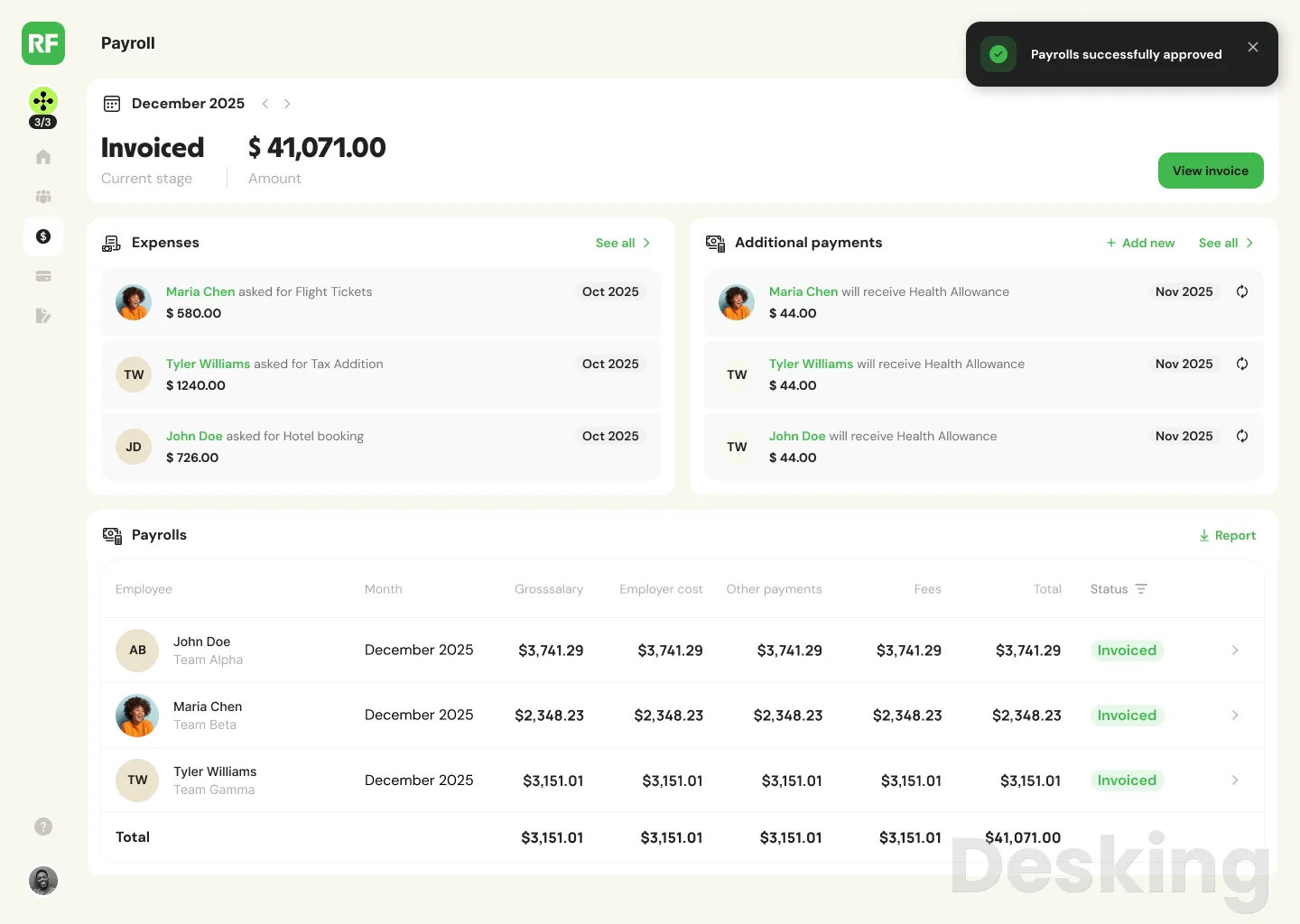
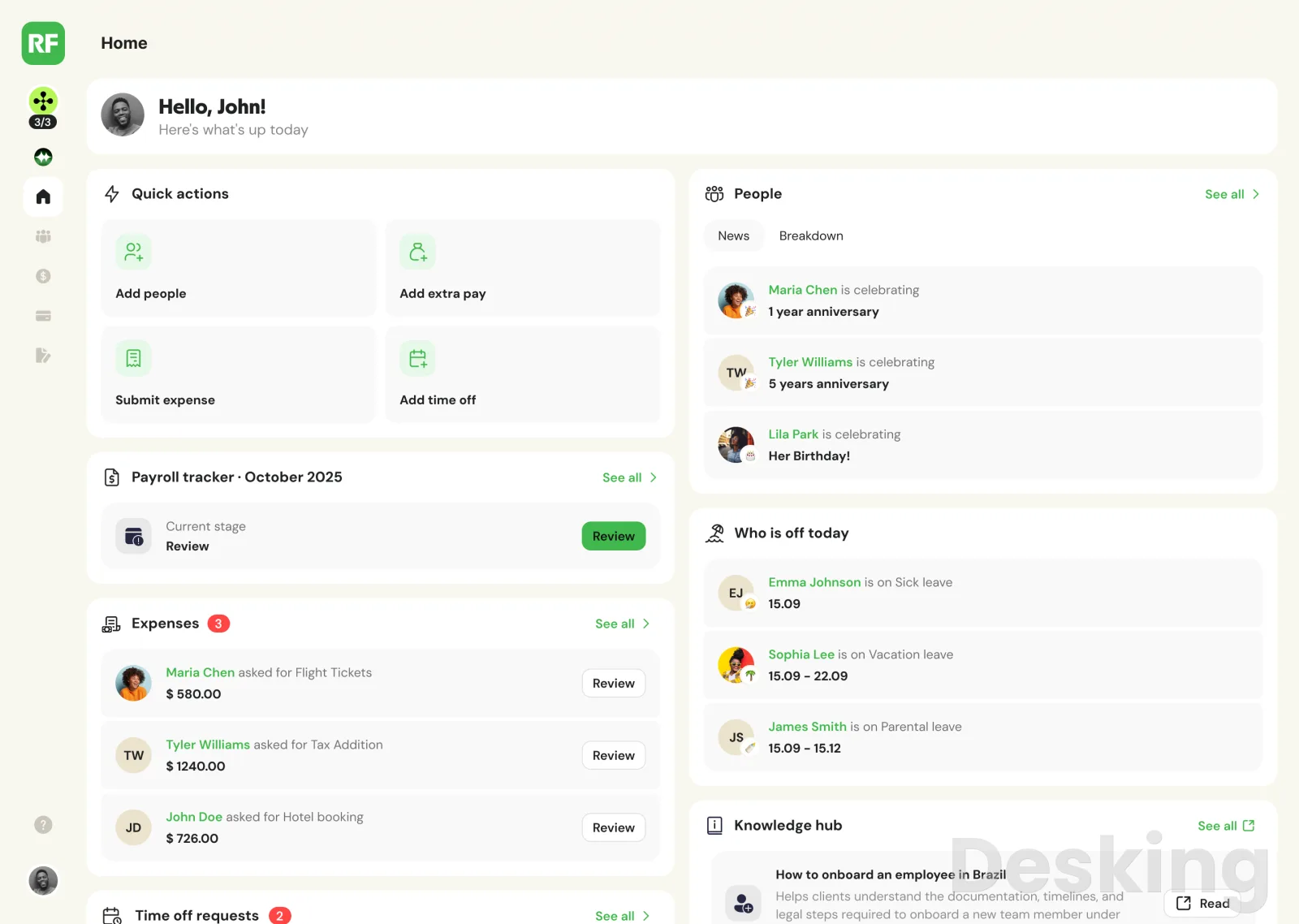
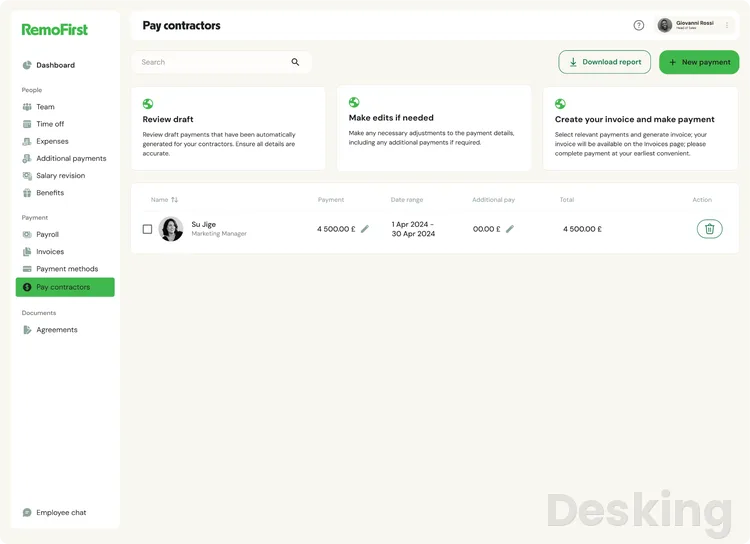
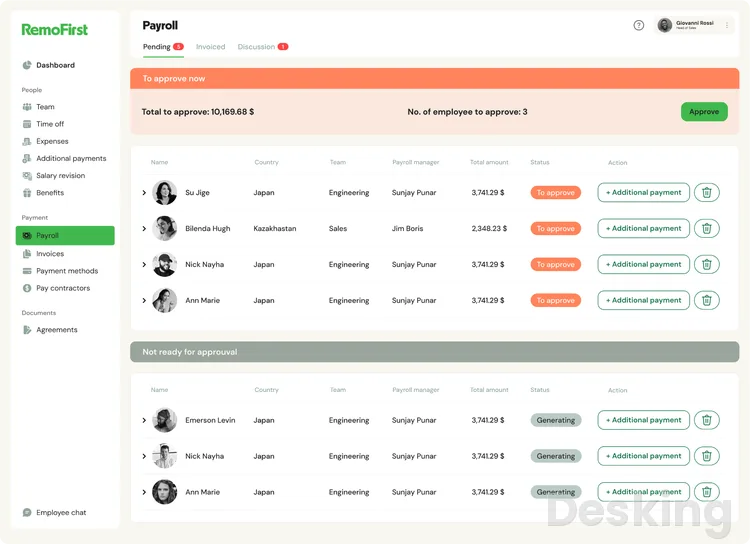
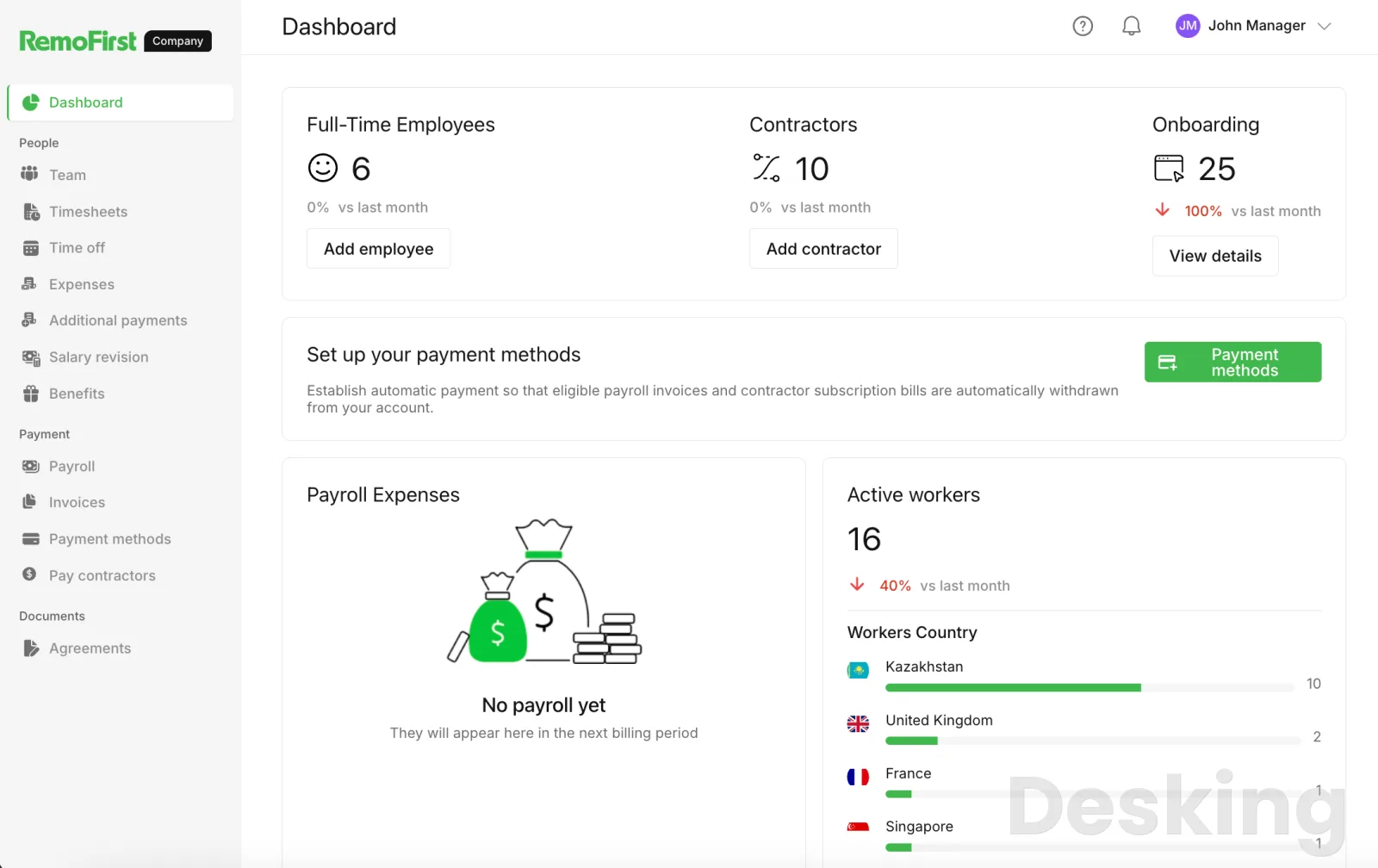
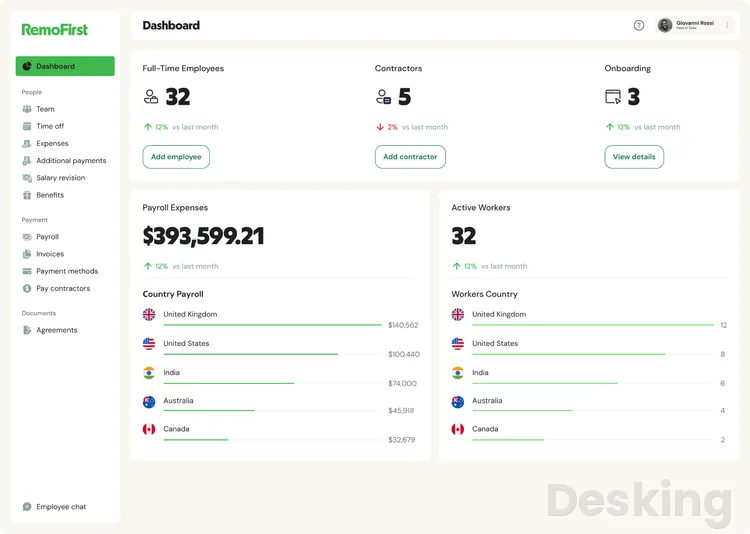
Table of contents
- 1. What is RemoFirst
- 2. How RemoFirst works
- 3. RemoFirst features
- 4. Pricing plans
- 5. RemoFirst alternatives
- 6. Integrations and administration
- 7. Security and compliance
- 8. Customer support and user experience
- 9. Pros and cons
- 10. Who should use RemoFirst
- 11. Implementation and onboarding
- 12. Final buying assessment
- Frequently Asked Questions
RemoFirst is a global Employer of Record (EOR) and contractor management platform that enables businesses to hire, employ, pay and administer international workers without establishing legal entities in every country.
Founded in 2021 by Nurasyl Serik and Volodymyr Fedoriv, the company operates as a remote first business with its principal US office in San Francisco.
Its investors include QED Investors, Octopus Ventures, Mouro Capital and Counterpart Ventures.
A $25 million Series A investment in March 2024, led by Octopus Ventures, followed a $14.1 million seed round in September 2022.
TechCrunch reported that the company had thousands of customers, including Zocdoc, Mastercard and the World Health Organization.
RemoFirst now advertises employment coverage across more than 185 countries, positioning its low starting fee against larger competitors such as Deel, Remote and Oyster.
The commercial proposition is straightforward: companies pay RemoFirst to handle the employment infrastructure that would otherwise require local subsidiaries, employment specialists and separate payroll arrangements.
The service covers employment contracts, payroll, statutory contributions, benefits administration and employment compliance, while its contractor offering addresses agreements, identity verification, expenses and international payments.
The distinction between these two services matters because an EOR becomes the legal employer, whereas contractor management does not automatically establish an employment relationship or remove worker classification responsibilities.
RemoFirst is therefore selling two related but legally different services under one platform.
The most important consideration is not whether $199 is cheaper than $599.
It is how much responsibility a customer is prepared to place in the hands of an employment provider that relies on local partners.
That operating model helps explain the price advantage, but it also makes the quality of partner management, contractual clarity and escalation procedures central to the buying decision.
1. What is RemoFirst
RemoFirst belongs to the global employment technology market, specifically the Employer of Record and international contractor management segments.
An EOR employs a worker through an appropriate local employment arrangement while the customer directs the person's day to day work.
This allows a business to recruit in a foreign country without incorporating a local subsidiary solely to employ that individual.
RemoFirst handles the formal employment responsibilities within the scope of its agreements and applicable local arrangements.
The platform is particularly relevant to companies whose hiring requirements cross national borders but do not justify the expense of establishing separate corporate entities.
A technology startup hiring its first engineer in Germany, for example, may prefer an EOR arrangement over incorporating a German subsidiary and arranging its own local payroll.
The same reasoning applies to a US business recruiting a marketing specialist in Portugal or a finance professional in Singapore.
Each country introduces different employment obligations, and the EOR relationship transfers much of the administrative work to a specialist provider.
RemoFirst advertises coverage in more than 185 countries for EOR employment.
Its contractor payment service covers more than 150 countries, while its visa and work permit services have a separately advertised geographic scope.
These numbers should not be treated as interchangeable.
A country where contractor payments are supported is not necessarily a country where a particular EOR employment arrangement or immigration service is available.
The company also has an important distinction in its operating structure.
It works with local partners rather than depending exclusively on a network of wholly owned legal entities.
This approach can reduce infrastructure costs and give the provider access to local employment expertise.
However, customers should establish which legal entity will employ their workers in each destination and who will be responsible when a dispute, termination or payroll error involves a local partner.
TechCrunch's March 2024 coverage identified affordability and the use of local legal partners as important elements of the company's strategy.
It also reported that RemoFirst primarily targeted small and medium sized businesses while accepting customers of different sizes.
That positioning remains relevant to its buying proposition: the service is designed to make international employment financially accessible without requiring a company to purchase a large enterprise HR infrastructure.
2. How RemoFirst works
The EOR process begins when a customer identifies the country and employment arrangement required for a new hire.
RemoFirst then coordinates the relevant employment arrangements, local documentation and onboarding requirements.
The employee enters the employment relationship through the appropriate local structure, while the customer retains responsibility for directing the person's actual work and managing their performance.
The distinction between legal employment and operational management deserves attention.
RemoFirst takes responsibility for the formal employment administration within the contracted arrangement, but it does not become the department responsible for the customer's product decisions, working priorities or business strategy.
The customer still needs to define the position, compensation expectations, reporting structure and performance requirements.
Once employment begins, the administrative relationship continues through payroll, statutory contributions, leave management and benefits.
Country specific employment requirements influence what can be included in the employment arrangement.
A benefit that is optional in one jurisdiction may be mandatory in another, and termination procedures can differ substantially between countries.
For contractor engagements, the workflow is different.
RemoFirst's documentation describes a process involving company account setup, contractor registration, agreement creation or uploading, contractor onboarding, work item management, invoice approval and payment.
Employers can add individual contractors or import multiple records, depending on their requirements.
The contractor then completes the required personal information, identity verification and tax documentation before setting up a withdrawal method.
Depending on the engagement, the contractor may submit timesheets, milestones, expenses and additional payment requests.
The customer remains responsible for providing accurate engagement information and reviewing eligible payment items.
This separation of responsibilities is important because the platform does not make every engagement legally compliant simply by processing a payment.
Companies still need to assess whether their relationship with an individual genuinely qualifies as independent contracting under the relevant country's employment rules.
3. RemoFirst features
RemoFirst's feature set is built around international employment administration rather than traditional workforce productivity management.
Its strongest capabilities concern the formal relationship between a company, its international employees and its contractors.
Payroll, employment documentation, local compliance and worker administration form the centre of the product.
Employer of Record
The EOR service is the main commercial offering.
RemoFirst advertises localized employment contracts, payroll administration, tax filings, pensions, benefits and guidance concerning onboarding and termination.
It also provides access to local employment expertise, which is particularly relevant when a customer enters a country where its internal HR department has limited knowledge.
The starting fee is attractive, but the customer should distinguish the provider's service charge from the actual cost of employment.
Salaries, employer contributions, statutory payments and benefits are separate financial obligations.
A $199 EOR fee does not mean that employing someone internationally costs $199 per month.
The provider's role is also especially important when employment ends.
Termination is not simply the removal of an employee from an online dashboard.
Notice requirements, severance, unused leave, consultation obligations and other local rules may apply.
Customers should obtain written confirmation of the applicable procedure and any anticipated costs before approving an employment decision.
Global payroll administration
International payroll requires more than transferring money to a foreign bank account.
Employers must account for local currencies, tax obligations, statutory deductions and country specific payment requirements.
RemoFirst places these responsibilities within its employment service.
Its pricing information describes international payroll, tax filings, pensions and international payments as part of the EOR proposition.
This reduces the need for a customer to coordinate multiple local payroll suppliers independently.
The practical value becomes clearer as the number of hiring countries increases.
A company with employees in five jurisdictions may otherwise need to manage five different payroll arrangements, each with its own administrative requirements and payment calendar.
However, payroll reliability is a particularly important area to examine during procurement.
An error involving a routine software subscription can usually wait for a support ticket.
An error involving someone's salary cannot.
Customers should establish payroll cutoffs, funding deadlines, correction procedures and escalation contacts before moving existing employees to the platform.
Contractor management
The contractor offering is one of RemoFirst's strongest entry points.
Its free tier includes contractor onboarding, identity checks, contract generation and management, document storage and expense reimbursement.
Businesses can therefore organize basic contractor documentation without immediately paying for the premium payment service.
The distinction is financial as well as functional.
The free tier is designed for management and documentation, while Premium Contractors introduces automated payment processing across more than 150 countries and invoice creation.
The published starting price is $25 per contractor per month.
For a business working with freelancers who already invoice through established payment arrangements, the free tier may be sufficient.
Companies that want centralized invoice creation and payment processing have a stronger reason to purchase the premium service.
Time off and leave management
RemoFirst includes time off management for employees, with a workflow that allows employees to submit leave requests and employers to approve or reject them.
The platform recognizes several leave categories, including vacation, sick leave, parental leave, caregiver leave and bereavement.
Its documentation explains that the system calculates leave without including weekends and national holidays in the employee's country of residence.
Half day requests can also be submitted by specifying whether leave begins or ends during the first or second half of a day.
For administrators, the workflow includes a dedicated Time off section where pending requests can be reviewed.
Employers can approve or reject a request and provide a reason when rejecting it.
Some requests may require supporting documentation.
This is a useful administrative capability, but it should not be confused with a full enterprise workforce scheduling system.
Businesses with complex shift planning, advanced attendance management or sophisticated workforce analytics should assess whether they need a separate HR platform.
Workday integration
RemoFirst's Workday integration is particularly relevant to businesses that already operate a mature HR information system.
Its documented integration supports the transfer of employee and contractor lifecycle information from Workday into RemoFirst.
The connection uses OAuth 2.0 authentication and requires a Workday Integration System User.
Administrators must configure API credentials and authorize the connection before mapping existing workers.
The integration supports lifecycle information such as hires, terminations, profile changes and time off requests.
However, its documented direction is one way, inbound from Workday into RemoFirst.
That limitation matters because buyers should not assume that information entered in RemoFirst will automatically update Workday.
There are also specific synchronization rules.
Approved time off can be imported, while pending and denied requests are excluded.
The integration supports scheduled synchronization and manual synchronization, but edits to previously approved time off in Workday do not automatically synchronize.
For a company that depends on Workday as its main HR record system, these details should be tested against its internal data governance requirements before implementation.
BambooHR and ADP integrations
The integrations catalogue also identifies BambooHR and ADP Workforce Now, alongside GoCardless for payroll and contractor payment funding.
These connections are relevant because RemoFirst is not necessarily intended to replace every HR, finance or recruiting application already used by a customer.
BambooHR is particularly relevant to smaller and medium sized businesses managing employee information through an established HRIS.
ADP Workforce Now is more commonly associated with companies that already have a broader payroll and workforce administration environment.
The available integration catalogue is relatively focused compared with the larger ecosystems offered by enterprise HR platforms.
Buyers should evaluate the actual data exchanged rather than simply counting integration logos.
A connection that transfers employee records is not equivalent to a fully synchronized payroll and financial reporting integration.
Visas and immigration
International recruitment sometimes requires more than an employment contract.
A foreign national may need a visa or work permit before legally taking up employment in a destination country.
RemoFirst advertises immigration assistance across more than 110 countries.
Its service includes assistance with visa sponsorship and work permit applications, with customized pricing based on location, visa category and employment status.
This is valuable for companies recruiting internationally mobile professionals.
However, immigration eligibility is determined by the relevant authorities, and a service provider cannot guarantee that an application will be approved.
Companies should obtain a country specific assessment before making an employment offer that depends on immigration approval.
Health benefits and equipment
RemoFirst also extends its offering beyond payroll and employment documentation.
RemoHealth provides access to medical, dental and vision coverage, with a published starting price of $55 per person per month.
Availability and actual coverage depend on the employee's location and the applicable insurance arrangement.
Equipment provisioning addresses another operational problem associated with international recruitment.
The service allows businesses to arrange equipment such as laptops and monitors for overseas employees.
The company also advertises background checks, bonuses, equity related administration and other additional services.
These capabilities broaden the scope of the relationship, although customers should confirm which services are included in their employment fee and which require separate payment.
4. Pricing plans
Pricing is where RemoFirst makes its strongest competitive argument.
Its advertised $199 EOR starting fee is substantially below the published starting prices of Deel and Oyster.
Contractor management also has an unusually accessible entry point because basic administration is free.
The following table separates the three principal commercial arrangements.
These are not three successive editions of the same subscription.
They represent different services with different responsibilities and billing structures.
| Service | Price | Main purpose | Payment processing |
|---|---|---|---|
| Contractor management | $0 | Agreements and administration | Not included |
| Premium Contractors | $25 per contractor/month | Contractor payment processing | Included |
| Employer of Record | From $199 per employee/month | International employment | Included in EOR service |
The distinction is essential when calculating costs.
A company using RemoFirst only to store contractor agreements should not budget for the premium payment service automatically.
Conversely, a company employing someone through the EOR service cannot substitute the free contractor tier for the legal employment arrangement.
Contractor management
The free contractor tier includes several practical functions:
- Contractor onboarding and account administration.
- Identity verification.
- Contract generation and management.
- Uploading and storing signed agreements.
- Expense reimbursement.
There is no published monthly subscription charge for these basic contractor management capabilities.
This makes the free offering relevant to businesses that want to organize international freelance relationships without immediately changing their payment infrastructure.
However, the free service does not represent a complete international payment solution.
Companies that need automated contractor payments should examine the premium tier.
Premium Contractors
Premium Contractors starts at $25 per contractor per month.
It adds automated payment processing across more than 150 countries and invoice creation.
The absence of a minimum contractor requirement is commercially useful.
A company does not need to commit to a large contractor population simply to access the paid service.
For a business with ten contractors, the advertised service fee would amount to $250 per month before any separately applicable charges.
The decision should depend on whether centralized payment processing reduces enough administrative work to justify the recurring cost.
Employer of Record
The EOR service starts at $199 per employee per month.
The advertised price includes the core employment administration service, but the actual employment budget must also account for salary, statutory employer contributions, benefits and country specific requirements.
The pricing page states that fees may vary according to local country requirements.
It also advertises no minimum employee count, no minimum contract term and no setup, onboarding or termination fees.
The following table shows how the three arrangements compare in terms of the paid and premium resources available.
| Resource | Free contractors | Premium Contractors | EOR |
|---|---|---|---|
| Contractor agreements | Yes | Yes | Not applicable |
| Identity checks | Yes | Yes | Background checks available |
| Expense reimbursement | Yes | Yes | Employee expense arrangements |
| Automated contractor payments | No | Yes | Employee payroll |
| Invoice creation | No | Yes | Not applicable |
| Local employment contracts | No | No | Yes |
| Payroll and tax administration | No | No | Yes |
| Employee benefits | No | No | Yes |
| Immigration assistance | No | No | Additional service |
| Equipment provisioning | No | No | Additional service |
| Health insurance | No | No | Optional service |
The table illustrates why choosing the cheapest arrangement without understanding the employment relationship can become an expensive mistake.
The free contractor tier is not a low cost substitute for EOR employment.
Its purpose is to administer genuine contractor relationships, while the EOR service handles formal employment through a local arrangement.
Real costs at different team sizes
The following calculations use published starting fees and assume that all workers are eligible for the advertised starting price.
They exclude salaries, employer taxes, benefits and country specific adjustments.
| Workforce | Monthly service fee | Annual service fee |
|---|---|---|
| 1 EOR employee | $199 | $2,388 |
| 5 EOR employees | $995 | $11,940 |
| 10 EOR employees | $1,990 | $23,880 |
| 20 EOR employees | $3,980 | $47,760 |
| 10 premium contractors | $250 | $3,000 |
| 20 premium contractors | $500 | $6,000 |
These figures reveal an important aspect of RemoFirst's pricing model.
Its affordability becomes particularly relevant for companies hiring several employees across different countries, where competing EOR service fees can create a substantial recurring expense.
However, the starting price is not a guaranteed universal quotation.
Each destination must be assessed individually.
5. RemoFirst alternatives
RemoFirst competes with companies that have larger commercial operations, established global employment infrastructures and broader HR technology ecosystems.
Its lower published price creates an obvious advantage, but it does not automatically make it the best option for every international hiring operation.
The three alternatives most relevant to a direct comparison are Deel, Remote and Oyster.
| Platform | Starting EOR price | Free contractor tier | EOR employment | Contractor management |
|---|---|---|---|---|
| RemoFirst | $199/month | Yes | Yes | Yes |
| Deel | $599/month | No equivalent free tier | Yes | Yes |
| Remote | $599/month | No equivalent free tier | Yes | Yes |
| Oyster | $699/month | No equivalent free tier | Yes | Yes |
Prices represent published starting service fees and should not be interpreted as complete employment costs.
Country availability, contractual terms and additional services can change the final quotation.
Deel
Deel is the most important competitor for buyers who want an extensive global employment and contractor management platform.
Its EOR starting price is $599 per employee per month, while its contractor offering is separately priced.
The difference in EOR starting fees is significant.
For ten employees, the published starting service fees would amount to $1,990 per month with RemoFirst and $5,990 with Deel.
That represents a $4,000 monthly difference before salaries and statutory costs.
Deel's appeal lies in its broader employment technology proposition and its ability to support businesses with multiple workforce arrangements.
It is a stronger candidate for companies that value a larger integrated HR platform and are prepared to pay a higher service fee.
RemoFirst is the more financially attractive starting point when the primary requirement is international employment rather than a broad workforce management ecosystem.
Remote
Remote competes directly through its global employment infrastructure, payroll services and contractor management capabilities.
Its EOR service has a published starting price of $599 per employee per month.
The main decision concerns the employment infrastructure and contractual arrangements offered in each country.
Companies should examine legal employer details, intellectual property protections, local benefits and the responsibilities assumed by the provider.
Remote deserves particular attention from organizations that place a high priority on the structure of international employment and the contractual protections associated with it.
Its higher price, however, makes it a more expensive option for a business whose principal requirement is simply to employ a small number of international professionals.
RemoFirst has a clear price advantage.
Remote should win only when its specific employment arrangements, coverage or service requirements justify the additional expenditure.
Oyster
Oyster is another established alternative in global employment management.
Its published EOR starting price is $699 per employee per month, placing it above both RemoFirst and Deel in this comparison.
Oyster is relevant to organizations that place considerable emphasis on international HR administration and employee experience.
Its value should be assessed through the complete employment arrangement rather than its headline price alone.
For ten employees, the published starting service fees would amount to $6,990 per month.
That is $5,000 more than RemoFirst's advertised starting fees for the same headcount.
Oyster may make sense when its particular country coverage, benefits arrangements or HR support meet requirements that RemoFirst cannot satisfy.
Otherwise, the price difference requires a convincing commercial justification.
6. Integrations and administration

RemoFirst's integration strategy deserves a closer examination because international employment platforms increasingly operate alongside established HR and financial systems.
The integration catalogue identifies Workday, BambooHR, ADP Workforce Now and GoCardless.
These connections address different operational requirements rather than providing identical functionality.
Workday is the most technically significant of the documented integrations.
Its connection supports worker lifecycle synchronization and requires an administrator to configure authentication, establish mappings and enable the relevant synchronization settings.
This is not a connection that should be treated as a simple installation.
Administrators need to configure the appropriate Workday security permissions, register an API client and establish the relevant integration credentials.
The time off synchronization rules also deserve attention.
Only approved absences are imported, and the platform does not automatically synchronize edits to previously approved Workday leave entries.
Administrators should understand these conditions before making RemoFirst part of an automated HR workflow.
For companies using BambooHR or ADP, the integration catalogue indicates that connections are available.
Nevertheless, the exact scope of supported fields, synchronization direction and update behavior should be confirmed for the intended account.
RemoFirst should therefore be viewed as an international employment layer that can connect to an existing HR environment, not as a replacement for every application in that environment.
7. Security and compliance
Security is a significant procurement requirement because an international employment provider handles personal information, identity documents, compensation data and other sensitive employee records.
RemoFirst's privacy policy identifies the company as RemoFirst Inc., a Delaware corporation with principal offices in San Francisco.
It describes security measures that include access controls, role based permissions, multifactor authentication, encryption in transit and at rest, logging, monitoring and incident management.
The policy also states that the company has obtained SOC 2 Type I and Type II attestations and ISO/IEC 27001 certification, subject to their applicable scope and validity periods.
These credentials are useful indicators of a formal security management program, but they should not replace procurement due diligence.
A buyer should request the relevant reports, examine the certification scope and confirm whether the specific services and data processing arrangements are covered.
The local partner model introduces another important consideration.
Employment data may be processed by parties involved in providing the service in individual countries.
Customers should understand the respective responsibilities of RemoFirst, its local partners and any other relevant data processors.
Before signing, the procurement team should request:
- The applicable data processing agreement.
- Information about international data transfers.
- The relevant SOC 2 reports and ISO certification scope.
- Details of role based permissions and administrator controls.
- Data retention and deletion procedures.
- Incident notification commitments.
- Information about local employment partners and subprocessors.
The important distinction is between a platform having security certifications and a customer understanding how its particular employment arrangement processes information.
Both matter.
8. Customer support and user experience
Support is one of the more important elements of RemoFirst's commercial proposition.
The company advertises 24/7 customer support and dedicated account management.
This matters because international payroll and employment questions do not always follow the customer's local business hours.
User feedback, however, presents a more complicated picture.
Positive reviews frequently describe helpful account representatives, straightforward onboarding and a relatively easy employee portal.
Negative feedback raises concerns about payment delays, communication and the handling of difficult employment situations.
Capterra's October 2026 review feed includes a particularly serious complaint from a customer who described an initially straightforward experience that deteriorated during an employee termination.
The reviewer reported unexpected legal charges, disputed settlement arrangements and difficulties obtaining supporting documentation.
"The platform was easy to use, and onboarding was straightforward."
Verified reviewer on Capterra, COO, October 2026
That positive assessment is useful, but it does not establish that complex employment situations will be handled equally well.
A smooth onboarding process and reliable termination administration are two different tests of an EOR provider.
Trustpilot also contains positive feedback about the onboarding experience and account assistance.
"Onboarding was straightforward and well supported from the first call"
Verified customer on Trustpilot, September 2026
There are also negative experiences that deserve attention.
"They don't pay out on time - shocking!"
Verified customer on Trustpilot, November 2026
The surrounding complaint describes delayed payment, communication problems and difficulty obtaining a response.
This is particularly relevant because payment administration is one of the primary responsibilities customers purchase from an EOR provider.
A separate Capterra review raises concerns about operational accountability when problems occur.
"The underlying operational execution does not live up to expectations."
Verified reviewer on Capterra, HR manager, January 2026
These accounts should not be treated as proof that every RemoFirst customer will encounter payroll or support problems.
They do, however, identify risks that a procurement team should investigate rather than dismiss.
There is also an important limitation in the available customer evidence: Capterra has only a small review sample, and Trustpilot has displayed a warning concerning its review guidelines and the removal of reviews.
Ratings across platforms are therefore not directly comparable measures of operational reliability.
My assessment is that support quality needs to be evaluated at the level of the actual service arrangement.
Ask who owns a payroll escalation, how an unresolved local employment dispute is handled and whether the assigned account representative can coordinate with the relevant local partner.
9. Pros and cons
RemoFirst has a compelling commercial advantage for businesses that need international employment without paying enterprise level service fees.
Its contractor free tier, broad advertised country coverage and additional employment services make it relevant to companies at different stages of international expansion.
Its limitations are concentrated around operational dependencies, integration depth and the need to establish the precise responsibilities of local partners.
The following assessment separates its strongest buying arguments from the issues that deserve attention before a contract is signed.
Advantages
- Low advertised EOR starting price
- Free contractor administration tier
- Wide advertised EOR country coverage
- International payroll administration included
- Localized employment contract creation
- Dedicated account management available
- Advertised twenty four hour support
- Visa assistance across multiple countries
- Optional international employee health insurance
- Contractor payment automation available
- Workday lifecycle synchronization supported
- No advertised minimum employee count
Disadvantages
- Final country pricing may vary
- Salaries remain additional employment costs
- Limited published integration catalogue
- Workday synchronization has directional restrictions
- Local partner dependency requires scrutiny
- Complex termination costs need clarification
- Payment complaints deserve procurement attention
- Customer review samples remain relatively small
- Premium contractor payments require subscription
- Immigration services incur additional charges
- Advanced workforce scheduling is not central
- Support experiences appear inconsistent
10. Who should use RemoFirst
RemoFirst is most attractive to companies that need to hire international employees without establishing subsidiaries in every destination.
Startups, growing technology businesses and small HR departments are natural candidates because they often lack the resources to manage several local employment infrastructures independently.
A company hiring one international employee may find the $199 starting fee considerably more manageable than paying $599 or $699 for an alternative EOR service.
The financial argument becomes stronger when a business has several international employees, provided the country specific quotations remain close to the advertised starting price.
Businesses employing independent contractors should examine the free tier separately.
If their main requirement is document storage, identity checks and agreement management, paying $25 per contractor every month may be unnecessary.
If automated international payments are central to the operation, Premium Contractors becomes more relevant.
Larger organizations should take a more demanding approach.
They may already have Workday, ADP or another HR platform, established procurement procedures and strict internal controls.
RemoFirst can fit into that environment, but its integration direction, data synchronization behavior and local employment arrangements need to be validated.
The following buyer profiles provide a practical starting point.
- Startups: Companies entering their first international markets without the resources to establish subsidiaries.
- Small and medium sized businesses: Employers that want to control recurring EOR service fees while expanding internationally.
- Distributed technology companies: Businesses recruiting engineers, designers and other specialists across several jurisdictions.
- Contractor based businesses: Organizations that need centralized agreements and international payment administration.
- International HR departments: Teams that need an external employment partner to handle local administration.
RemoFirst is less suitable for organizations that require extensive HR analytics, complex workforce scheduling or a deeply integrated enterprise HR ecosystem as their primary requirement.
Those businesses should compare the platform against larger workforce management providers before making a decision.
11. Implementation and onboarding
The implementation process depends on whether the customer is hiring employees through EOR or managing contractors.
These workflows should not be combined into one generic onboarding procedure because the documentation and responsibilities differ.
For contractor management, RemoFirst documents a six stage process.
The employer establishes its company account, enters contractor details, creates or uploads an agreement, invites the contractor, manages work and payments, and completes the offboarding process when the engagement ends.
The process is relatively straightforward, but the quality of the initial information matters.
Incorrect compensation details, incomplete agreements or missing identity information can delay activation and subsequent payments.
For a Workday connection, implementation is more technical.
The administrator needs the appropriate Workday API credentials, a configured Integration System User and access to the relevant settings within RemoFirst.
A typical Workday setup follows these documented steps:
- Register an API client in the Workday tenant and configure the required authentication settings.
- Create or obtain the Client ID and Client Secret needed for the connection.
- Open Company settings and select Integrations in the RemoFirst dashboard.
- Locate Workday and select Start.
- Choose Connect Workday and enter the required authentication credentials.
- Authorize the connection and map existing RemoFirst workers to their corresponding Workday profiles.
- Configure the time off synchronization settings and map absence categories to the appropriate RemoFirst leave types.
- Verify the initial synchronization and confirm that the imported worker and leave records match the source system.
The most important implementation check is not whether the connection successfully authenticates.
It is whether the synchronized data behaves as expected in the customer's actual HR workflow.
The one way synchronization model and restrictions concerning edits to approved leave should be included in the implementation acceptance criteria.
Companies should also complete a separate payroll implementation checklist, confirming payment deadlines, funding requirements, employee documentation and country specific obligations before the first salary cycle.
12. Final buying assessment
RemoFirst has built a credible position around one of the most commercially sensitive aspects of international employment: the recurring cost of using an Employer of Record.
Its $199 starting price is difficult for competitors charging several hundred dollars more to ignore, particularly when the buyer is a smaller business hiring a limited number of international employees.
The contractor offering strengthens the proposition.
Free agreement administration gives businesses a low risk way to organize contractor documentation, while the $25 premium service adds payment automation when required.
This is a sensible separation of capabilities because not every company needs to outsource every part of contractor administration.
The challenge is operational confidence.
An EOR provider is responsible for matters that directly affect employees' financial security and legal employment status.
Customers cannot evaluate the relationship solely through a product demonstration or a published starting price.
They need evidence that payroll corrections, employee disputes and termination procedures are managed with the same care as routine onboarding.
The local partner structure is not inherently a disadvantage.
It can be an efficient way to deliver employment services across a large number of jurisdictions.
What matters is the quality of those partners, the contractual allocation of responsibilities and the speed with which RemoFirst resolves problems that cross organizational boundaries.
For companies considering RemoFirst, the best procurement approach is to request a country specific quotation and a written explanation of the employment arrangement before committing.
Include an actual termination scenario in the commercial discussion, clarify the escalation chain and establish the payment correction process.
That is where the decision should be made.
A low service fee has genuine value only when the employment infrastructure behind it performs reliably.
Key features
- Employer of Record employment administration
- Localized international employment contract creation
- Global employee payroll processing
- International tax filing administration
- Statutory pension contribution administration
- Employee benefits and insurance administration
- International contractor onboarding management
- Free contractor identity verification
- Contract generation and document storage
- Contractor expense reimbursement administration
- Premium international contractor payment processing
- Automated contractor invoice creation
- Employee time off request management
- Country specific holiday calculations
- Half day leave request handling
- Workday employee lifecycle synchronization
- BambooHR workforce data integration
- ADP Workforce Now integration
- GoCardless payroll funding integration
- International visa and work permits
- RemoHealth medical dental vision coverage
- RemoCheck employee background screening
- RemoTech international equipment provisioning
- Employee bonuses and equity administration
- Local employment compliance guidance
Pricing
- Contractor onboarding and account management
- Free identity verification and screening
- Contract creation and document storage
- Contract uploads and agreement management
- Expense reimbursement administration included
- Everything in free contractor management
- Automated international contractor payment processing
- Payments across 150 plus countries
- Multiple currency payment administration supported
- One click contractor invoice creation
- International employee legal employment arrangements
- Localized contracts and payroll administration
- International tax and pension management
- Employee benefits and compliance administration
- Twenty four hour employment support access
Pros & cons
Pros
- Low advertised international employment fees
- Free contractor administration without subscription
- Broad advertised EOR country coverage
- International payroll administration included
- Localized employment agreements and documentation
- Dedicated account management availability
- Twenty four hour support advertised
- International visa assistance services available
- Optional employee health insurance coverage
- Automated contractor payments available
- Workday lifecycle synchronization supported
- No minimum employee count requirement
- No minimum EOR contract term
- Additional equipment provisioning services available
Cons
- Final country pricing may vary
- Employee salaries remain separate costs
- Limited published integration catalogue
- Workday synchronization is one directional
- Local partner dependency requires scrutiny
- Termination expenses require written clarification
- Payroll complaints appear in reviews
- Customer support experiences appear inconsistent
- Premium contractor payments require subscription
- Immigration services carry additional charges
- Advanced workforce scheduling is not central
- Small Capterra review sample available
- Integration capabilities require technical validation
- Country specific benefits affect total costs
Who makes RemoFirst

Desking App is an independent publication. We are not the developer or publisher of RemoFirst and we never collect personal or payment details for it. Sign up and pay only on the official site.
RemoFirst is available on
2 platformsRemoFirst specs
- Platforms: Web based platform and online dashboard
- Free plan: Yes for contractor management
- Starting price: $199 per employee / month
- Integrations: Workday BambooHR ADP GoCardless
- Support: 24/7 support dedicated account management
- Best for: International hiring and contractor management
Our verdict
RemoFirst gets international hiring costs down without sacrificing its core EOR responsibilities, making it a strong choice for startups and growing businesses. Choose Employer of Record for employees and Premium Contractors for payment automation. Choose Deel when broader workforce infrastructure matters more. We rate it 8.3 out of 10. Request a country specific quotation before signing.
View PlansFrequently Asked Questions
What is RemoFirst used for?
How do I add a contractor to RemoFirst?
Can I upload an existing contractor agreement?
How does RemoFirst handle contractor payments?
How do I approve employee time off?
Does the Workday integration synchronize employee leave automatically?
Can I terminate an employee through RemoFirst?
Does RemoFirst charge extra for employee health insurance?
Sources5
- RemoFirst on EOR and contractor pricing
- RemoFirst on platform integrations
- RemoFirst on security and privacy
- Deel on global employment pricing
- QED Investors on RemoFirst founding
External pages are independent third-party sources. Desking App does not control or endorse their content and accepts no responsibility for it. Visiting them is at your own responsibility and risk.
Reader reviews
Be the first to review
